Africa is currently operating as one of the world's most aggressive rice-importing engines and for any Indian trade desk then this creates a massive structural opening. India stands as a dominant global supplier that is uniquely positioned to feed this rising demand. If you want to export rice to Africa then the scale of the opportunity is already staggering. According to APEDA (2024-25), India moved 33,250 thousand metric tonnes of non-basmati rice alone and the total trade value reached USD 28,686.80 million.

Africa Rice Market Size & Demand Outlook
The appetite for rice across the continent isn't just growing so that it is effectively exploding. The Africa rice market is projected to climb from USD 29.98 billion in 2025 up to USD 31.23 billion by 2026. Looking further out then experts expect the market to hit USD 38.30 billion by 2031 so that it maintains a CAGR of 4.17%. This surge is being fueled by rapid urbanization and rising consumption patterns so that trade liberalization under the AfCFTA plays a major role.

India's Rice Export Performance (2024-25 Data)
India’s grip on the global market is defined by two very different segments so that you have high-volume staples on one side and premium grains on the other.

| Rice Type | Quantity (000 MT) | Value (USD Million) |
|---|---|---|
| Non-Basmati Rice | 33,250.00 | 28,686.80 |
| Basmati Rice | 6,065.50 | 5,944.50 |
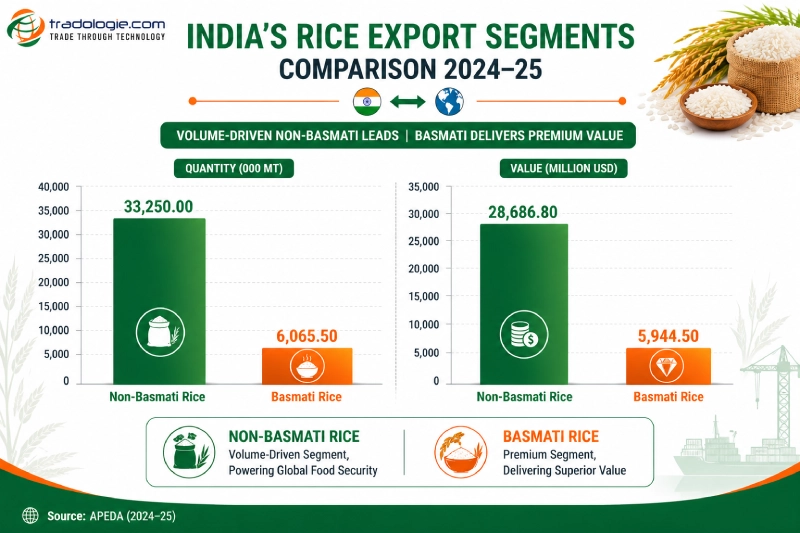
In the 2024-25 cycle then India exported 6,065.50 thousand metric tonnes of Basmati rice and the value stood at USD 5,944.50 million. While Basmati secures the premium shelf space then non-basmati remains the volume-driven workhorse of the Africa trade.
Which Rice to Export to Africa? (Buyer Preference Analysis)
If you are deciding which rice to export to Africa then the answer usually lies in the parboiled category. Non-basmati varieties are the dominant force here because the market is highly price-sensitive. Buyers specifically look for low-cost options and there is a massive preference for locally milled parboiled formats.
Top African Countries Importing Rice
West Africa has established itself as the primary hub for Indian rice and specific countries act as gateways for the rest of the continent.
| Country | Import Value (USD Million) | Share |
|---|---|---|
| Benin | 1025.38 | 15.71% |
| Guinea | 536 | 8.21% |
| Cote d'Ivoire | 520.3 | 7.97% |
| Togo | 421.5 | 6.46% |
| Bangladesh (re-export link) | 358.82 | 5.5% |

Major rice importers include Benin and it holds a 15.71% share valued at USD 1,025.38 million. This is followed closely by Guinea at 8.21% and Cote d'Ivoire at 7.97%. Benin in particular serves as a massive re-export hub and it moves grain into neighboring markets.
Bulk Rice Buyers in Africa (Buyer Segmentation)
To find bulk rice buyers in Africa then you have to understand the layers of the market. It isn't just one type of buyer:
- Government Tenders: These are for large-scale procurement to ensure national food security.
- Private Importers: These are high-volume traders who manage the local supply chains.
- Distributors: These act as the bridge and they break down bulk shipments for retail.
- Re-export Traders: These specialists move grain across borders and they are very active in West African hubs.
Price Comparison: India vs Africa Rice Market
Pricing is the ultimate differentiator in this trade and margins shift based on the variety and the logistical costs.
| Rice Type | India Export Price (USD/MT) | Africa Market Price (USD/MT) | Margin |
|---|---|---|---|
| Non-Basmati | 350-450 | 500-650 | Medium |
| Parboiled Rice | 400-500 | 600-750 | High |
| Basmati | 900-1100 | 1200-1500 | Medium |
Disclaimer: Prices are indicative based on 2024-2025 trade benchmarks. The price gap is largely created by freight costs and local demand surges and distribution overheads also play a part.
Profit Potential in Rice Export to Africa
The math behind a successful shipment depends heavily on the market and the specific rice type. Parboiled rice generally yields higher margins and it is the preferred choice for profit.
| Metric | Value |
|---|---|
| Container | 25 MT |
| Cost | $10,000 |
| Selling Price | $15,000 |
| Profit | $5,000 |
How to Start Rice Export to Africa
If you are ready to start rice export to Africa then follow this direct roadmap:
- Identify Buyers: Locate credible bulk rice importers in Africa.
- Choose Rice Type: Focus on high-demand parboiled or non-basmati varieties.
- Documentation: Ensure all phytosanitary and export certificates are in order.
- Logistics: Secure reliable shipping lines and you can reach major hubs like Cotonou.
Challenges in Exporting Rice to Africa
It isn't all easy money so you have to navigate real-world hurdles. Payment risk is a major concern which requires secure letters of credit and you don't end up with capital stuck in a foreign port. You also have to manage complex logistics where poor inland infrastructure can double your delivery time if you aren't careful. Furthermore, fierce market competition from other global suppliers like Thailand or Vietnam is always present so that you must stay sharp on your pricing.
Future Outlook (2026-2031)
The trajectory for this market is clearly upward and it remains a long-term goldmine for Indian exporters. Driven by relentless urbanization and structural trade reforms like the AfCFTA, the African rice market is expected to reach a value of USD 38.30 billion by 2031. As local production still struggles to meet the pace of population growth then the reliance on high-quality imports from India will only deepen. This creates a massive opportunity for traders so that those who build strong relationships now will likely dominate the next decade of African food trade.
Conclusion
Africa is a high-demand market that needs the supply India provides and it remains a top destination for traders. Ultimately then your ability to export rice to Africa profitably will depend on choosing the right product—specifically parboiled varieties—so that you target the right regional hubs like Benin or Guinea. Success here is not just about the grain but about mastering the logistics and local buyer preferences that define the trade. With the market set to grow by billions in the coming years then there has never been a more perfect time to establish your trade desk in the African rice corridor.
Disclaimer
The pricing, margins, and shipment examples mentioned are indicative and based on trade benchmarks from 2024–2025. Actual export profitability may vary depending on logistics, buyer negotiations, currency fluctuations, and market demand. Exporters should conduct due diligence before entering trade agreements.
Writer Profile
Pravarsh Sharma - Trade Expert at Tradologie.com
Pravarsh Sharma is directly involved in international trade assistance and B2B commodity exports. He helps exporters identify high-demand markets, connect with verified global buyers, and optimize trade strategies for higher profitability.