Key Highlights
- Marico portfolio (Saffola, Parachute) reaches 1 in 3 Indians with strong demand.
- Investment ranges between ₹3 lakh to ₹25 lakh+ based on territory size.
- Distributor margins typically fall between 4% to 8% across categories.
- Core categories include edible oils, foods, coconut oil, and personal care.
- Requires GST, FSSAI, warehouse, logistics, and working capital setup.
- Works on a structured FMCG distribution model with defined territories.
- Business is high-volume, repeat consumption with stable long-term demand.
Intro:
If you’re exploring a Marico distributorship India, the first thing you’ll notice is this—Marico doesn’t operate like a typical FMCG company where distributors are just “added.”
It works on strong category dominance + controlled distribution expansion.
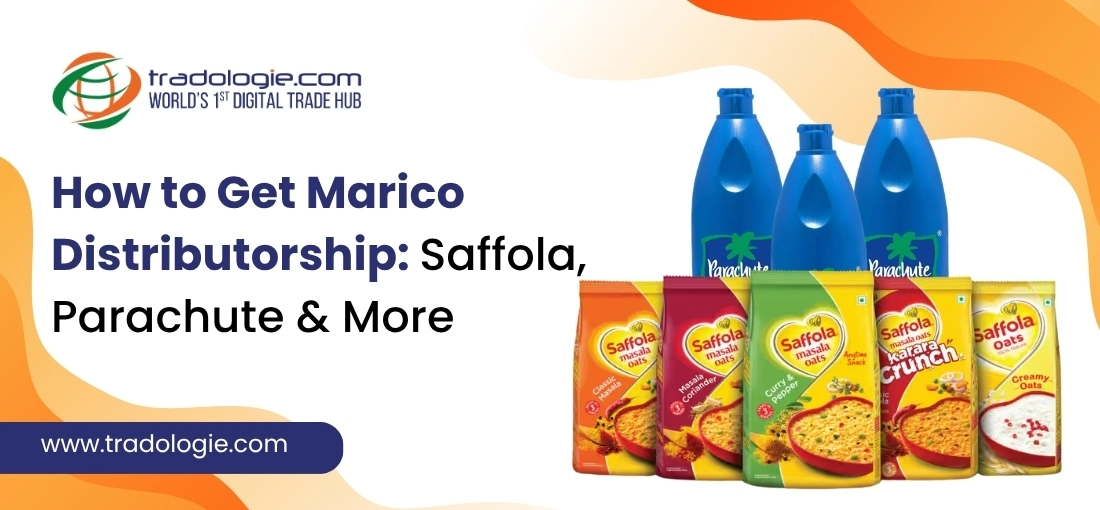
Products like Saffola and Parachute are not trying to create demand anymore—they already sit inside millions of Indian households. In fact, Marico’s portfolio reaches 1 out of every 3 Indians, which tells you how deeply embedded the brand is in daily consumption.
So if you’re planning to get Marico distributorship, you’re not entering an open market—you’re entering a pre structured, high movement system where execution matters more than entry.
Let’s break this down properly.

Understanding Marico’s Business (Why It Matters Before You Apply)
Before jumping into a dealership, you need to understand the company’s scale and positioning.
- Crossed ₹10,000+ crore annual revenue milestone recently
- Core brands: Saffola (edible oils & foods), Parachute (coconut oil), Livon, Set Wet
Strong presence across:
- Edible oils
- Packaged foods
- Personal care
In India:
- Around 75% of total revenue comes from domestic business
- Saffola + Parachute together contribute a significant share of total revenue
What this means for a distributor:
- You’re dealing with high frequency consumption products
- Demand is already established
- Growth is driven by distribution reach and product mix
Marico Product Portfolio (What You’ll Actually Distribute)
When people search for Marico products distributorship, they often think of just oil.
But the portfolio is wider—and that impacts your earnings.
1. Edible Oils & Foods (Saffola Segment)
- Saffola Gold, Active, Tasty oils
- Saffola Oats, Muesli, Honey
- Healthy snacking products
This is a fast growing segment, especially in urban markets.
2. Coconut Oil (Parachute Segment)
- Parachute Coconut Oil
- Parachute Advanced variants
One of the market leaders in India with strong rural + urban demand.
3. Value Added Products
- Hair oils
- Grooming products
- Premium personal care
Helps improve overall distributor margins.
Where Marico Stands in the FMCG Market
Before taking a Marico FMCG distributorship India, you need clarity on positioning.
- Strong leadership in coconut oil category
- Premium positioning in edible oil segment (Saffola)
- Expanding into health foods and packaged nutrition
Also:
- Consistent volume growth in India (high single digits)
- Steady demand even during slow FMCG cycles
So this is not a volatile category.
It’s a stable, repeat consumption business model.
Step-by-Step: How to Get Marico Distributorship
Let’s get into the actual process—but not just from an application point of view. The way Marico onboards distributors is closely tied to how its supply chain and territory planning works.
Step 1: Understand Marico’s Distribution Structure (How the System Is Built)
Marico follows a multi-layer distribution model, which is quite typical in large FMCG companies but slightly tighter in execution.
The structure usually looks like:
- Company → Super Stockist (in some regions)
- Super Stockist → Distributor
- Distributor → Retailers / Wholesalers
In urban markets, Marico may also operate:
- Direct distributor-to-retail servicing
- Coverage through modern trade (supermarkets, chains)
Now, where do you fit in?
Most new entrants come in as:
Primary Distributor (handling a defined territory of retailers)
In some cases (especially smaller towns), you may also take on:
Semi-wholesale or hybrid roles (retail + bulk supply)

What matters here is:
- Number of outlets you can service
- Frequency of delivery (often weekly cycles)
- Ability to handle multiple SKUs (Saffola + Parachute + others)
Step 2: Evaluate Territory Availability (This Decides Everything)
This step is often underestimated.
Marico already has:
- Deep penetration in both urban and rural India
- Strong distribution in categories like coconut oil and edible oils
So territories are not “open” by default.
They open up due to:
- Distributor performance issues
- Territory bifurcation (high-demand areas split into smaller zones)
- Expansion into new retail clusters (semi-urban / rural)
Now here’s something practical.
Companies like Marico track:
- Outlet coverage per distributor
- Sales per territory
- Growth potential of region
So if you’re approaching them, you should ideally know:
- Number of retail outlets in your area
- Existing brand presence
- Gaps in servicing (this becomes your entry argument)
This is not always asked formally—but it heavily influences approval.
Step 3: Infrastructure & Operational Readiness
This part is more than just “having a warehouse.”
Marico expects distributors to function as last-mile supply units, not just stock holders.
Minimum requirements typically include:
- GST registration + trade license
- FSSAI (if handling food products like Saffola oats, honey, etc.)
- Warehouse space:
- ~300–500 sq. ft. (small towns)
- ~500–1000+ sq. ft. (urban territories)
- Basic inventory management system (billing + stock tracking)
But beyond that:
Operational capability matters more than size.
You should be able to:
- Handle fast-moving SKUs (daily dispatches)
- Maintain secondary sales tracking (retailer-level movement)
- Manage credit cycles (7–21 days typical in FMCG)
Also:
- A small delivery vehicle or tie-up with transport
- 1–2 field sales executives (for larger territories)
This is where many applicants underestimate the business—it’s execution-heavy.
Step 4: How to Approach Marico (What Actually Works)
There are multiple ways to approach—but not all are equally effective.
1. Direct Application (Formal Route)
You can apply through
- Official website
- Business inquiry forms
This works—but responses can be slow unless there's an active requirement.
1. Direct Application (Formal Route)
You can apply through
- Official website
- Business inquiry forms
This works—but responses can be slow unless there's an active requirement.
2. Field Sales Network (Most Practical Route)
This is usually the fastest and most effective.
You connect with:
- Area Sales Manager (ASM)
- Territory Sales Officer (TSO)
These are the people who:
- Manage distributor network
- Know territory gaps
- Recommend new appointments
In reality, most distributorships are finalized through this channel.
3. Trade References & Network
If you already operate in FMCG:
- Retailers
- Existing distributors
- Stockists
can connect you to the right contact.
This works well because:
Companies prefer distributors with existing market credibility
Step 5: Evaluation Process (What Marico Actually Looks For)
Once you’re in discussion, evaluation is not just about money.
Marico typically assesses:
1. Financial Strength
- Ability to maintain inventory
- Working capital for rotation
- Handling credit cycles
2. Market Coverage Capability
- Number of retailers you can serve
- Existing relationships
- Territory familiarity
3. Operational Setup
- Warehouse readiness
- Delivery capability
- Sales team (if applicable)
4. Experience (Preferred but Not Mandatory)
- Prior FMCG distribution experience
- Understanding of fast-moving products
Now here’s the key insight.
Marico is not looking for someone to “try” the business.
They’re looking for someone who can plug into an existing demand system and keep it running efficiently.
Step 6:Onboarding & Initial Setup (What Happens After Approval)
This part is rarely discussed, but important.
Once approved:
- You’ll receive product list (SKUs)
- Initial order quantity is defined
- Billing and supply process is set
Also:
- Sales targets may be discussed (monthly/quarterly)
- Reporting structure is defined
You may also get:
- Marketing support (schemes, retailer offers)
- Visibility materials (posters, branding)
The first 2–3 months are critical for setting your distribution rhythm.
Step 7: Building Secondary Sales (Where Real Business Happens)
Primary sales (company → distributor) is just the start.
Your actual business depends on:
Secondary sales (distributor → retailer)
This involves:
- Regular retailer visits
- Ensuring stock availability
- Managing schemes and discounts
- Expanding outlet coverage
In categories like Saffola and Parachute:
- Retailers expect consistent supply
- Stock-outs directly impact your performance
Investment Required to Get Marico Distributorship
Let's talk numbers clearly
Estimated Investment:
- Small distributor: ₹3–5 lakh
- Mid level: ₹5–12 lakh
- Large territory: ₹12–25 lakh+
Cost Breakdown:
- Initial stock (Saffola + Parachute major share)
- Warehouse setup
- Logistics
- Working capital
Important:
Working capital cycle matters more than setup cost.
Margin Structure (Realistic View)
Margins vary by product category.
Typical Margins:
- Distributor margin: ~4% – 8%
- Retail margin: ~8% – 15%
Category Insight:
- Saffola oils → Lower margin, high volume
- Packaged foods → Better margins
- Personal care → Higher margins
Profit depends on product mix + rotation
How This Business Actually Works (Ground Reality)
This is where clarity matters.
- Products like oil and hair oil move daily
- Stock rotation is high
- Retailers expect regular supply
Also:
Distributor success depends on:
- Coverage
- Supply consistency
- Credit management
Why Marico Distributorship Makes Business Sense
From a practical standpoint
- Strong brand recall (Saffola, Parachute)
- High frequency consumption products
- Expanding food portfolio
- Stable demand across rural + urban
Also:
- Company targeting ₹20,000 crore scale by 2030
Indicates long term growth vision
Key Difference vs Other FMCG Distributorships
| Factor | Marico | Other FMCG |
|---|---|---|
| Brand Strength | High | Variable |
| Product Rotation | High | Medium |
| Margin | Moderate | Variable |
| Stability | High | Medium |
This is a balanced FMCG model—not extreme volume like oil only, not high margin like niche brands.
How to Apply (Execution Stage)
- Prepare documents
- Finalize territory
- Connect with company
- Present your distribution plan
Being structured here increases your approval chances.
Final Thoughts
Getting a Marico distributorship India is not about entering a new market—it’s about becoming part of an already established system.
You’re dealing with:
- Products that move daily
- Brands that already have trust
- A network that values consistency
If you manage:
- Inventory
- Retail relationships
- Supply discipline
This becomes a steady and scalable FMCG distribution business.
And in Marico’s case, growth comes quietly—but consistently.