Key Highlights
- Canada imports over USD 40 billion worth of agricultural products annually.
- India is a major supplier of pulses, Basmati rice, organic powders, and processed foods to Canada.
- CFIA and SFCR compliance are mandatory for agro exports to Canada.
- Canada maintains some of the world's strictest food safety and traceability standards.
- Identity-preserved pulses and value-added food products offer strong export opportunities.
- Moisture control and residue compliance are critical for border clearance.
- Vancouver and Montreal serve as major entry ports for Indian agro products.
- Demand for plant-based proteins continues to strengthen India's export potential.
Introduction:
The North American agricultural import market maintains some of the most rigid food safety and biosecurity protocols globally. For South Asian agribusinesses exporting rice, pulses, species and other such commodities, moving commercial food shipments across this trade lane requires transitioning from traditional bulk supply practices to an audited, digitally traceable compliance system. Canada's regulatory landscape does not tolerate structural data gaps or unverified phytosanitary lots.
Succeeding in the export to Canada from India agro corridor depends entirely on an exporter's ability to align processing facilities with advanced border screening frameworks.
This guide breaks down the operational logistics, strict clearance frameworks, and high-volume commodity opportunities defining the modern India Canada agro trade landscape.

The Macro Picture: India Canada Trade Dynamics
Resilience is the defining trait of the core commercial framework supporting India Canada trade, holding steady even when maritime routes face sudden logistical realignments or shifting geopolitical tensions. Border inspectors don't compromise when a shipment fails the lab checks for heat damage or microbial spikes. Discovering even a fraction of lead, arsenic, or banned pesticide residue from poorly managed soil will trigger an immediate border rejection at the entry port. The exporter is then stuck with the worst-case logistical fallout: paying out of pocket for expensive return freight, or worse, watching the entire container get destroyed right at the terminal.
According to bilateral customs statistics, Canada’s total annual intake of agricultural imports breaks past the USD 40 billion mark, with India operating as a key supplier of high-density pulses, basmati rice, processed organic powders, and marine commodities. For a professional trade desk, entering this market is not about chasing temporary spot-market spikes. It requires building a long-term economic architecture based on complete compliance transparency, giving Indian suppliers a structural edge over competitors who fail to clear North American safety gates.
Canada Food Import Rules: Navigating the CFIA Grid
You might be looking to export rice in bulk or looking to trade bulk spices. The single most critical operational hurdle for international suppliers is satisfying the statutory requirements enforced by the Canadian Food Inspection Agency (CFIA). Under the Safe Food for Canadians Regulations (SFCR), Canada has unified its oversight systems into a digital screening grid.
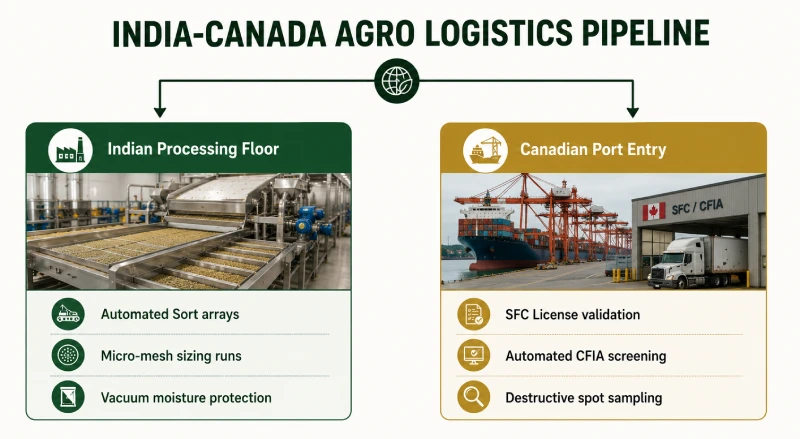
To prevent costly cargo detentions at terminals in Vancouver or Montreal, bulk agro exporters must verify that their Canadian importing partners hold a valid Safe Food for Canadians (SFC) license. The cross-border data workflow matches the exporter’s phytosanitary filings directly with the importer’s digital declaration before the ocean vessel even docks.
Core CFIA Regulations India Exporters Must Manage
- The Automated Import Reference System (AIRS): Prior to scheduling port delivery, a thorough review of the interactive AIRS portal is required by the trade desk. This is because confirming whether a specific crop requires a specialized import permit or faces conditional seasonal restrictions depends entirely on verifying the exact entry status dictated by the system.
- The Preventive Control Plan (PCP): Under CFIA regulations India exporters frameworks, a legal obligation falls squarely on Canadian buyers to ensure that foreign processing facilities operate under safety protocols fully equivalent to Canadian domestic plants. Because of this, maintaining documented hazard analyses, clear critical control point (HACCP) logs, and strict plant sanitation records for digital verification is a baseline necessity for Indian milling operators.
- Traceability Mandates: Handled directly by the SFCR is the enforcement of a strict "one step forward, one step back" tracking rule. To manage potential microbiological contamination alerts effectively, every single bag of agricultural cargo must display distinct lot numbers, clear country-of-origin marks, and explicit manufacturer tracking codes, making rapid, targeted recalls possible at terminal points.

High-Volume Commodities: Pulses Export to Canada
The movement of legumes and dried pulses exports to Canada represents an important structural lane within the broader India Canada trade matrix. While Canada is widely recognized as a massive global exporter of raw yellow peas and lentils, a closer look at bilateral trade data reveals a heavy counter-flow of highly specialized pulse exports to Canadian food processing hubs.
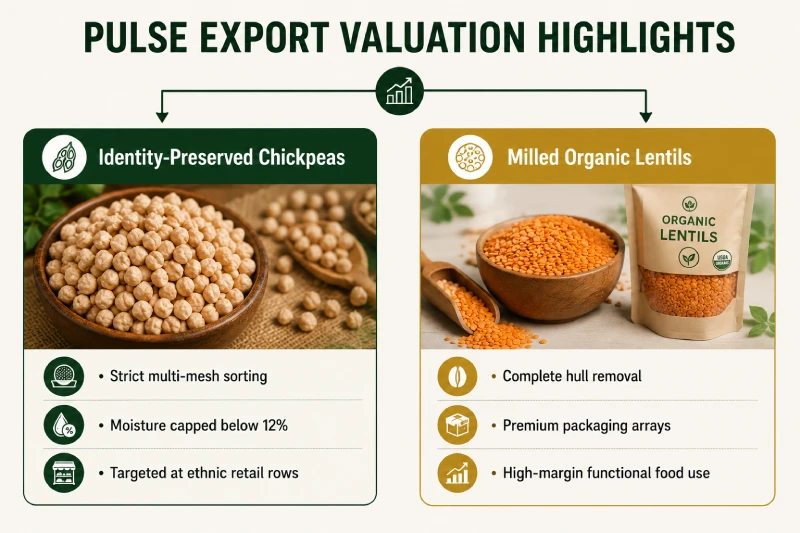
The pulses export to Canada pipeline focuses heavily on value-added, identity-preserved varieties like premium Kabuli chickpeas, specialized black gram (urad), and de-hulled mung beans designed for direct retail packaging and ethnic food sectors. Sourcing desks evaluate these shipments based on precise physical metrics:
Technical Specifications for Canadian Pulse Entry
| Grain Quality Dimension | Target Structural Metric | Primary Trade Justification |
|---|---|---|
| Purity Fraction | Minimum 99.5% clean seed | Zero tolerance for accidental field debris, stones, or foreign weed seeds. |
| Moisture Content | Capped strictly below 12% to 14% | Prevents internal caking and mycotoxin development during sea transit. |
| Defective Seed Cap | Less than 1% to 2% total damage | Limits split hulls, heat-damaged kernels, or insect-bored grains. |
| Chemical Residue Assay | Below CFIA Maximum Residue Limits (MRL) | Absolute prohibition of unapproved desiccants or old pesticide lines. |
Evaluating these parameters through independent labs prior to vessel loading is mandatory. If a container arrives at a Canadian terminal carrying trace volumes of prohibited field weeds or cargo moisture levels that cause internal mold growth, the CFIA will issue an immediate terminal hold, forcing expensive re-cleaning protocols or total cargo destruction at the exporter's expense.
How Agro Cargo Is Exported from India to Canada: The Operational Flow
Agriculture Exporters typically establish the regulatory and quality foundation required for international trade long if not before any physical agricultural material moves toward a port terminal. For a professional trade desk, the export process doesn't follow a simple government checklist. It functions as a carefully synchronized quality loop that balances farm-level cultivation with international custom clearance protocols.
Transitioning cargo cleanly from Indian processing floors to Canadian entry terminals requires the process to move through several operational stages:
- Harvesting & Sourcing: Procuring raw crops from verified agricultural clusters that track and document field-level pesticide application history.
- Pneumatic Cleaning: Routing the raw grain through multiple series of gravity separators and optical sorters to eliminate all foreign organic matter.
- Moisture Stabilization: Uniform consistency across the entire batch is achieved by routing the material through automated drying tunnels, bringing residual moisture down below the strict sub-12% target.
- Microbiological Testing: Verifying the complete absence of Salmonella, E. coli, and heavy metal traces involves running comprehensive batch samples through independent certified laboratories.
- Vacuum Packaging: To block ocean humidity during the long voyage, packing teams stow the processed stock into multi-wall paper sacks or heavy-duty jumbo bags equipped with integrated, heat-sealed polymer liners.
- Documentation Assembly: Preparing for customs screening requires compiling APEDA clearances, verified phytosanitary certificates, and independent laboratory assay reports into a single digital folder before port delivery.
- Customs Checkpoints: Submitting customs declarations to clear border verification at major Indian ports like Mundra or JNPT.
- Ocean Transit: Shipping the sealed container via direct container lines, tracking internal temperature variables during the sea voyage.
Export Documentation and Border Clearance
Canadian customs clearance agents evaluate incoming food containers strictly on documentation precision. A single typographical mismatch between an Indian export manifest and a Canadian import declaration will trigger an automated terminal hold.
To ensure trouble-free border clearance, the trade desk must assemble a complete compliance folder:
- Import Export Code (IEC Credentials): The legal baseline for corporate export authorization, issued directly by the DGFT in India.
- Commercial Shipping Invoice: Declares the absolute transaction value, weight parameters, and custom item codes for duty check metrics.
- Phytosanitary Certificate: Issued directly by India’s Ministry of Agriculture, confirming the cargo has undergone official treatment (such as valid fumigation) and is entirely free of quarantine pests.
- Safe Food for Canadians (SFC) Declaration: Cross-referenced with the Canadian importer’s active license to permit immediate automated customs processing.
- Certificate of Independent Analysis: Detailed laboratory breakdown verifying that the batch complies with Canada’s strict Maximum Residue Limits (MRLs) for pesticides.
- Ocean Bill of Lading: Official contract of carriage detailing shipping lines, port points, and title transition data.
Common Trade Challenges and Practical Field Solutions
Managing a long-haul agricultural supply chain across the export to Canada from India agro corridor presents unique operational risks. The single most persistent hazard is condensation damage inside sea containers during the long voyage. When cargo moves from the tropical heat of Indian loading docks through cold ocean currents, the temperature drop causes internal sweating. This moisture can ruin premium pulse shipments. To resolve this, procurement desks should mandate the use of high-barrier container liners, heavy-duty desiccants, and multi-ply kraft paper bags equipped with thick heat-sealed inner polymer sleeves.
Inherent baseline soil microbes naturally contaminate raw field sourcing, making microbiological contamination a persistent operational hazard. pathognetic variations like Salmonella face absolute zero-tolerance thresholds from international food regulators. Neutralizing bacterial counts without cooking or degrading the delicate seed hull requires processing plants to install automated continuous steam-sterilization units or run chemical-free processing layouts.
Market Outlook and Strategic Sourcing Recommendations
A highly positive long-term trajectory characterizes the India Canada agro trade corridor, fueled by steady consumer migration toward plant-based proteins, an expanding Canadian urban population, and institutional reliance on global food networks. Procurement volumes are projected to scale upward over the next decade.
Relying strictly on spot-market buys when demand peaks is a surefire way to expose your supply chain to brutal price swings. If you want long-term commercial stability, you have to bypass the open market and set up direct, contract-backed deals with vertically integrated processors in India—specifically the ones running modern optical sorting lines and automated sterilization systems. Locking in your volume commitments right after the harvest window does three things: it guarantees your inventory is always there, shields your margins from unseasonal weather price spikes, and gives you ironclad, batch-to-batch traceability from the farm gate all the way to Canadian retail shelves.
Want to export agro commodities to Canada? Register as a seller on Tradologie today and connect with genuine buyers.





-(1)converted.webp "Tradologie Reviews: Bridging Global Trade Gaps Through Technology")
-export-from-india.webp "Corn (Maize) Export from India: Capitalizing on India's Non-GMO Edge, Pricing, HS Codes, and Key Destination Markets")