Key Highlights
- India exported 17,604 tonnes of spices to Germany worth US$109.70 million in FY2025-26.
- Indian spice exports to Germany grew from US$89.31 million in FY2021-22.
- Turmeric, cumin, red chilli, coriander and black pepper offer potential export opportunities.
- Exporters need an IEC and applicable Spices Board registration, including CRES.
- EU rules cover pesticide residues, contaminants, food safety and traceability.
- Quality testing must match the spice, buyer specifications and applicable regulations.
- Export documents may include invoices, packing lists, shipping bills and laboratory reports.
- Tradologie can help exporters connect with potential buyers and negotiate trade deals live.
Introduction:
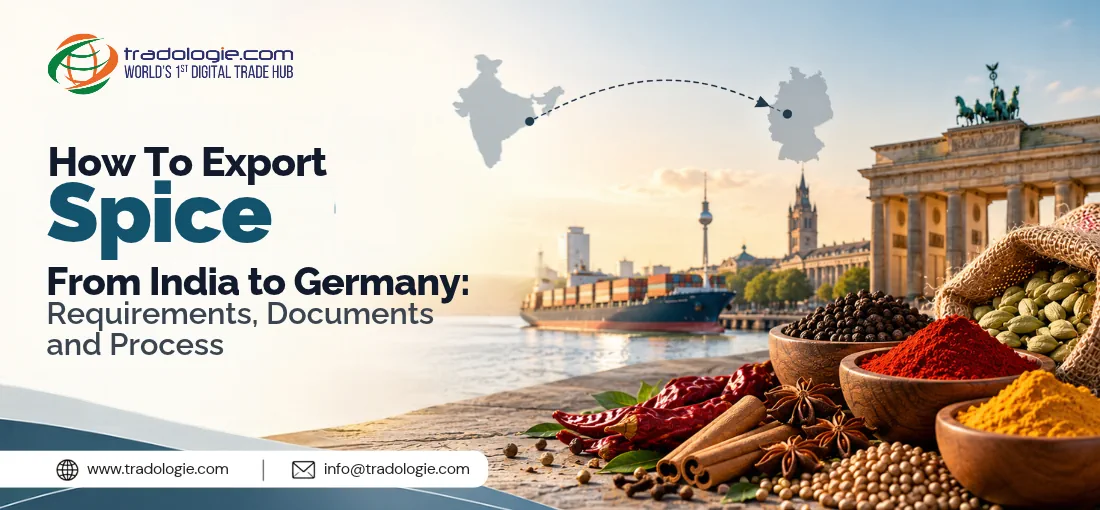
Germany is an important market to consider for Indian spices exporters, but entering it involves more than finding an importer willing to place an order. A German spice blender may need cumin with a particular aroma profile, a food manufacturer may require turmeric with consistent colour and curcumin content, while a distributor supplying ethnic grocery stores could be looking for a broader range of whole and ground spices. Each buyer has different expectations, and exporters need to understand them before looking to export spice to Germany.
For Indian businesses researching how to export spices to Germany , the process begins with understanding the buyer's requirements, the applicable European Union food-safety rules and the documentation needed for clearance. Businesses planning to export spices to Germany must also pay attention to pesticide residue limits, product testing, traceability and any additional checks that apply to specific spices from India. These Spice export requirements in Germany can affect procurement and processing decisions well before a consignment is ready to ship.
The next question is commercial: how can Indian businesses sell spices to Germany at a price that works for both the exporter and the buyer? Product quality, consistency, packaging and reliable delivery all influence that decision. Exporters also need to prepare the correct documents to export spice to Germany, including standard shipping paperwork and any product-specific certificates or test reports required for the shipment.
Germany's Position in India's Spice Export Trade
Germany is an established destination for Indian spices, although its export volumes remain smaller than those of India's leading markets. According to the Spices Board of India, India exported 17,604 tonnes of spices to Germany, worth US$109.70 million, in FY2025–26.
By comparison, exports to the United States reached US$624.35 million, followed by China at US$518.98 million and the UAE at US$409.77 million. Germany's trade is smaller, but it has grown steadily over the five years covered by the data.
| Destination | Export Quantity (FY2025-26) | Export Value |
|---|---|---|
| United States | 115,113 tonnes | US$624.35 million |
| China | 243,971 tonnes | US$518.98 million |
| UAE | 162,968 tonnes | US$409.77 million |
| Bangladesh | 305,401 tonnes | US$345.42 million |
| Saudi Arabia | 44,793 tonnes | US$206.80 million |
| Germany | 17,604 tonnes | US$109.70 million |
Source: Spices Board of India. Figures represent India's spice exports to each destination.
India's spice exports to Germany increased from 15,176 tonnes worth US$89.31 million in FY2021-22 to 17,604 tonnes worth US$109.70 million in FY2025-26. The growth has been gradual, but it confirms that Germany remains part of India's established export network.
For Indian exporters, the opportunity lies in understanding what German buyers need, from bulk whole spices to processed ingredients, and supplying products that meet their quality specifications consistently. The existing trade offers a starting point; building lasting business depends on finding the right buyers and meeting their requirements.

Why Germany Is Worth Considering for Indian Spice Exporters
Germany has a sizable food-processing industry, a developed retail market and established distribution channels for imported food products. Spices enter the country through several routes: specialist importers supply wholesalers, food manufacturers buy ingredients for processing, and private-label suppliers source products for supermarket shelves.
Indian exporters can approach these buyers with different product offerings. A bulk buyer supplying food manufacturers may prioritise consistency across large consignments, while a retail-oriented importer may be more concerned with packaging, labelling and the appearance of the finished product.
Price matters in both cases, but it rarely tells the whole story. An importer sourcing turmeric, cumin or chilli powder needs confidence that the next shipment will meet the same specifications as the previous one. A low quotation becomes less attractive if a consignment fails testing, arrives with inconsistent quality or requires additional handling before it can be sold.
Germany is therefore worth considering for exporters who can offer more than an available supply of spices. Product consistency, reliable documentation and an understanding of the buyer's intended use can help build a longer-term business relationship.
Which Spices Can Indian Businesses Supply to Germany?
India produces a wide range of spices used in food manufacturing, retail and commercial kitchens. The products an exporter should target depend on their sourcing network, processing capabilities and the specifications they can maintain.
| Spice | Potential Commercial Applications | Important Quality Considerations |
|---|---|---|
| Turmeric | Food processing, seasoning blends and retail packs | Colour, curcumin content, moisture and residue compliance |
| Cumin | Spice blends, packaged foods and wholesale distribution | Aroma, purity, moisture and foreign matter |
| Red chilli | Sauces, seasoning mixes and retail products | Colour, pungency, microbial quality and aflatoxins where applicable |
| Coriander | Seasoning blends, food manufacturing and retail | Aroma, cleanliness, moisture and uniformity |
| Black pepper | Food processing, restaurants and retail | Density, pungency, moisture and purity |
| Ginger | Seasonings, processed foods and spice blends | Aroma, moisture, cleanliness and processing consistency |
| Cardamom | Premium food products, confectionery and retail | Size, colour, aroma and grade |
| Fenugreek | Spice blends, food processing and ethnic retail | Purity, moisture and uniformity |
These are potential applications, not guaranteed market opportunities. Exporters should establish demand with prospective buyers and confirm the specifications for each order before purchasing or processing the goods.
Whole spices and ground spices may also involve different commercial expectations. Grinding can introduce additional concerns around contamination, microbiological quality and consistency. A buyer purchasing whole cumin may have different testing and processing requirements from a manufacturer purchasing cumin powder for a finished food product.

Spice Export Requirements in Germany: What Indian Businesses Need to Know
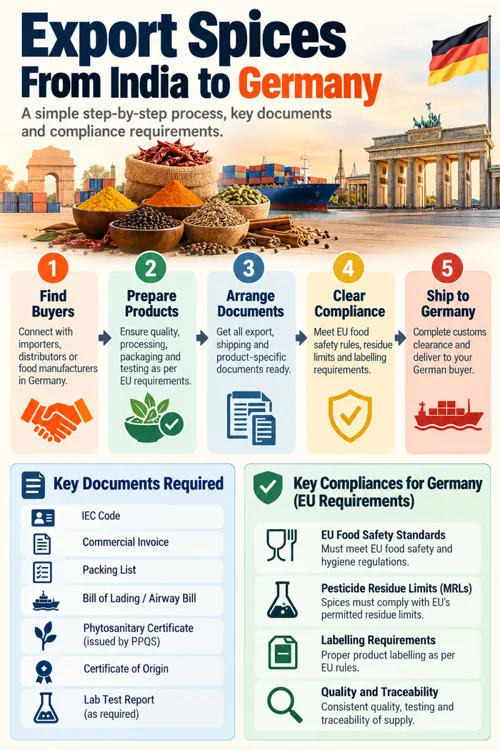
Germany follows European Union food-safety legislation. Indian exporters must therefore understand the relevant EU rules for the particular spice, its intended use and its country of origin. Meeting Indian export requirements alone does not establish that a product will be accepted in Germany.
1. Pesticide residue limits
The European Union sets maximum residue levels (MRLs) for pesticides in food and feed. These limits also apply to imported products.
A spice may look clean and meet the buyer's visual specifications while still failing a residue test. Exporters should check the applicable limits for the specific product and arrange appropriate testing through a competent laboratory. Where a buyer has a stricter specification than the legal limit, the contractual requirement must also be considered.
Residue compliance should be discussed with the supplier before procurement. Testing at the end of the process may reveal a problem only after the exporter has already committed money to the shipment.
2. Contaminants and microbiological quality
Depending on the spice and its processing, relevant checks may cover contaminants such as aflatoxins, heavy metals or other regulated substances, as well as microbiological parameters.
Ground spices deserve particular attention because processing and handling can affect contamination risks. Buyers may ask for a certificate of analysis covering parameters agreed in the purchase contract. The required tests should reflect the product, the applicable regulations and the buyer's specifications rather than relying on one standard testing package for every spice.
3. Traceability and additional import controls
EU food law requires traceability across the food supply chain. Exporters should maintain records identifying their suppliers, batches, processing details and shipment lots. These records become especially important if a buyer raises a quality concern or an authority requests further information.
Certain food products from particular countries may also face increased official controls at EU borders. The applicable list can change, so Indian exporters should verify the current position for their exact spice and product classification before shipping. Additional checks may affect documentary preparation, sampling and clearance timelines.
4. Buyer and product specifications
Legal compliance is only one part of the transaction. Buyers may specify grade, colour, aroma, moisture content, mesh size, packaging format, shelf life and acceptable levels of foreign matter.
Ask for these specifications in writing. If the buyer expects a particular treatment, processing method or laboratory report, establish that before finalising the quotation. A shipment can comply with general food-safety rules and still fail to meet the purchase contract.
How to Export Spices to Germany: The Process
The export process becomes easier to manage when documentation, testing and buyer requirements are addressed before the goods are dispatched.
Step 1: Obtain the necessary registrations
An Indian exporter generally needs an Importer Exporter Code (IEC) issued by the Directorate General of Foreign Trade. Businesses exporting spices should also check the applicable registration and compliance requirements of the Spices Board of India, including the Certificate of Registration as Exporter of Spices (CRES), where required.
Other registrations or certificates may be necessary depending on the product, business model and shipment. Confirm the current requirements with the relevant authorities rather than assuming that one registration covers every obligation.
Step 2: Identify the buyer and confirm the order
Decide whether the target customer is a spice importer, wholesaler, food manufacturer, distributor or private-label business. Each may purchase different quantities and require a different product format.
Before quoting, confirm:
- Spice variety, grade and country of origin
- Quantity and packaging format
- Quality parameters and laboratory testing
- Delivery terms and destination
- Payment terms and inspection conditions
These details help determine the actual cost of fulfilling the order. Without them, an apparently competitive quotation can become unprofitable once testing, packaging, freight and compliance costs are included.
Step 3: Procure, process and test the spices
Source the product against the agreed specifications. Maintain batch records and ensure that cleaning, grinding, packing and storage conditions protect product quality.
Arrange testing for the parameters relevant to the spice and destination market. If the German buyer has nominated a laboratory or specified a particular testing protocol, agree on that arrangement before dispatch.
Where a shipment fails to meet the required specifications, resolving the issue before export is generally less costly than dealing with a rejected or delayed consignment.
Step 4: Finalise packaging and shipment arrangements
Choose packaging that protects the spices during handling, storage and transportation. Bulk shipments and retail packs may require different materials and labelling arrangements.
The exporter and buyer should agree on shipping terms, insurance responsibilities, freight arrangements and the documents required for customs clearance. Confirm the appropriate product classification and check whether any additional official documentation applies.
Step 5: Prepare the documents and dispatch the consignment
Once the order, product testing and packaging are in place, prepare the shipping documentation. The exporter or customs broker should verify that the details across the invoice, packing list, shipping bill and transport document are consistent.
The German importer should also be ready to fulfil its responsibilities for import clearance, including any applicable food-safety checks, duties and taxes. A shipment should not be treated as ready simply because the goods have left the warehouse.
Documents to Export Spice to Germany
The exact documents depend on the product, origin, shipment terms and applicable regulations. The following table covers common export paperwork and documents that may be required for specific consignments.
| Document | Purpose |
|---|---|
| Importer Exporter Code (IEC) | Establishes the Indian business's registration for export and import activities |
| CRES, where applicable | Spices Board registration relevant to spice exporters |
| Commercial Invoice | Records the goods, quantity, price, seller and buyer |
| Packing List | Details package count, contents, weight and packing information |
| Shipping Bill | Export customs declaration in India |
| Bill of Lading or Air Waybill | Transport document for the consignment |
| Certificate of Origin | Establishes the declared origin of the goods when required by the buyer or applicable procedure |
| Certificate of Analysis | Provides laboratory results for agreed quality and safety parameters |
| Phytosanitary or Other Official Certificates, Where Applicable | Supports compliance with requirements that apply to the specific product and shipment |
Not every shipment will require every document listed above. A certificate of analysis, for example, may be a contractual requirement even when a particular format is not universally mandated by law. Likewise, phytosanitary documentation depends on the product and the applicable rules.
The exporter should confirm the final document list with the buyer, customs broker and relevant authorities before dispatch. Errors in product descriptions, weights, origin details or shipment references can create avoidable delays.
Packaging and Labelling for the German Market
Packaging should reflect how the buyer intends to use the spice. Industrial customers may purchase large food-grade bags or bulk containers, while retailers generally need smaller packs designed for sale to consumers.
Packaging must protect the product against moisture, contamination and damage during transit. Exporters should also consider the storage conditions and expected shelf life specified by the buyer.
For prepackaged retail food, EU food-information rules govern the information that must appear on the label. Depending on the product and its intended sale, this can include the food's name, net quantity, durability information, storage instructions and details of the responsible food business operator. German-language information is generally important when a product is marketed to consumers in Germany.
The precise label requirements depend on the product and sales format. Bulk ingredients supplied to a food manufacturer may be treated differently from finished retail packs. It is sensible to obtain the importer's label approval before printing packaging in large quantities.
How to Find Buyers and Sell Spices to Germany
Finding a buyer is only the first part of building an export business. The more useful question is whether that buyer has a clear requirement, understands the product specifications and can complete the transaction on agreed terms.
Indian exporters can explore several channels:
- Importers and wholesalers: Businesses supplying food manufacturers, retailers and specialist food distributors.
- Food manufacturers: Companies purchasing spices as ingredients for seasoning blends, sauces, processed foods and other products.
- Private-label suppliers: Buyers sourcing spices for products sold under their own brands.
- Trade fairs: Industry events can help exporters meet importers, distributors and potential commercial partners.
- B2B trade platforms: Online platforms like Tradologie can help identify potential buyers and negotiate trade deals live.
Before agreeing to supply, verify the buyer's business identity, import capability, payment terms and purchase requirements. Discuss the product grade, quantity, testing expectations and delivery terms in writing.
A request for a quotation is not the same as a confirmed order. Exporters should avoid committing to large quantities or offering open-ended credit without understanding the counterparty and the commercial risks.
What Determines the Price of Indian Spices in Germany?
There is no single export price that applies to every shipment. The final quotation depends on the spice, grade, origin, order size, processing, packaging and delivery terms.
For example, whole spices supplied in bulk may have a different cost structure from finely ground products packed for retail. Laboratory testing, quality certification, freight, insurance and customs-related expenses can also influence the price.
Currency movements and changes in raw-material availability may affect margins between the quotation and the actual shipment. Exporters should calculate the full cost of fulfilling the order before committing to a price.
Buyers, meanwhile, compare more than the quoted rate. A supplier who can deliver consistent quality, provide reliable documentation and meet the agreed delivery schedule may be more commercially useful than one offering a slightly lower price but leaving important details uncertain.
Building a Sustainable Spice Export Business in Germany
Germany offers Indian spice exporters access to importers, wholesalers, food manufacturers and retail-oriented businesses. India's established spice industry provides a useful starting point, but each product and buyer relationship comes with its own commercial and compliance requirements.
Businesses learning how to export spices to Germany should treat compliance as part of procurement and production, not as a final formality. The right raw material, consistent processing, appropriate testing and accurate documentation all contribute to a smoother shipment.
For exporters looking to sell spices to Germany, the longer-term opportunity lies in supplying what the buyer actually needs, meeting the applicable requirements and delivering consistent quality from one order to the next.
One successful consignment can establish a business relationship. Reliable supply is what gives that relationship a reason to continue.
Disclaimer
The information provided is for general guidance. Export figures relate to the stated financial years, while registration, documentation and EU import requirements may change. Exporters should confirm current requirements with the relevant authorities and the German importer before shipping.