Key Highlights
- India exported approximately 20.19 million metric tonnes of rice worth US$12.47 billion in FY2024–25.
- The UAE remains an established destination for Indian rice exports.
- Indian exporters can supply Basmati, non-Basmati, parboiled, Sella Basmati and broken rice.
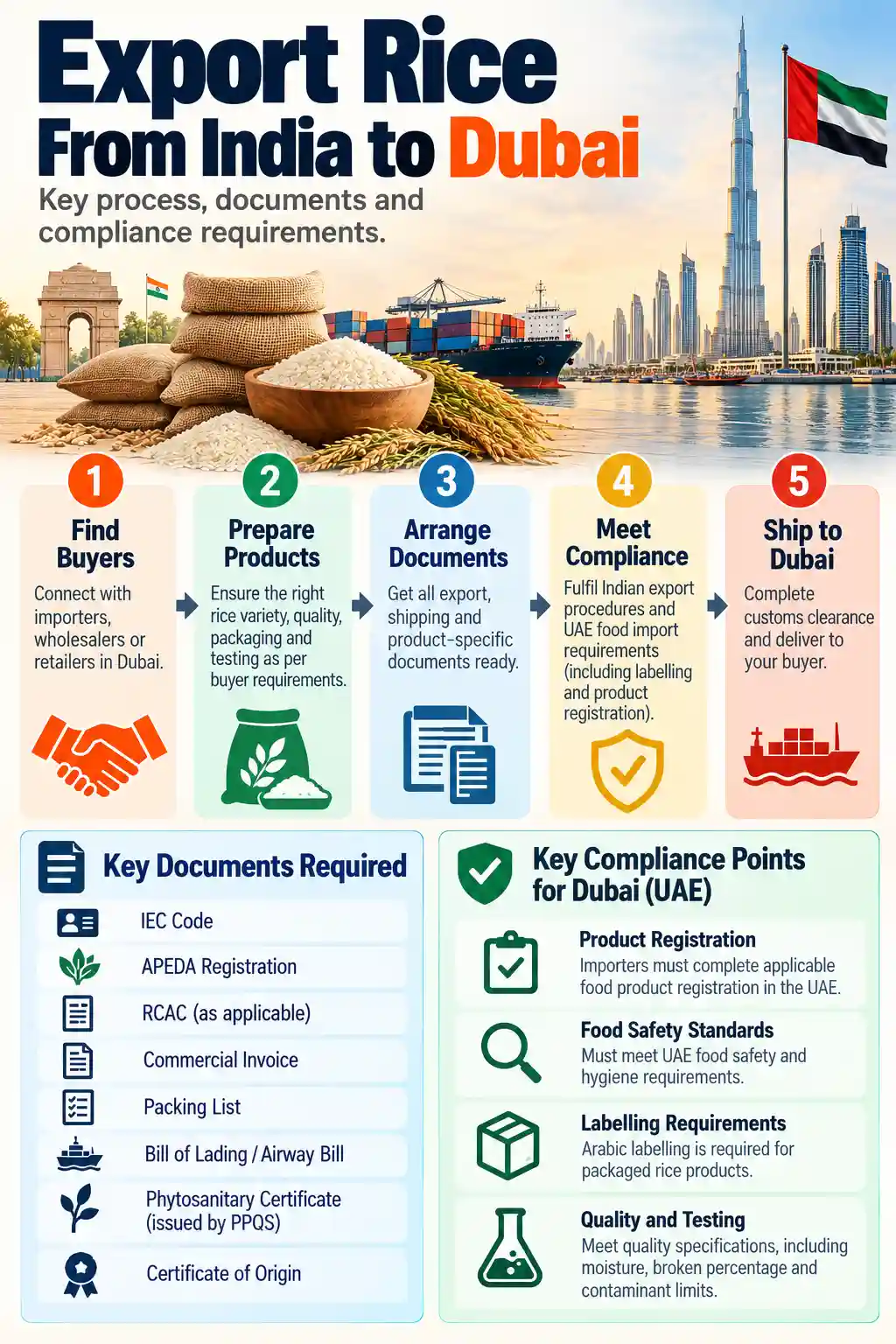
- Exporters need an IEC, applicable APEDA registration and RCAC under the relevant export procedure.
- Dubai food imports involve applicable product registration, labelling and clearance requirements.
- Arabic labelling and consistent rice quality are important for packaged products.
- Export pricing depends on rice variety, grade, packaging, freight and delivery terms.
- Tradologie helps exporters connect with potential rice buyers and explore trade opportunities.
Introduction:
Dubai has long been an important destination for Indian rice, supported by its large South Asian consumer base, established food distribution networks and position as a regional trading hub. But an exporter looking to export rice to Dubai needs to understand more than the demand for Indian Basmati or non-Basmati rice. The buyer's requirements, the cost of delivery and the paperwork needed for clearance all influence whether a shipment makes commercial sense.
For Indian businesses researching how to export rice to Dubai, the process starts with identifying the right buyer and confirming the type of rice, quality specifications, packaging and quantity required. Businesses planning to sell rice to Dubai must also account for Indian export procedures and the UAE's food-import rules, including product registration, labelling and inspection requirements applicable to the consignment.
The commercial question is just as important: how can an Indian exporter sell rice to Dubai at a price that works for both sides? A wholesaler buying container loads of non-Basmati rice may have very different requirements from a retailer sourcing premium Basmati in consumer packs. Those differences affect procurement, packaging, freight and margins.
Exporters also need to prepare the correct documents to export rice to Dubai and verify the applicable rice export requirements in Dubai before dispatch. A shipment that is ready at the Indian port may still face delays if the importer has not completed the necessary registrations or the documents do not match the consignment.
According to APEDA, India exported approximately 20.19 million metric tonnes of rice worth US$12.47 billion in FY2024–25. The United Arab Emirates was among the major destinations for Indian rice that year. The trade is already established; the challenge for an individual exporter is finding a suitable buyer and delivering the product according to the agreed specifications.
Why Dubai Is an Important Market for Indian Rice
Dubai serves both its local market and the wider regional food trade. Rice moves through importers, wholesalers, supermarket suppliers, restaurants, catering businesses and food distributors. Some buyers supply consumers directly, while others handle bulk purchases or move products into other markets.
Indian exporters can approach this market with different varieties and commercial formats. Basmati is often sold on the strength of its aroma, grain length and cooking characteristics. Non-Basmati varieties compete in different price segments and may be purchased in larger volumes for wholesale distribution and everyday consumption.
The buyer's business model determines what makes a shipment attractive. A wholesaler may prioritise landed cost, availability and consistent grain quality. A retailer may pay closer attention to branding, pack sizes and shelf presentation. A food-service buyer may want a particular cooking performance and dependable delivery.
India's established rice export industry gives suppliers a strong starting point, but competition remains important. Exporters need to calculate the full cost of supplying Dubai rather than basing a quotation on the price of rice alone.

Which Types of Rice Can Indian Exporters Supply to Dubai?
The right product depends on the buyer's customers, price segment and intended use.
These are potential market segments rather than a guarantee of demand. Before purchasing stock, ask the buyer to confirm the variety, grade, crop year if relevant, broken percentage, packaging, quantity and acceptable quality tolerances.
A quotation for “Basmati rice” alone is rarely detailed enough to support a reliable export order. Two products sold under that broad description can differ substantially in quality and price.
| Rice type | Potential buyers and applications | Important specifications |
|---|---|---|
| Basmati rice | Premium retailers, wholesalers and restaurants | Grain length, aroma, ageing, broken percentage and cooking quality |
| Non-Basmati white rice | General food distributors and wholesale buyers | Broken percentage, moisture, grain uniformity and cleanliness |
| Parboiled rice | Wholesalers and buyers serving specific consumer markets | Processing consistency, colour, moisture and grain integrity |
| Sella Basmati | Retailers, restaurants and bulk buyers | Grain length, processing quality, colour and cooking performance |
| Broken rice | Suitable industrial and food-processing buyers, subject to their requirements | Broken percentage, purity, moisture and intended use |

Rice Export Requirements in Dubai: What Indian Businesses Need to Know
Exporters need to satisfy Indian export procedures as well as the requirements governing food imports into Dubai. The importer usually handles local import registration and clearance, but the Indian supplier must provide compliant goods and the correct supporting documents.
1. Indian export registrations and rice contract requirements
An Indian exporter needs an Importer Exporter Code (IEC) issued by the Directorate General of Foreign Trade. APEDA also provides the relevant Registration-cum-Membership Certificate (e-RCMC) for scheduled products.
APEDA's rice export guidance specifies a Registration-cum-Allocation Certificate (RCAC) for Basmati and non-Basmati rice exports following registration of the export contract. Exporters should check the current procedure and obtain the required approval before proceeding with shipment arrangements.
The exporter must also confirm the rice export policy in force at the time of the order. Export conditions can change, so a previous shipment should not be treated as proof that the same procedure will automatically apply to a new consignment.
2. Food safety and quality
Rice must meet the applicable food-safety requirements and the quality specifications agreed with the buyer. Depending on the product and applicable rules, checks may cover pesticide residues, contaminants, moisture, foreign matter and other quality parameters.
The buyer may also request laboratory reports or a certificate of analysis. These requirements should be agreed before procurement, particularly when the buyer specifies testing parameters beyond the standard commercial grade.
3. Product registration and import clearance in Dubai
Dubai Municipality oversees food safety for food entering the emirate. Its Food Import and Re-export System (FIRS) is used for food-import procedures, including applications to release imported consignments.
The Dubai importer should confirm that the food item and importing establishment meet the applicable registration requirements before the shipment arrives. The consignment may be inspected, and additional documents or laboratory testing may be required depending on the circumstances.
Indian exporters should coordinate with the importer early. If the product registration or import request is incomplete, the goods may be held at the port while the necessary requirements are addressed.
4. Packaging and labelling
Packaged rice intended for sale in Dubai must meet the applicable food-labelling rules. Arabic labelling is an important consideration, and the importer should confirm the required label format before packaging is printed.
Depending on the product and pack, label information may include the product name, net weight, country of origin, manufacturer or packer details, production or expiry information where required, batch identification and storage instructions.
Bulk commercial shipments and retail packs may be subject to different practical requirements. Agree on the packaging format and label details with the buyer before the goods are prepared.
How to Export Rice to Dubai: Step-by-Step Process
Step 1: Obtain the required registrations
Secure the IEC and the applicable APEDA e-RCMC. Check the current RCAC procedure for the type of rice being exported and complete the required contract-registration process.
Step 2: Find a buyer and confirm specifications
Identify whether the prospective customer is a rice importer, wholesaler, retailer, restaurant supplier or food distributor. Confirm the variety, grade, quantity, packaging, delivery schedule and payment terms in writing.
Step 3: Calculate the export price
Work out the cost of rice procurement, processing, grading, packaging, inland transport, port charges, freight, insurance and any applicable inspection or testing. Quote against clearly agreed delivery terms, such as FOB or CIF, so both parties understand which costs each side will bear.
Step 4: Procure and prepare the rice
Source rice that meets the agreed specifications. Arrange cleaning, grading, sorting and packaging as needed. Check the finished product and maintain records that connect the shipment to its batch and supplier.
Step 5: Arrange inspection and export documentation
Obtain the applicable phytosanitary certificate and other certificates required for the shipment. Prepare the commercial invoice, packing list, shipping bill, transport documentation and the relevant APEDA registration or allocation paperwork.
Step 6: Ship and coordinate Dubai clearance
After Indian customs formalities are completed, the goods can be dispatched according to the agreed shipping schedule. The Dubai importer or its customs representative should be ready to complete the relevant food-import procedures and submit the required documents.
The shipment is not fully delivered simply because it has left India. Import clearance, inspection where applicable and release to the buyer remain important parts of the transaction.
Documents to Export Rice to Dubai
The final document list depends on the rice variety, shipment terms and the requirements applicable to the consignment. The following are the main documents Indian exporters should prepare or verify.
| Document | Purpose |
|---|---|
| Importer Exporter Code (IEC) | Required for Indian export operations |
| APEDA e-RCMC | Relevant exporter registration for rice and other APEDA-scheduled products |
| RCAC | Required for Basmati and non-Basmati rice exports under the applicable APEDA procedure |
| Phytosanitary certificate | Confirms compliance with applicable plant-health requirements |
| Commercial invoice | Records the buyer, seller, product description, quantity and value |
| Packing list | Details package count, weights and packing information |
| Shipping bill | Indian customs export declaration |
| Bill of lading | Transport document for sea freight |
| Certificate of origin | Establishes the declared origin when required |
| Certificate of analysis or inspection report | Provides quality or test results when required by the buyer or applicable rules |
| Fumigation certificate or other treatment documents | Required where applicable to the product or shipment |
Not every shipment will require every supporting document in the table. The exporter should confirm the exact requirements with APEDA, the relevant plant-quarantine authority, the freight forwarder and the Dubai importer before dispatch. The importer should also verify any additional documents required by Dubai Municipality for food clearance.
How to Find Buyers and Sell Rice to Dubai
The most useful starting point is to identify buyers whose requirements match the rice an exporter can supply consistently.
- Rice importers and wholesalers: Suitable for businesses handling bulk quantities and established distribution networks.
- Supermarket suppliers: May require branded packs, consistent retail quality and approved labels.
- Restaurants and catering suppliers: Often focus on cooking performance, dependable availability and commercial pricing.
- Food distributors: May supply several customer segments and purchase different varieties or pack sizes.
- B2B trade platforms: Can help exporters identify prospective buyers and initiate commercial discussions.
Before accepting an order, verify the buyer's business credentials, import capability, payment terms and purchasing requirements. A written specification and clear payment arrangement are especially important for a first transaction.
Exporters can also use platforms such as Tradologie to connect with potential buyers and explore trade opportunities. As with any business channel, buyer verification, product specifications and agreed payment terms remain essential before committing to a shipment.
What Determines the Price of Rice in Dubai?
The export price depends on the rice variety, grade, broken percentage, processing, packaging, order volume and delivery terms. Freight and insurance can change the landed cost significantly, while currency movements and changes in domestic rice prices can affect the exporter's margin.
Basmati and non-Basmati rice also serve different market segments, so comparing prices without accounting for variety and quality can be misleading. An exporter should calculate the full cost of fulfilling the order before making a firm offer.
Buyers, meanwhile, need confidence that the rice delivered will match the agreed specifications. A competitive price may win the first order, but consistent quality and dependable shipment schedules are what help retain the customer.
Building a Rice Export Business in Dubai
Dubai offers Indian rice exporters access to importers, wholesalers, retailers and food-service businesses, with opportunities across both premium Basmati and non-Basmati segments. India's established export industry provides a strong foundation, but each shipment still depends on the product, buyer requirements and applicable compliance procedures.
Businesses learning how to sell rice to Dubai should confirm the export policy, complete the necessary registrations, agree on product specifications and coordinate with the importer well before dispatch. The documents to export rice to Dubai should be prepared alongside procurement and shipment planning, rather than treated as paperwork to complete at the last minute.
For businesses looking to sell rice to Dubai, the objective is to find buyers whose requirements match their supply capabilities and whose commercial terms make the transaction viable. One shipment can open the door. Consistent quality, reliable documentation and timely delivery give the buyer a reason to place the next order.
Finally:
Like any other market, Dubai is also a market worth understanding to the core. If you want to export rice, the biggest opportunity for Indian rice exporters is geographical proximity. Dubai has a well-established stable demand for Indian rice but you need to comply with the regulations, documentation, and all the statutory norms. Keep track of the compliance and maintain quality to cater to the requirements of the bulk buyers.
Want to export or import rice to Dubai? Register as a buyer or seller on Tradologie today.
Disclaimer
The information provided is for general guidance. Export figures relate to FY2024–25, and export policies, documentation and UAE import requirements may change. Exporters should verify the latest requirements with the relevant authorities and the Dubai importer before shipping.




.webp "Types of Rice in India’s Export Market: Complete Guide for Global Buyers")