Key Highlights
- Japan imports premium, traceable, and high quality food products globally.
- India exports spices, tea, fruit preparations, and animal feed products to Japan.
- Japan imported USD 51.53 million worth of spices and tea products from India.
- MAFF regulations strictly govern food imports entering Japan.
- Japan follows a strict Positive List System for pesticide residues.
- Packaging precision and labeling accuracy are critical in Japanese retail markets.
- HACCP and FSSC 22000 certifications improve buyer confidence significantly
- Value added and clean label food products hold strong export potential in Japan.
Introduction:
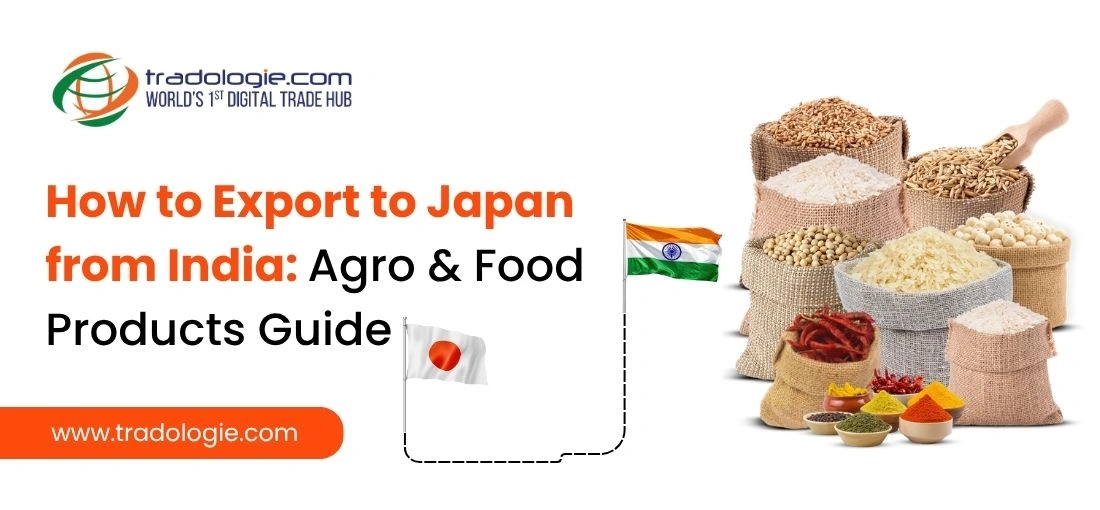
Exporting food products to Japan is rarely just about pricing. Quality consistency, documentation discipline, and long-term reliability play an equally important role in how Japanese buyers evaluate suppliers. For commercial enterprises aiming to export food to Japan from India, navigating this market demands an alignment with unmatched technical expectations.

Japan operates as a high-value, highly protective food import gateway. The regulatory infrastructure there prioritizes consumer safety, ironclad product traceability, and flawless packaging aesthetics. For Indian agribusinesses, this sophisticated consumer landscape offers an exceptional premium positioning opportunity, provided that trade desks abandon raw commodity mindsets in favor of zero-defect execution. Entering this channel successfully requires deep administrative preparation well before cargo leaves the dock, making structural discipline the ultimate driver of sustainable food export Japan operations.
India Japan Food Trade: Key Import Categories
The diversity of Japan's food imports from India becomes more visible when individual categories are examined closely. According to United Nations COMTRADE data via Trading Economics, the bilateral India Japan food trade spans a highly diversified range of agro-processing sectors, anchored by specialized animal inputs, premium beverage-linked crops, and value-added consumer formats:
Annualized Indo-Japanese Food Import Performance
| Product Category | Import Value from India |
|---|---|
| Residues, waste of food industry & animal fodder | USD 59.93 Million |
| Coffee, tea, mate & spices | USD 51.53 Million |
| Edible fruits, nuts & melons | USD 40.08 Million |
| Vegetable, fruit & nut food preparations | USD 38.12 Million |
| Meat, fish & seafood preparations | USD 23.02 Million |
Trade networks moved approximately USD 59.93 million in animal feed and production residues during 2025, alongside a steady USD 51.53 million for spice lots and raw beverage ingredients. Whole fruits and nuts held their own commercial ground, crossing USD 40.08 million. These numbers reveal a broad structural presence across multiple distinct agricultural sectors rather than a single commodity focus. This diversification matters. Japanese supply chain managers buy selectively, prioritizing origin setups where farm-level tracking and handling certifications align with their long-term supply safety frameworks. This solidifies a reliable foundation for expansion in Japan agri import from India.

Which Indian Food Products Have Demand in Japan?
The Japanese distribution landscape is characterized by a strong appetite for value-added, clean-label agricultural derivatives. Bulk raw shipments are increasingly giving way to specialized, retail-ready food demand, where processing precision defines contract longevity. To successfully export food to Japan from India, suppliers must match their product matrices with specific Japanese industrial and culinary applications.
| Product Segment | Japan Import Trend | Sourcing Focus |
|---|---|---|
| Spices & Seasonings | Stable demand | Pure oleoresins, whole sterilized pepper, and deseeded chili variants |
| Tea Products | Premium niche demand | Single-origin orthodox teas, organic Darjeeling, and herbal infusions |
| Fruit Preparations | Growing processed-food demand | Chilled purees, aseptic fruit pulps, and IQF tropical varieties |
| Seafood Preparations | Specialized category demand | High-dexterity surimi, value-added prawns, and frozen fillet extractions |
| Animal Feed Ingredients | Industrial-scale procurement | High-protein de-oiled cakes, manufacturing residues, and organic fodder |
Value-added products are rapidly gaining preference over unrefined commodities. In the tea segment, for instance, standard bulk leaf sales face steep price pressures, but premium organic orthodox leaf packaged in retail-ready configurations secures strong margins inside Tokyo's high-end wellness boutiques. Similarly, fruit preparations must be delivered in aseptic packaging formats optimized for industrial dairy or confectionery manufacturing. For food export Japan syndicates, shifting capital into these specialized processing lines is no longer an alternative play; it is the baseline requirement to satisfy institutional Japanese buyers.
Japan Import Regulations Food Exporters Must Understand
Japan's food import framework is highly detail-oriented. Even minor inconsistencies in labeling, ingredient declarations, or residue compliance can create shipment delays. To achieve continuous clearance at maritime ports like Yokohama or Tokyo, trade houses must strictly align operations with Japan import regulations food frameworks.
| Compliance Area | Core Operational Target | Regulatory Impact |
|---|---|---|
| Residue Testing | Maximum Residue Limits (MRLs) | Absolute gatekeeper for port entry; positive list system |
| Labeling Compliance | Detailed component declarations | Retail acceptance; mandatory Japanese print formats |
| Traceability | Documented field-to-port tracking | Buyer confidence; structural risk insulation |
| Health Certification | Government-backed purity seals | Legal custom clearance; phytosanitary validation |
The country operates an unyielding Positive List System for agricultural chemicals. If a shipment registers even trace levels of an unauthorized pesticide residue or non-permitted food additive, the entire cargo container faces immediate, permanent custom seizure or destruction at the exporter's expense. To eliminate this commercial risk, exporters cannot rely on spot-market aggregation. Sourcing desks must execute direct, traceable contracts with farmers, enforcing strict pre-harvest chemical limits and backing every single shipment with validated pre-export laboratory testing certificates.
Step-by-Step Process to Export Food Products to Japan from India
Exporting to Japan usually becomes smoother when compliance preparation starts well before shipment scheduling. Documentation gaps that may seem minor in other markets can create delays in Japan's import clearance system. The actual execution requires following a highly sequential, institutional process flow rather than relying on generic trade theories.
Step 1: Secure Legal Export Authorization
Exporters must first obtain a valid Import Export Code (IEC) from the Directorate General of Foreign Trade (DGFT) in India. This serves as the mandatory legal baseline for any maritime or air exit clearance from Indian ports.
Step 2: Determine Specific Product Scrutiny
Exporters must verify the exact import classification of their cargo under Japan import regulations food files. Ground pressings, raw vegetation, marine hauls, and retail-bound provisions route through separate custom screening circuits.
Step 3: FSSAI and Food Safety Compliance
Manufacturing facilities must hold valid FSSAI licensing and should implement internationally recognized food safety management platforms like HACCP, ISO 22000, or FSSC 22000. Foreign buyers lean heavily toward mills utilizing automated sorting lines and mechanical foreign body clean-outs.
Step 4: Execute Advanced Laboratory Assays
Before containers roll past port gates, representative product samples require exhaustive checking. Purity labs must evaluate chemical trace limits, mycotoxin footprints, and micro-organism thresholds. Border points will target any minor variance from the state's positive list system.
Step 5: Draft Precise Technical Labeling
Every package requires clean batch stamps, complete allergen disclosures, and verifiable shelf logs. Buyers typically demand full Japanese translations for these technical profiles before ocean dispatch.
Step 6: Secure Phytosanitary and Health Clearances
Plant materials demand authentic phytosanitary documents from India's quarantine officials, documenting clear compliance with mandated temperature or chemical disinfection standards.
Step 7: Consolidate Commercial Cargo Documentation
The trading desk must compile an ironclad document folder containing the commercial invoice, packing list, bill of lading, certificate of origin, insurance policies, and third-party laboratory purity results.
Step 8: Importer Coordination & MAFF Clearance
The export desk must work in close symmetry with the Japanese importer. The buyer must execute pre-import notifications with the Ministry of Agriculture, Forestry and Fisheries (MAFF) and file clear customs declarations well before the vessel drops anchor.
| Export Requirement | Operational Purpose |
|---|---|
| IEC Code | Legal export authorization |
| FSSAI License | Food processing compliance |
| HACCP/FSSC Certification | Food safety assurance |
| Phytosanitary Certificate | Plant health clearance |
| Residue Testing | Japanese compliance standards |
| Certificate of Origin | Customs & trade documentation |
Understanding MAFF Japan Regulations for Indian Exporters
The regulatory enforcement mechanism of Japanese border security rests heavily within the hands of the Ministry of Agriculture, Forestry and Fisheries. Japanese food import systems are designed around long-term consumer safety and traceability standards rather than only shipment-level verification. Compliance under MAFF Japan regulations India is an unyielding requirement for plant and animal-origin food lines.
Quarantine gates managed under this branch screen arrivals for biological risks, plant pathogens, and organic dirt traits. Fresh fruit or bulk seeds cannot step inland unless origin processing points run specialized sanitation runs. These runs require certified vapor-heat or immersion-disinfection treatment setups. MAFF inspectors emphasize absolute food quality integrity, meaning any discrepancy in quarantine papers will immediately freeze a trader's capital. Sourcing desks must treat these technical inspections as rigid manufacturing rules, establishing clean processing pathways that satisfy Japanese biosecurity watchdogs completely.
Packaging and Quality Expectations in Japan's Food Market
The Japanese retail landscape maintains some of the most uncompromising product presentation standards in the world. For commercial success, understanding Japan import regulations food codes must be matched by a deep respect for local retail aesthetics. Packaging precision is deeply linked with consumer trust across all major Japanese cities.
- Flawless Container Integrity: Cartons, jars, or pouches must be completely free from dents, micro-tears, or misaligned sealing lines. A package with minor exterior scratching is viewed as defective by retail handlers.
- Flawless Labeling Accuracy: Component print lines, shelf-life stamping, and batch coding must look clean and readable, ensuring absolute transparency regarding allergen exposure and origin tracing.
- Batch Traceability: The back-end logistics must track every container directly to its processing run, allowing for immediate quality identification if an industrial buyer conducts an audit.
- Shelf-Life Clarity: Japanese consumer channels rotate inventory rapidly, requiring high-contrast expiry tracking to sustain shelf presence.
| Packaging Requirement | Why It Matters |
|---|---|
| Accurate Labeling | Regulatory approval and consumer safety |
| Packaging Integrity | Passing strict retail aesthetics and quality audits |
| Shelf-Life Clarity | Securing consumer trust and fast product rotation |
| Batch Traceability | Passing border import compliance and quality checks |
Buyers prioritize consistency heavily. A shipment that shifts in color, particle size, or moisture content from the approved baseline sample will immediately damage a commercial relationship, regardless of competitive pricing.
Opportunities for Indian Agro & Food Exporters in Japan
Japan remains a highly attractive market for exporters capable of maintaining consistency, documentation discipline, and long-term supply reliability. Sourcing desks looking to build substantial value under Japan agri import from India parameters should steer clear of hyper-competitive, low-margin bulk commodity wars. The true profit expansion sits within specialized premium niches and advanced clean-label food segments.
Demographic contractions across major Japanese prefectures are driving institutional interest toward pure dietary additions, natural immune extracts, and clean protein feedstocks. Indian milling groups can leverage this transition by delivering high-grade organic derivatives like pure moringa pressings, unrefined plant seed oils, and certified ancient grains. Transactional consistency frequently holds far more weight than cut-rate price bidding inside this corporate space. If a processor lands a zero-variance track record across consecutive shipments, the buyer moves to secure long-term, multi-year volume commitments, isolating the crusher from raw commodity volatility.
Conclusion
Japan is an exceptionally quality-focused import market where competitive pricing alone can never secure a permanent shelf foothold. For agribusinesses looking to systematically expand their export food to Japan from India, the commercial imperative requires a total transition toward institutional discipline, technical processing excellence, and zero-defect document handling.
India already commands a reliable baseline across several specialized agricultural sectors, but scaling up requires total regulatory harmonization. Exporters who commit to strict MAFF quarantine tracking, implement flawless packaging finishes, and match long-term buying schedules are the ones positioned to build lasting commercial channels. The premium returns are entirely accessible, but they belong exclusively to trading desks that treat logistics with technical precision.