Key Highlights
- If you want to export dry ginger from India to Europe, identify the product form and confirm the buyer’s specifications.
- Check the applicable export policy, HS code, registrations and EU food-safety requirements.
- Ensure compliance with pesticide residue limits, quality standards, packaging and labelling requirements.
- Prepare the required export documents and verify destination-specific import conditions.
- Calculate export costs, arrange shipping and agree on payment terms before dispatch.
- Connect with potential European buyers through trade networks and B2B platforms such as Tradologie.
Introduction:
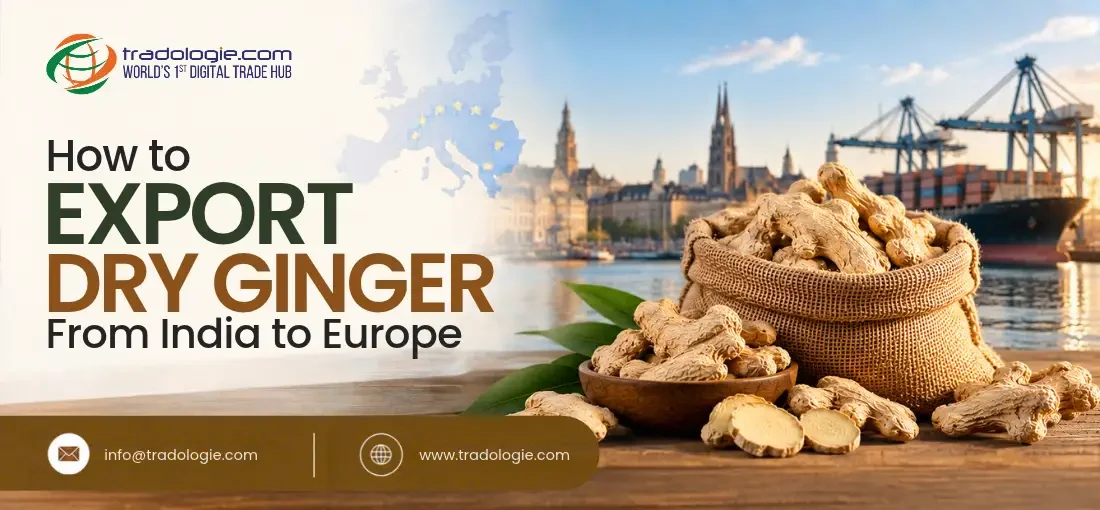
Dry ginger is used across the European food industry, from spice blends and bakery products to seasoning mixes, tea and food manufacturing. But finding a buyer is only one part of the export process. If you're researching how to export dry ginger from India to Europe, you need to understand the buyer's quality requirements, European food-safety rules, import documentation and the costs involved in delivering the shipment.
The requirements depend on the product you supply. Whole dried ginger, cut ginger pieces and ginger intended for grinding into powder may have different specifications. The buyer's country, intended use and product classification also influence the checks required before shipment.
This guide covers the complete export process and detailed steps to export dry Ginger from India to Europe, from selecting the right product grade and finding buyers to meeting import requirements and arranging delivery.
Steps to Export Dry Ginger From India to Europe: Complete Process
Step 1: Decide Which Type of Dry Ginger to Export
Before approaching European buyers, decide which form of dried ginger you can supply consistently. Different buyers purchase ginger for different purposes, and their specifications can vary accordingly.
| Product type | Potential buyers | Important considerations |
|---|---|---|
| Whole dried ginger | Spice importers, wholesalers and processors | Size, dryness, cleanliness, appearance and aroma |
| Dried ginger slices or pieces | Food manufacturers, spice processors and ingredient suppliers | Slice size, moisture, colour and uniformity |
| Dried ginger for grinding | Spice mills and seasoning manufacturers | Cleanliness, foreign matter, microbial quality and processing suitability |
| Ginger powder | Spice brands, food manufacturers and ingredient distributors | Fineness, colour, aroma, moisture and contamination controls |
Ginger powder is a related product, but its processing and specifications differ from those of whole dried ginger. Confirm the product form with the buyer before preparing a quotation.
You should also establish whether the buyer wants conventional or certified organic ginger. Organic exports involve additional certification and supply-chain requirements. Do not make organic claims unless the product meets the applicable standards.

Step 2: Find a Reliable Dry Ginger Supplier in India
If you do not process ginger yourself, work with a supplier who can maintain consistent quality across repeat orders. A low purchase price offers little advantage if the material fails inspection or does not meet the buyer's specifications.
Before finalising the supplier, check the following parameters:
| Quality parameter | Why it matters |
|---|---|
| Moisture content | Excess moisture can increase the risk of mould and deterioration during storage |
| Foreign matter | Soil, stones, plant debris and other contaminants can affect acceptance |
| Appearance and colour | Helps assess product consistency and suitability for the intended use |
| Aroma and pungency | Important for food manufacturers and spice processors |
| Size and uniformity | Relevant to whole ginger and sliced products |
| Microbiological quality | Buyers may require testing for relevant pathogens and other microorganisms |
| Pesticide residues | Must meet the applicable European limits |
| Heavy metals and other contaminants | Testing may be required based on product risk and buyer specifications |
Agree on the testing method, sampling procedure, acceptable limits and inspection arrangements before production or dispatch. A certificate of analysis should relate to the actual shipment or production lot.
Step 3: Complete India's Export Registrations and Check Export Policy
Before accepting an order, ensure your business can legally export the product and complete the required customs formalities.
Importer-Exporter Code (IEC): An IEC issued by the Directorate General of Foreign Trade (DGFT) is generally required for commercial exports from India.
GST registration: Check the applicable GST registration and export-related tax requirements for your business and transaction.
FSSAI licence: Businesses involved in food exports should confirm the FSSAI licensing requirements applicable to their activities.
APEDA registration: Check whether APEDA registration or a Registration-Cum-Membership Certificate (RCMC) applies to your product, business category or intended export benefits. Do not assume every spice shipment requires the same registration.
Export policy: Verify the current export policy and correct HS code for the product. Requirements can differ by product classification and may change over time.
You should also confirm whether phytosanitary certification, inspection or other plant-health documentation applies to the particular shipment. Do not assume that the same certificate is mandatory for every form of dried ginger.

Step 4: Understand European Union Food-Safety Requirements
Meeting European food-safety requirements is one of the most important parts of exporting dried spices. European buyers need confidence that the ginger is safe for consumption, handled properly and traceable to its source.
The European Union (EU) applies food-safety requirements to imported products as well as food produced within the EU. The exact requirements depend on the product classification, its origin, intended use and any additional import measures in force.
Pesticide residue limits
Dried ginger must comply with the applicable EU maximum residue levels (MRLs) for pesticides. These limits vary by substance and commodity, so a product accepted in India will not automatically meet European requirements.
Before shipment, review the supplier's pesticide-control practices and arrange testing according to the buyer's requirements and the applicable limits. Pay attention to the source of the ginger, pesticide application records and the risk of contamination during drying and storage.
Contaminants and microbiological quality
The buyer may request laboratory results covering relevant contaminants and microbiological risks. Depending on the product and risk assessment, this may include heavy metals, mould-related risks, pathogens and other parameters relevant to dried spices.
Drying and storage conditions matter. Ginger that is inadequately dried or stored in a humid environment can deteriorate or develop mould. Keep the product in clean, dry, pest-controlled storage and protect it from moisture during transport.
Do not rely on a generic certificate stating that the product is food grade. Agree on the actual tests and acceptance limits with the buyer before dispatch. EU rules establish limits for specified contaminants, and the applicable requirements vary by substance and food category.
Import checks and official certification
Some food products are subject to additional official import controls. Whether a particular consignment of dried ginger requires special certification, border checks or other documentation depends on its classification and the EU measures in force at the time of shipment.
Check the European Commission's import-control requirements and the relevant destination country's competent authority before dispatch. Where an official certificate is required, the procedure may involve the EU's TRACES system.
Do not assume that every dried ginger consignment requires the same certificate or border-control procedure. Confirm the current requirements for Indian dried ginger and the exact product classification before booking the shipment.
Organic dried ginger
If you intend to sell the product as organic, verify that the producer, exporter and supply chain meet the applicable organic requirements. Simply stating that the ginger was grown without chemical pesticides does not establish organic status.
Organic imports into the EU generally require an electronic certificate of inspection (e-COI) managed through TRACES. The importer and relevant control body should confirm the certification and documentation arrangements before the shipment leaves India.
Step 5: Check Import Duties and Product Classification
Before quoting a European buyer, confirm the correct customs classification for the product. The classification may depend on whether the shipment contains whole dried ginger, crushed ginger or ginger powder.
The HS code is important because it affects customs declarations, applicable duties and the import requirements that may apply to the consignment.
Check the following before finalising your price:
- The correct HS or Combined Nomenclature (CN) code.
- The applicable import duty in the destination country.
- Any preferential tariff treatment available under relevant trade arrangements.
- The customs value and country-of-origin declaration.
- Any additional import controls or restrictions applying to the product.
- Whether the buyer or its customs representative will handle import clearance.
Do not use the same tariff assumption for every European destination. The EU has a common customs framework, but countries outside the EU, including the United Kingdom, have their own customs arrangements. Confirm the current tariff and import conditions for the actual destination.
Step 6: Prepare the Packaging and Labelling
The right packaging protects dried ginger from moisture, contamination, pests and physical damage. It also helps preserve the product's aroma and condition during storage and transport.
Packaging requirements depend on the buyer. A spice processor importing whole dried ginger in bulk may need a different format from a retail brand selling small consumer packs.
Bulk packaging
Common options include food-grade bags, lined sacks and suitable bulk packaging. The choice depends on the quantity, product form, transport conditions and buyer's handling requirements.
Before dispatch, check that:
- The packaging is suitable for contact with food.
- The inner liner protects the ginger from moisture and contamination.
- Bags are strong enough to withstand loading, stacking and transport.
- The product is adequately dried before packing.
- The packaging is clean, intact and free from foreign odours.
- Batch identification and traceability information are maintained.
Do not pack ginger while it is still warm or inadequately dried. Trapped moisture can lead to deterioration during transit.
Retail packaging and labels
Retail packs need additional attention because the product will be sold directly to consumers. EU food-information rules generally require mandatory information to be presented clearly and in a language readily understood by consumers in the destination market. National language requirements can differ.
Depending on the product and packaging, the label may need to cover:
- Name of the food: Identify the product accurately, such as dried ginger.
- Net quantity: State the net contents in the required format.
- Date marking: Include the best-before date and any required storage instructions.
- Lot or batch identification: Maintain traceability.
- Business details: Include the name and address of the responsible food business operator or importer, as applicable.
- Country of origin: Provide origin information where required or necessary to avoid misleading consumers.
- Instructions for use: Include them where required.
- Other mandatory particulars: Check the requirements applicable to the product and destination.
The importer should review the final label against the destination market's requirements before printing. Do not assume an English-only label will be accepted in every European country.
Organic claims, quality claims and statements about pesticide-free cultivation must be accurate and supported. If the product is intended for further processing rather than direct retail sale, confirm with the buyer which labelling and accompanying information are required for that supply chain.
Step 7: Prepare the Documents Required for Export
The documents needed to export dry ginger from India to Europe depend on the product, destination, shipping terms and applicable certification requirements.
The following documents are commonly relevant to an export shipment.
| Document | Purpose |
|---|---|
| Importer-Exporter Code (IEC) | Identifies the Indian exporter for commercial export procedures |
| Commercial invoice | Records the product description, quantity, value and sale terms |
| Packing list | Provides package details, weights and quantities |
| Shipping bill | Indian customs export declaration |
| Bill of lading or air waybill | Transport document for the shipment |
| Certificate of origin | Establishes origin where required by the buyer or import procedure |
| Certificate of analysis | Records agreed quality and laboratory results |
| Phytosanitary certificate | Required if applicable to the product and destination's plant-health rules |
| Fumigation certificate | Required if stipulated by the destination, buyer or applicable transport rules |
| Organic certificate and e-COI | Relevant when exporting under the EU organic system |
| Insurance certificate | Required where applicable under the contract or shipping arrangement |
A certificate of analysis and a phytosanitary certificate serve different purposes. The former records product-quality results, while the latter addresses plant-health requirements. One does not replace the other.
Before dispatch, ask the European importer or customs representative to confirm the exact documentation required for the product's HS code and destination. This is particularly important where additional official import controls apply.
Step 8: Find Buyers for Dry Ginger in Europe
Once your product specifications and export documentation are in order, the next step is to identify buyers whose requirements match your supply.
Potential buyers include:
- Spice importers and wholesalers.
- Food ingredient distributors.
- Spice grinding and processing companies.
- Seasoning and food-mix manufacturers.
- Tea and herbal infusion manufacturers, where the product suits their intended use.
- Retail spice brands and private-label businesses.
Germany is one market worth researching for ginger and other spice ingredients, while the Netherlands can be relevant for importers and distributors serving wider European markets. Demand varies by product form, buyer category and price, so research individual buyers instead of assuming that every market offers the same opportunities.
You can approach buyers through trade exhibitions, food-industry associations, importer directories, direct outreach and B2B platforms. Tradologie is another option for connecting with international buyers and exploring bulk procurement inquiries.
When sending an offer, include the information a buyer needs to assess your product:
- Product form: whole dried ginger, slices or pieces.
- Origin and available quantity.
- Moisture content and agreed quality parameters.
- Laboratory reports, where available.
- Packaging type and minimum order quantity.
- Indicative price and quotation basis.
- Loading port and expected shipment schedule.
A clear specification is more useful than simply stating that you can supply Indian ginger. It helps buyers compare your offer with their existing suppliers.
Step 9: Calculate the Export Price
Your selling price should cover the cost of procuring the ginger, preparing it for export and delivering it according to the agreed terms.
| Cost component | What to include |
|---|---|
| Procurement | Purchase price of dried ginger |
| Cleaning and grading | Sorting, cleaning and removal of foreign matter |
| Processing | Cutting, additional drying or other agreed preparation |
| Laboratory testing | Quality, pesticide residue and other required tests |
| Packaging | Bags, liners, labels and cartons where applicable |
| Inland transportation | Movement from the supplier or processing facility to the port |
| Export handling | Customs clearance, documentation and port charges |
| Freight | Sea or air freight to the destination |
| Insurance | Cargo insurance where applicable |
| Finance and currency | Banking charges, working capital and exchange-rate exposure |
| Destination costs | Duties, customs clearance and handling, depending on the agreed terms |
The final cost depends on the product grade, order volume, packaging and destination. Testing and cleaning costs can also affect the economics of a shipment, particularly when the buyer has strict specifications.
When quoting, clearly state whether the price is FOB, CFR or CIF and specify the relevant port. These Incoterms allocate costs and responsibilities differently, so the buyer should understand what is included.
Avoid quoting only on the basis of the supplier's purchase price. A shipment that looks profitable at the sourcing stage may leave a much smaller margin after testing, freight and handling costs are added.
Step 10: Arrange Shipping and Storage
Dried ginger must remain protected from moisture and contamination throughout the journey. Poor handling can reduce product quality even if the ginger met the specification when it left the processing facility.
Sea freight is commonly considered for bulk shipments because it can accommodate larger quantities. Air freight may be considered for smaller or time-sensitive consignments, although the cost can be substantially higher.
Before loading, confirm that:
- The container is clean, dry and free from pests.
- Packaging is intact and suitable for the expected transit conditions.
- The product is protected from rain, condensation and moisture ingress.
- Bags are stacked securely to minimise damage.
- Lot numbers and shipment details can be traced.
- The shipping documents match the actual cargo.
For longer voyages, discuss the expected transit time and storage conditions with the buyer. Moisture protection is particularly important because damp conditions can lead to mould and deterioration.
Step 11: Complete Customs Clearance and Dispatch
Once the goods are ready, the exporter or customs broker prepares the shipping bill and supporting documents for Indian export clearance.
The shipment is then transported to the port and loaded according to the shipping schedule. The European importer or its customs representative handles the import declaration and applicable destination-side procedures.
A typical dispatch process includes:
- Final quality inspection and confirmation of the packed quantity.
- Verification of the invoice, packing list and required certificates.
- Completion of Indian export customs formalities.
- Cargo loading and issuance of the bill of lading or air waybill.
- Submission of documents to the buyer or bank, as agreed.
- Shipment tracking and communication with the importer.
- Retention of export, quality and payment records.
If the shipment is selected for additional checks, the importer may need to provide further documentation or arrange inspections. This is one reason to confirm the applicable import requirements before booking cargo.
Step 12: Finalise Payment Terms and Manage Risk
A first export order involves financial risk, particularly when you must pay the supplier, arrange testing and cover transportation before receiving payment from the buyer.
Common payment arrangements include:
- Advance payment: The buyer pays before shipment, reducing the seller's payment exposure.
- Letter of credit (LC): A bank-administered payment mechanism that depends on compliance with the credit's terms and document requirements.
- Documentary collection: Banks handle the shipping documents against payment or acceptance, but payment is not guaranteed merely because the documents are handled by a bank.
Before accepting an order, verify the buyer's credentials and agree on the payment schedule. The contract should also specify product quality, acceptable tolerances, inspection procedures, delivery timelines and how shortages, damage or quality disputes will be handled.
For dried ginger, the agreement should clearly define the required moisture level, product form, cleanliness, packaging and testing criteria. Vague quality terms can create disagreements when the goods reach the destination.
Conclusion
A successful dried ginger export operation depends on consistent product quality, reliable sourcing and careful preparation before shipment. Exporters need to understand the buyer's specifications, account for the full delivery cost and ensure that the required documents are ready on time.
Pay particular attention to moisture control, pesticide residue compliance, traceability and suitable packaging. Sorting these details out before accepting an order can reduce delays, avoid unnecessary costs and help build lasting relationships with international buyers.
Disclaimer
Export policies, customs duties, HS classifications, food-safety standards and import documentation requirements may change. Requirements can also differ depending on the product form and European destination. Exporters should verify current regulations with the relevant Indian and destination-country authorities and confirm shipment-specific requirements with the importer or customs representative before dispatch.