Key Highlights
- Sella Basmati is preferred for its firm texture and long grain.
- Prefer choosing suppliers with their own milling and processing facilities.
- Select the right grain variety based on your target market.
- Third-party lab testing helps avoid shipment rejections.
- Proper packaging protects rice during ocean transport.
- Secure payment terms reduce risks for international buyers.
Introduction:
Watch any commercial kitchen during peak hours. Rice takes an absolute beating—boiling pots for hours, warmers, cooks tossing pans repeatedly. Normal raw basmati breaks down fast under that kind of heat. It turns gummy, splits along the spine, and turns into a clump on the plate. In 2025- 2026 India shipped 6.52 million metric tonnes of basmati rice globally.
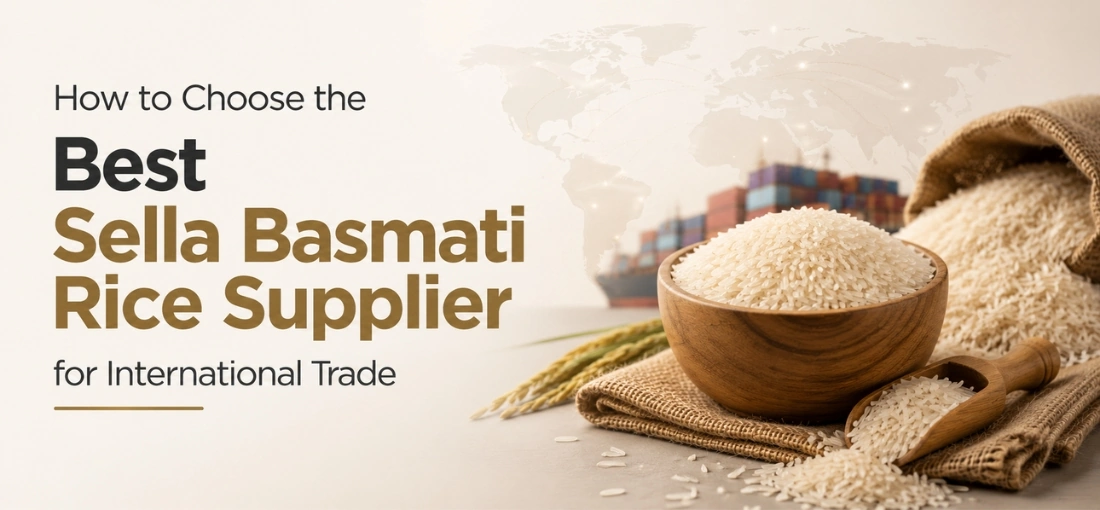
That's the main reason basmati rice importers buy Sella Basmati in such huge volumes. Sella is just parboiled basmati. It's tough. But sourcing a few containers isn't as simple as searching online and wiring cash to a supplier. Work with the wrong Sella Basmati rice suppliers , and you end up stuck with tons of yellowed, split, or off-smelling grain that buyers in your market won't take.
If you are planning to bring in bulk shipments for regional distribution or pack under your own brand label, getting the supply chain right requires looking far beyond basic seller promises.
It is imperative to shortlist suppliers based on their processing capabilities, the amount of experience they have in the industry, quality certification and the exact documentation that should be in compliance with the trade industry norms if you are looking for best sella basmati rice suppliers . Low price isn't a guarantee that the product will be of top quality.

What Makes Parboiled Sella Grain Different?
The difference comes down to the parboiling step before milling. Millers soak the raw paddy in hot water, run pressure steam through it, and dry it out slowly. That thermal process gelatinizes internal starches completely. When cooked later, grains stay firm and separate. Even if a line cook overcooks a batch slightly or lets it sit under heat lamps during a long dinner service, it won't turn into paste.
Varieties like 1121 or 1509 also expand significantly on the plate, sometimes stretching past 20 millimeters in length.
Because steam pressure pushes bran nutrients into the grain core prior to hulling, it holds onto nutritional value despite being polished. Heat treatment also neutralizes pest larvae and stabilizes natural oils, so it survives ocean freight and warehouse storage without spoiling quickly.
When contacting Sella Basmati rice exporters , expect two main types: White Sella (ivory shade) and Golden Sella (amber color from longer steam cycles). White Sella gets less steam exposure, so it stays closer to the traditional look of raw polished basmati while keeping the firm texture. Golden Sella undergoes extended steaming, turning the kernel a distinct yellowish-gold that turns bright white once cooked.
Choosing the Right Grain Code for Your Buyers
Don't ask Sella Basmati rice sellers for a generic quote on "parboiled basmati." Prices depend entirely on grain codes, and asking for generic products invites sellers to send whatever cheap lot they have sitting in the warehouse.
Supplying high-end restaurants usually requires 1121 Golden Sella for its length and slender appearance. The raw grain averages around 8.35 millimeters, and it is the standard for biryani houses where presentation is everything.
If you are buying for budget catering or cost-sensitive markets, 1509 Sella offers similar raw length at a much lower price per ton. The downside to 1509 is that it breaks a bit easier during aggressive milling, but for price-focused buyers, the savings make up for it.
1718 Sella works well too, bred as a disease-resistant variant of 1121 that gives nearly identical cooking traits. For basic food service accounts where cost overrides grain length, DB Pusa Sella provides a solid budget-friendly alternative.
Sourcing Steps to Avoid Bad Lots
The biggest mistake is buying from middleman traders who don't own processing plants. They take deposits, source cheap leftover lots from small regional mills, and mix them into single shipments. Mixed lots cook unevenly—half the bag cooks soft while the rest stays hard because different paddy crops were blended together. Stick to direct millers running their own optical color sorters and mechanical dryers.
Put explicit specs in your purchasing contract. Require a minimum average grain length, cap moisture strictly under 12.5%, and set hard limits on broken kernels (usually 1% or less for premium grades).
Moisture management is where many millers cut corners. Rushed drying to save electricity costs leaves water trapped inside the grain core. Put that rice in a sealed shipping container for three weeks at sea through tropical shipping lanes, and that trapped moisture causes the whole shipment to ferment. It arrives moldy and sour.
Always demand that paddy gets aged properly before parboiling. Freshly harvested paddy (often called new crop) has too much internal moisture and soft starches. If a supplier parboils new crop paddy without letting it age in silos for at least a few months, the cooked rice won't achieve that signature firm separation. It cooks soft, defeats the purpose of buying Sella, and ruins your reputation with catering clients.

Handling Chemical Limits and Port Clearance
Chemical rules are another major risk that catches importers off guard. Customs authorities in the EU, US, and Gulf regions test incoming shipments for pesticide traces like Tricyclazole, Buprofezin, or Chlorpyrifos. If paddy comes from farms using restricted chemicals late in the growing cycle, port officials will impound and destroy the container. Always demand an independent lab test from an accredited facility proving the batch complies with your destination country's Maximum Residue Limits before anything gets loaded onto a vessel.
Once the ship departs, verify your seller sends clean original paperwork without delay so your customs broker avoids daily port storage fees. You need:
- Bill of Lading: It is the master document released by the ocean carrier that basically proves physical ownership of the cargo once it arrives.
- Phytosanitary Certificate: It is issued by agricultural government authorities which confirm that the grain was inspected and cleared of live pests, weed seeds, and the diseases that might be at the source which is the plant.
- Certificate of Origin: Official verification from the local Chamber of Commerce proving the rice was cultivated, harvested, and processed in India.
- Certificate of Analysis: It is a lab sheet which is generated by an independent inspector that confirms that the grain length, moisture percentages, purity levels, and broken grain ratios match exactly the ones mentioned in the contract.
If any of these documents carry spelling errors or mismatched container numbers, port authorities will hold the shipment at the dock. Demurrage charges accumulate fast, quickly wiping out any profit margin you planned to make on the deal.
Red Flags During Supplier Negotiations
Suspicious cheap quotations for a premium rice like 1121 Sella Basmati rice are a big no. Although third-party inspections of goods are done before the shipment is dispatched, there is still a lot of suspicion if the price is usually way too low. Take for instance, If a seller quotes $200 or $250 below prevailing market rates, it is a strong indication that something is wrong with the batch.
Also, it is important to pay close attention to packaging choices. Take for instance, a dense parboiled rice is heavy, and if a seller packs it in thin, single-layer polypropylene bags to shave off a few cents per unit, then you should expect sacks that are ripped and spilled grain across the container floor during ocean transit. Insist on heavy-duty non-woven bags, BOPP printed sacks, or lined jute bags from the start. Ideally, a professional sella basmati rice exporters should be well-aware of such technical aspects of the export process.
Whether you are sourcing from a miller or a Basmati Rice Exporter India , experience with international documentation, packaging standards, quality assurance, and destination-country compliance remains equally important for successful bulk shipments.
Contract Terms and Payment Safety
Never ship bulk agricultural cargo on pure goodwill or unsecured credit terms, especially when working with a new supply partner.
For initial orders, structure payments through an Irrevocable Letter of Credit (LC at sight) or a structured advance payment agreement—such as 20% or 30% advance deposit via telegraphic transfer, with the remaining balance payable against scanned copies of the shipping documents and independent inspection certificates.
This structure ensures the sella basmati rice supplier gets paid only when the goods are packed, tested, and loaded onto the vessel, while protecting your capital against non-delivery.
If you work directly with verified millers and suppliers who have a credible track record, if you set quality specifications, hire a quality third-party inspection agency and keep everything well documented under the contract, then it definitely gives you complete control over product quality. In fact, once you develop this strong foundation, you can expect a consistent supply chain that delivers clean Sella Basmati rice on every batch.
Disclaimer
The information provided in this article is for educational and informational purposes only. Product specifications, pesticide residue limits, import regulations, and documentation requirements vary by destination country. Buyers should independently verify supplier credentials, laboratory reports, certifications, and commercial terms before placing bulk orders.