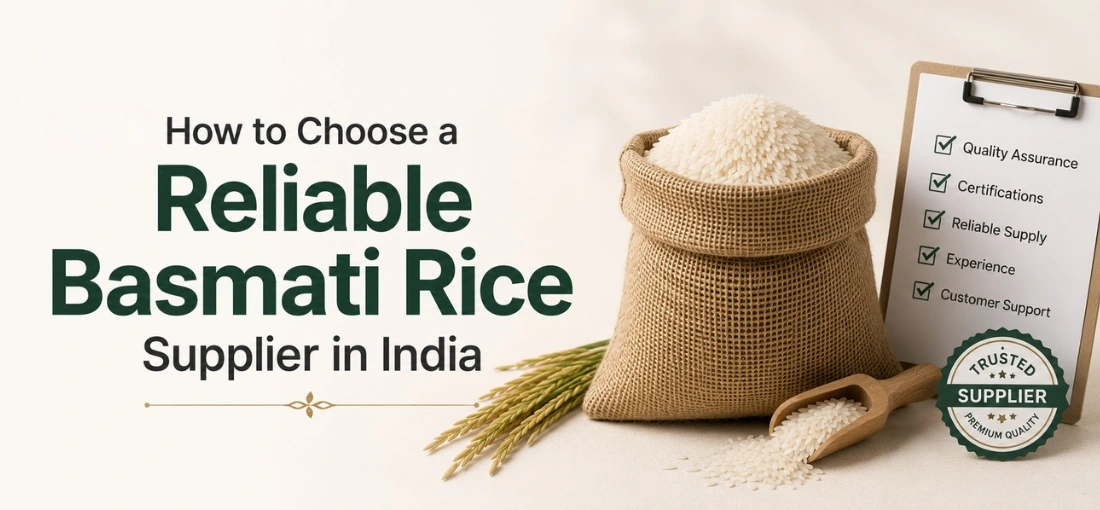
Key Highlights
- Choose suppliers with their own milling and aging facilities or credible sourcing partners.
- Verify APEDA and FSSAI certifications before buying.
- Experienced exporters understand different Basmati varieties.
- Ensure suppliers meet destination-country MRL standards.
- Proper packaging protects rice during long shipments.
- Always begin with samples and a trial order.
Introduction:
Finding a trustworthy rice supplier isn't as simple as checking a few quotes online, is it? On paper, almost every basmati rice exporter claims to offer top-tier grains, unmatched purity, and rock-bottom prices. But if you’ve been in the basmati rice import business for even a short while, you already know how this goes. A shiny brochure and a nice website don't mean much when your container shows up at the destination port loaded with broken grains, high moisture, or weeks of unexpected delays.
India leads the world when it comes to aromatic long-grain exports. We all know that. But for global rice buyers, trying to navigate through thousands of online trade listings, local traders, and pushy brokers can get really overwhelming, really fast.

So how do you actually tell the real, high-capacity mill owners apart from risky middlemen? How do you make sure that the cargo sitting in the ship's hold is the exact same quality as the sample sitting on your desk?
Let’s talk through how to vet a bulk basmati rice supplier in India step by step, so you can protect your money and your business reputation.
Don't Just Look at Price—Look at Processing Infrastructure
It’s always tempting to jump at the lowest price per metric ton, isn't it? We’ve all been there. But honestly, in agricultural trading, a ridiculously low price tag is usually the first massive red flag.
Think about it this way: how can someone sell far below the going market rate without losing money? They have to cut corners somewhere. Usually, that means quietly blending high-grade rice with cheaper lookalike grains, skipping proper color sorting, or rushing the drying process so the rice carries way too much moisture.
So before you get excited about a cheap quote, take a step back and ask: What does this supplier's actual operation look like?
- In-House Milling vs. Third-Party Processing: A direct mill owner controls everything—the sorting, the polishing, the cleaning. A middleman who just rents machinery at someone else's facility? They rarely have real quality control over what goes into the bag. However, there are some suppliers who source from trusted millers as well.
- Modern Sorting Tech: Premium basmati rice exporters rely heavily on high-end Japanese or German optical sorting machines. Why? Because these sorters catch subtle chalky grains, tiny yellow seeds, and foreign bits that human eyes miss every single time.
- Storage and Aging Capacity: Real Basmati needs time to age properly so it gets that classic aroma and stretches when cooked. A supplier with proper climate-controlled silos can give you stable, mature grain month after month.
When you work with a well-equipped premium basmati rice exporter, you aren't just paying for raw grain. You're paying for the machinery and process that keeps your cargo from getting rejected at destination customs.

Check Mandated Certifications: APEDA and FSSAI
You wouldn't buy medical equipment or electronics from an unverified factory without checking their credentials, would you? So why take that gamble with food commodities? Global food safety laws are getting stricter by the day, and importing unverified cargo is a quick way to get your shipment seized or destroyed.
Before you even think about signing a contract or sending a deposit, you need to check two critical Indian government credentials:
APEDA Registration
The Agricultural and Processed Food Products Export Development Authority—or APEDA—is the main body watching over Indian farm exports. An active APEDA registration isn't just a fancy badge for a website. It’s actual legal proof that the supplier is registered with the Indian government to export grain overseas. APEDA keeps tabs on quality standards and export volumes. If a supplier makes excuses when you ask for their APEDA registration number, that’s your cue to walk away.
FSSAI Certified Rice Supplier
Then there’s the Food Safety and Standards Authority of India, which handles food safety standards on the ground. Partnering with an FSSAI certified rice supplier tells you that their processing plants, storage units, and packing lines follow real hygiene standards. It means the rice you're buying was processed in a clean, pest-free environment with food-grade equipment.
Understand Varietal Expertise (Especially Hybrids)
Basmati isn't just one single product line that you can buy off a shelf. It’s a whole family of traditional crops and modern lab hybrids. A reliable supplier ought to know these grains inside out—how they grow, how they handle milling, and how they cook on a plate.
Take 1509 Basmati, for example. It’s become hugely popular across international markets because it’s priced competitively and stretches wonderfully when cooked. But handling 1509 is totally different from handling 1121 or Traditional Basmati.
- Fragility: Grains from 1509 are naturally softer than 1121. If a mill over-polishes them or messes up the parboiling step, the grains shatter, and your percentage of broken rice skyrockets during ocean transit.
- Milling Precision: An experienced 1509 basmati rice exporter knows the exact moisture thresholds needed during steaming or sella processing so the grains stay whole and firm.
Test your potential 1509 basmati rice exporter with a few technical questions about grain specs. If they can’t explain the difference in Average Grain Length (AGL) between raw, steam, and sella processing for specific hybrid lines, they probably don't have the technical depth to manage large bulk orders smoothly.
Lock Down Strict Chemical and Residue Compliance (MRLs)
Pesticide residue is probably the single biggest reason shipments end up stuck at port authorities—especially if you are shipping into the European Union, the US, or the Middle East.
Maximum Residue Limits, or MRLs, vary wildly depending on where you are shipping. A chemical level that's completely acceptable in one country might trigger an immediate ban and destruction order in another. A smart exporter doesn't cross their fingers and wait for customs to run tests at the destination port. They run lab checks right at the farm gate and inside the mill.
When you're negotiating with a supplier, make sure they agree to a few clear rules:
- Batch-Wise Lab Testing: They must provide fresh analysis certificates from trusted third-party labs like SGS, Intertek, or Geo-Chem before loading.
- Traceability Protocols: They should source paddy directly from farm regions where pesticide use is actively monitored.
- Customized Specification Matching: They should be willing to adjust their sourcing to match the exact chemical tolerance limits of your destination country.
Audit Their Physical Packaging and Shipping Standards
Even the absolute best grain in the world will ruin if water gets into the container or if pests break in during a long sea voyage, won't it? Proper packaging is basically your insurance policy against damage at sea.
A reliable supplier will offer multiple packaging options based on where the rice is going and how long it will be on the water:
| Packaging Type | Best Used For | Key Advantage |
|---|---|---|
| Jute Bags | Traditional Middle Eastern Markets | Lets the grain breathe naturally; great for traditional aged raw rice. |
| Non-Woven PP Bags | Retail Bulk & Supermarket Distribution | Tough, budget-friendly, and keeps ambient moisture out. |
| Vacuum-Sealed Bags | Gourmet Specialty & European Imports | Sucks out all oxygen; stops pests completely and locks in the natural smell. |
| Master Cartons / PP Bags | Containerized Bulk Shipments | Protects individual retail bags from tearing during heavy transport handling. |
Don't stop at just asking about the bag material, though. Ask them about container stuffing. Do they line the container walls with craft paper? Do they place enough moisture-absorbing desiccant bags inside to handle sea sweat? It’s these small operational habits that show you who the real professionals are.
How to Run a Safe Risk-Mitigation Workflow
Ready to move forward with a basmati rice supplier who looks promising? Don't just jump in headfirst with a 500-metric-ton contract right away. Take a stepped approach so you can test their work without taking big financial risks:
Step 1: Request Physical & Lab Samples
Never base your decision on photos or video clips. Ask for a physical 1 kg sample pulled directly from their current stock. Cook it in your own kitchen or run it through your lab: check how long the grains get, see how it smells, and look for yellow or chalky bits.
Step 2: Conduct an Independent Factory Audit
If you are planning a massive order, hire a local third-party inspection agency to visit the supplier’s mill. They will inspect the plant's cleanliness, check real inventory levels, and verify that their machinery actually exists.
Step 3: Start with a Trial Order
Have you heard of a famous saying, "test the waters"? So yes, it would be wise to order just one 20-foot container first, which is roughly 24 to 25 metric tons. Use this small trial run to check their real shipment timelines, how fast they answer emails, how accurate their paperwork is (Bill of Lading, Certificate of Origin, Phytosanitary Certificate), and how well the bags hold up.
Step 4: Use Secure Payment Terms
Protect your working capital by using safe payment methods—like an Irrevocable Letter of Credit (LC at Sight) or structured Telegraphic Transfer (TT) tied directly to a clean pre-shipment inspection report.
Wrapping It Up
When you boil it all down, running a successful rice import business comes down to finding partners who care more about long-term business than making a quick profit on one shipment.
Basmati rice isn't just an ordinary food commodity. It's a top-notch premium quality rice that requires serious money for bulk procurement. There is no way you should unsee any loophole and import basmati rice in bulk from any unverifiable seller. Give attention to detail for APEDA, FSSAI and quality certifications and all that stuff. If it's possible, import only from trusted millers who have their processing units or else if you are going with a supplier, make sure that he has a credible track record.
Want to import basmati rice in bulk from the trusted basmati rice suppliers in India? Register as a buyer on Tradologie today.
Disclaimer
The information provided in this article is for educational and informational purposes only. Supplier credentials, export certifications, food safety requirements, and import regulations may vary by country. Buyers should independently verify APEDA registration, FSSAI certification, laboratory reports, and contractual terms before placing bulk orders.