Key Highlights
- The landed cost goes far beyond mandi prices and ocean freight charges.
- Transit moisture loss can reduce shipment weight and impact profitability.
- Inland logistics costs often include tolls, loading charges, cess, and handling fees.
- Phytosanitary inspections and laboratory testing can create unexpected delays.
- Demurrage, detention, and storage charges can quickly erode export margins.
- Accurate landed cost calculations help exporters quote profitable and competitive prices.
Introduction:
A lot of new exporters think they have their math completely figured out. They check the local mandi prices for a premium batch of basmati or oilseeds, add the basic ocean freight quote from a forwarder, tack on a standard margin, and send off a shiny FOB or CIF quote to a buyer in Dubai or Rotterdam. Then, three months later, they look at their bank account and wonder how a seemingly profitable deal somehow ended up bleeding money.
If you want to export rice in bulk, export spices in bulk, or ship any other food commodity, relying on surface-level math is a dangerous trap. In the international agribusiness trade, your on-paper margins can get eaten alive by a dozen tiny, invisible operational friction points before your cargo even clears Indian waters.

To build a sustainable, highly profitable trading house, you have to master your true agro export landed cost. That means calculating every single rupee spent from the exact second a crop leaves the soil until it is safely unloaded at the buyer’s warehouse.
Why Basic FOB/CIF Quotes Leave Money on the Table
In generic manufacturing—like shipping garments or plastic goods—your costs are relatively static. A box of t-shirts doesn't lose weight in transit, it doesn't rot if a container vents incorrectly, and it doesn't require a state government official to check it for bugs before it hits the water.
But when you deal in agricultural commodity shipping, you are moving living, breathing, perishable assets. Your underlying export cost calculation has to change completely because your inventory is constantly vulnerable to environmental shifts, weight loss, and regulatory bottlenecks.
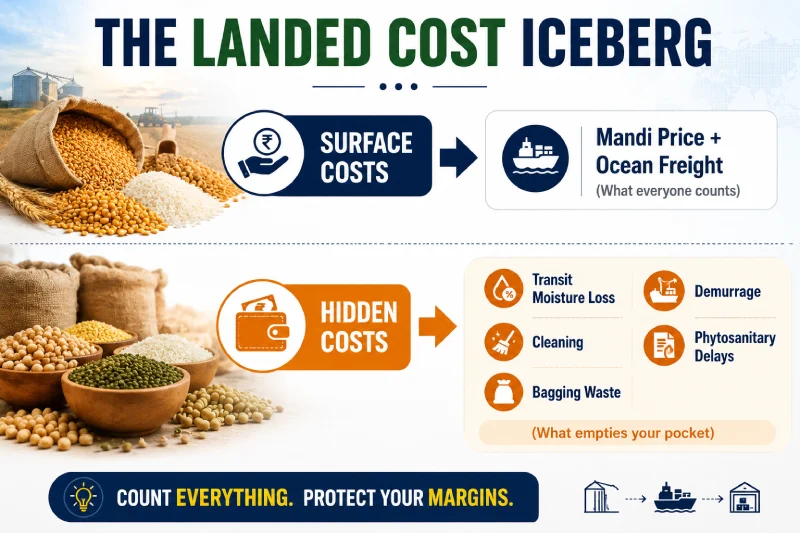
If you are trying to export edible oil in bulk or ship containers of premium pulses, your pricing baseline isn't just about what you paid the miller or the crushing plant. It is about anticipating the operational leaks that happen at every single handover point. Let’s break down the major hidden costs that most suppliers completely overlook until it's too late.
1. The Invisible Drain: Transit Moisture Loss and Invisible Shortages
This is the biggest silent killer in bulk grain and spice trading. Let's say you buy 100 metric tons of raw grain at a local mandi, and the moisture level at the time of loading is 14%. During a thirty-day sea voyage through hot tropical shipping lanes, that grain is going to sweat, dry out, and release its internal water vapor through the container vents.
By the time the vessel drops anchor at the destination port, that exact same batch might dry down to 13% moisture. On paper, you shipped 100 tons. In reality, your buyer's automated terminal scale is only going to register 99 tons of physical product.
If your agro export pricing model doesn't intentionally build in a 1% to 2% buffer for natural weight loss and shrinkage, you are essentially giving away thousands of kilograms of free product on every single voyage.
2. The Mandi-to-Port Leakage: Inland Handling and Toll Surprises
The highway run from agricultural hubs like Madhya Pradesh, Rajasthan, or Haryana down to coastal gateways like Mundra or Nhava Sheva is rarely a smooth ride. New exporters often calculate a flat trucking rate but completely ignore the secondary costs of inland logistics:
- Mandi Cess and Local Taxes: Depending on the state of origin, clearing a crop out of a local market yard requires paying specific market fees or state-level agricultural transit taxes that can quickly add up across multiple truckloads.
- Loading and "Kata" (Weighment) Charges: Every single time a truck is loaded at a local warehouse, weighed at an official toll station, and re-verified at an inland container depot, minor cash payments are required to keep the wheels turning.
- Stuffing and Bagging Waste: When moving goods like dried fruits in bulk, rough handling by manual labor during container stuffing can tear jute bags or smash high-value kernels, turning a percentage of your premium inventory into low-value dust before it even leaves the terminal shed.

3. The Regulatory Waiting Game: Testing, Certificates, and Detentions
Agricultural goods face more border scrutiny than almost any other product class on earth. Your shipment cannot just clear customs; it has to pass strict bio-security filters.
Take a standard deal to export millets in bulk or ship whole seed spices. Before your container can gate-in at the port, it must be inspected by a Plant Quarantine official to secure a Phytosanitary Certificate. If the inspector finds a minor documentation mismatch, or if a third-party laboratory takes five days instead of two to clear your pesticide residue scan, your truck sits idle.
This is where the dreaded hidden export costs of demurrage and detention kick in. Truck operators will charge you daily detention fees for holding their fleet, and if your container is stuck inside the port yard waiting for a clearance stamp, the port terminal will hit you with escalating ground-rent charges that can easily wipe out your entire profit margin in less than a week.
The Master Blueprint: True Landed Cost Calculation Sheet
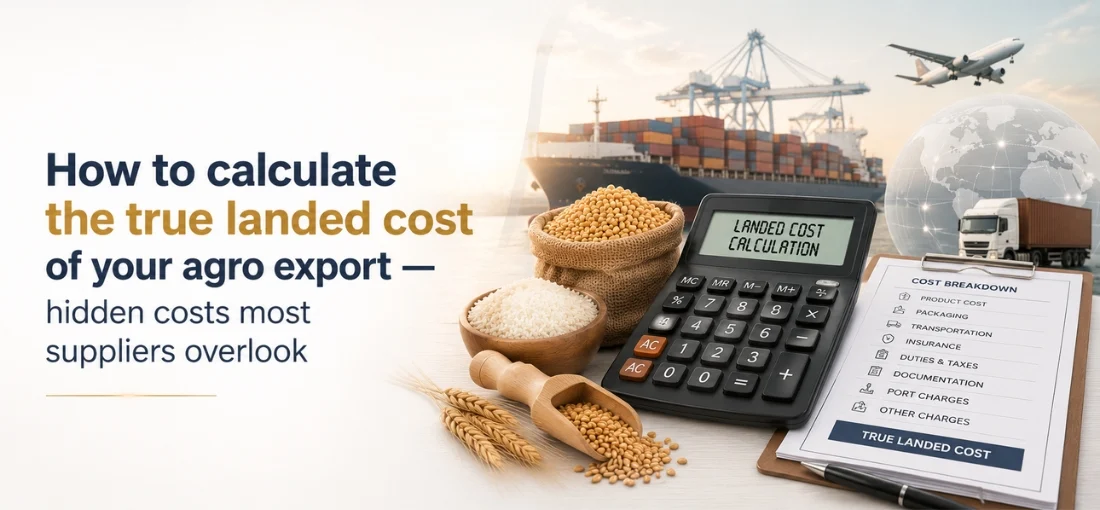
To keep your trade margins fully protected, you need an exhaustive, itemized view of your expenses. Here is how a professional trading desk structures an agro export landed cost sheet for a typical containerized shipment:
Itemized Landed Cost Breakdown for Indian Agro Exports
| Operational Stage | Direct Cost Component | How It Is Calculated | The Hidden Risk Factor |
|---|---|---|---|
| Origin Sourcing | Mandi Spot Price | Per Metric Ton (MT) basis | Quality variations between spot samples and actual bulk lots. |
| Local Procurement | Mandi Cess & Loading | State agricultural tax + manual labor rates | Sudden mid-season changes in state market fees. |
| Inland Transit | Reefer / Dry Trucking | Flat route rate from mandi to port | Highway delays, fuel surcharges, and festive driver shortages. |
| Pre-Loading Care | Warehouse Fumigation | Cost per container for Phosphine/Aluminium Phosphide | Live weevil discoveries at port causing mandatory re-fumigation. |
| Export Compliance | APEDA & Phytosanitary | Statutory inspection and certificate fees | Lab backlogs stalling shipments and triggering truck detentions. |
| Ocean Logistics | Freight & Origin Terminal | Carrier ocean freight + Terminal Handling Charges (THC) | Sudden peak-season space crunches and container roll-over fees. |
| Transit Allowance | Moisture Loss Buffer | Deduct 1% to 1.5% from gross weight billings | Extreme maritime heat causing heavy sweating and weight shrinkage. |
4. The Destination Shock: Unloading, Duties, and Hidden Surcharges
A common mistake is thinking your financial responsibility ends completely the moment you hand over a CIF shipment. Even if the buyer is handling the final import customs clearance, unexpected friction at the discharge port can travel right back up the supply chain to your desk.
If you are shipping to markets with highly complex customs regimes—like the European Union or the GCC—your cargo might face mandatory random sampling at the border. If an overseas inspector decides to pull your bulk edible oil container aside for an intensive heavy-metal scan, the container will sit in a specialized customs bonded zone.
If your sales contract doesn't explicitly state who bears the cost of unexpected destination port storage and customs testing delays, you might find yourself stuck in a bitter legal dispute with your buyer while your container racks up hundreds of dollars a day in terminal penalties.
The Tactical Verdict
In the high-volume world of international food trading, the difference between a highly successful export house and a bankrupt operation comes down to decimal points on a spreadsheet. Hunting for the absolute cheapest trucking rate or the lowest ocean freight quote won't save a deal if you are blind to the operational leaks happening along the highway and inside the port yard.
Real commercial success in agro commodity logistics management belongs to the suppliers who build a cushion for reality right into their pricing models. Take your time to thoroughly map out every single physical mile of your supply chain. Factor in the moisture loss, budget for a few days of potential port delays, and make sure your local mandi-level handling expenses are tracked with absolute precision. When you know your true landed cost down to the exact paisa, you gain the ultimate edge in international trade: the power to quote competitive, bulletproof prices to global buyers with the absolute certainty that your bottom line is safe.
Disclaimer
The information provided is for educational and informational purposes only. Freight rates, port charges, mandi fees, compliance costs, customs procedures, and logistics expenses may vary by commodity, route, destination, and market conditions. Exporters should independently verify all operational costs and consult logistics, customs, and trade professionals before making pricing or export decisions.