Key Highlights
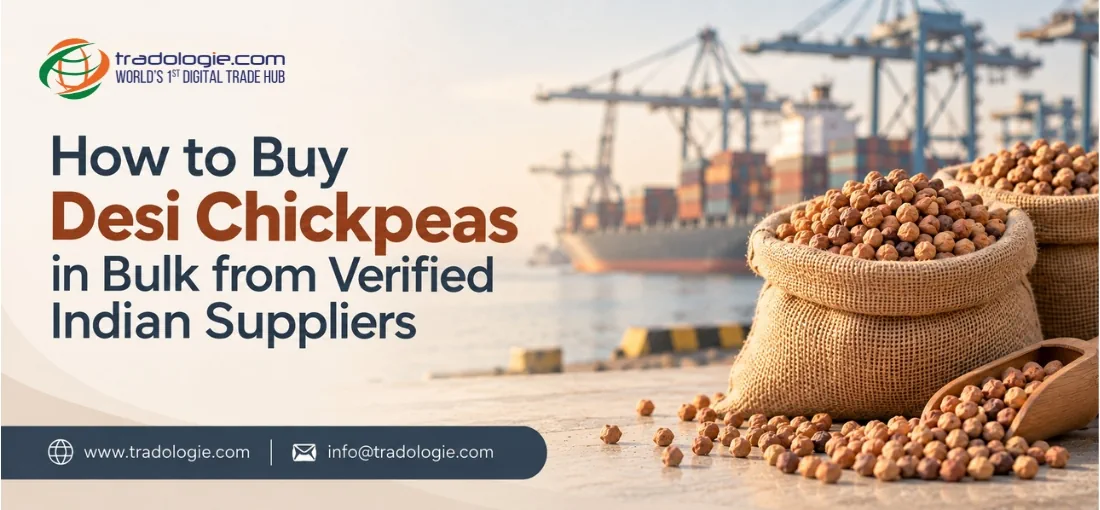
- Desi chickpeas are smaller and darker than Kabuli chickpeas.
- India is one of the world's major chickpea-producing countries.
- Maharashtra, Madhya Pradesh and Rajasthan are key production states.
- Desi chickpeas are used for chana dal, besan, snacks and whole-grain markets.
- Buyers should check size, moisture, foreign matter and damaged grains.
- Satyam Traders, Trust International and AGT Foods India are listed suppliers.
- Rajat Global and Laxmi Agro Processors also offer bulk Desi chickpeas.
- Landed cost matters more than the lowest initial quotation.
Introduction:
Buying desi chickpeas in commercial quantities is a rather different exercise from buying a packet of chana for the kitchen. A pulse mill may be looking for grain that splits cleanly and gives a predictable recovery, a besan manufacturer may be more concerned with milling yield, while a food distributor could be focused on uniformity, cleanliness and shelf life. By the time the requirement runs into truckloads or container quantities, the specification becomes almost as important as the Desi Chickpeas Price.
And the market itself is sizable. India remains among the world's largest Desi Chickpeas Suppliers. APEDA puts India's total pulse production at 274.09 lakh tonnes for 2025-26 and says the country exported 1,000,547 tonnes of pulses worth US$969.53 million during the year and chickpea was among the major commodities in it.
Desi chickpeas are only one part of those figures, but they sit right in the middle of India's domestic pulse economy.

Desi Chickpeas Are Not the Same Market as Kabuli
The Basic Difference Between Desi Chickpeas and Kabuli Chickpeas
The distinction between desi and Kabuli chickpeas is easy enough to see once the two are placed side by side.
Desi chickpeas are generally smaller, darker and covered by a thicker seed coat. Kabuli chickpeas are larger and pale or cream-coloured. The difference is not merely cosmetic. The two types have developed around different culinary uses and buyer preferences.
Desi chickpeas are particularly important in South Asian food markets. They can be eaten whole, roasted, split and dehulled into chana dal, or milled into besan. That last use creates a substantial processing market because the grain does not necessarily have to reach the consumer as a whole pulse.
ICAR's Indian Institute of Pulses Research lists several released desi chickpea varieties with different seed sizes and agronomic characteristics. IPC 2006-77, for example, has a reported 100-seed weight of 16.5 grams and protein content above 24%, while the newer Kundan variety, released in 2024, is a machine-harvestable desi type with a reported 100-seed weight of 14.7 grams.
So even within “desi chickpeas”, the grain is not one uniform commodity.
Where Indian Desi Chickpeas Come From
Major Chickpea-Producing Regions
Chickpea cultivation is spread across several parts of India, although a few states account for a large share of production.
ICAR-IIPR identifies Maharashtra, Madhya Pradesh, Rajasthan, Gujarat and Uttar Pradesh among the major chickpea-producing states. Its crop information records 13.75 million tonnes of Indian chickpea production in 2021–22, with Maharashtra contributing 25.97%, Madhya Pradesh 18.59%, Rajasthan 20.65%, Gujarat 10.10% and Uttar Pradesh 5.64%.
That geographical spread is useful for bulk buyers.
A processor does not necessarily have to source every lot from the same district, but origin can influence the grain characteristics, harvest timing and availability. In a tight market, the ability of a supplier to source from more than one production belt can also become useful.
For a buyer, therefore, asking “Where is the chickpea from?” is not a ceremonial question. It can tell you quite a bit about the supply behind the quotation.
What Makes a Good Desi Chickpea Lot?
Quality Parameters Buyers Should Compare
The answer depends on what the buyer plans to do with it.
A trader buying whole grain for wholesale distribution may be particularly concerned with appearance, uniformity and cleanliness. A dal processor will look at factors affecting dehusking and splitting. A besan manufacturer may have a different preference altogether because milling performance and flour yield become more important.
There are a few parameters that tend to come up repeatedly:
| Quality Parameter | Why It Matters |
|---|---|
| Grain size | Influences grading, processing and buyer preference |
| Moisture | Important for storage stability and milling |
| Foreign matter | Directly affects cleaning requirements and usable yield |
| Admixture | Indicates how uniform the lot is |
| Damaged grains | Can affect appearance and processing performance |
| Discoloured grains | Relevant for food appearance and grading |
| Insect damage | Important for quality and storage |
| Broken grains | Particularly relevant where whole-grain appearance matters |
| Test weight | Useful for assessing physical quality and handling |
| Microbiological quality | Important for food-processing and export applications |
There is no single number that makes every desi chickpea shipment “premium”. A flour mill and a packaged-pulse company can reasonably want different things from the same crop.
That is why the purchase specification should be agreed before the supplier starts quoting.

Desi Chickpeas Price Moves With More Than the Crop
Why Mandi Prices Are Only One Benchmark
Anyone searching for the Desi Chickpeas Price will quickly discover that there is no single India-wide number that can be used for every transaction.
On September 22, 2026, for example, whole Bengal gram at Sehore APMC in Madhya Pradesh was quoted at a modal price of ₹6,450 per quintal for the listed “Desi (F.A.Q. Split)” variety. At Ashta APMC in the same district, Bengal gram was quoted between ₹5,270 and ₹8,461 per quintal, with a modal price of ₹6,750. Dewas APMC reported Bengal gram at ₹6,399 per quintal on September 21.
These are mandi references, not delivered bulk-export prices.
Once grain moves from the producing area to a processor, warehouse, port or buyer's factory, cleaning, grading, packing, finance, transport and handling enter the calculation. A container-load export quotation can therefore look quite different from a mandi price even when the underlying crop is the same.
There is another useful benchmark. India's minimum support price for chickpea for the 2025-26 rabi crop was fixed at ₹58,750 per tonne, up from ₹56,500 the previous year.
MSP is not a wholesale market quotation either. It simply gives some context to the economics around the crop.
Buying Desi Chickpeas in Bulk Starts With the End Use
Match the Grade to the Application
This is where many procurement conversations become unnecessarily complicated.
A buyer should first decide what the chickpeas are supposed to do.
If the requirement is for whole grain retail packs, uniformity and appearance will probably carry considerable weight. If the shipment is going to a dal mill, the conversation moves towards splitting performance, husk removal and recovery. For a besan manufacturer, the useful question may be how efficiently the grain converts into flour.
The same supplier can potentially serve all three, but the specification should not be identical by default.
Bulk quantity also needs to be defined properly. “One truck” or “one container” is not a specification. The buyer should know the required net weight, packing format, tolerance, delivery point and whether the price is ex-warehouse, delivered, FOB or another basis.
Only then does the quotation become genuinely comparable.
What to Check With Desi Chickpeas Suppliers
Bulk Desi Chickpeas Supplier Capacity and Quality Checks
There are plenty of Desi Chickpeas Suppliers in India, ranging from local pulse traders to processors with export facilities.
The first question should be whether the supplier actually handles the quantity being discussed.
A company selling 20 or 50 tonnes a month is operating differently from one arranging several hundred tonnes across multiple destinations. Neither is automatically better. What matters is whether the supplier's sourcing, cleaning, storage and dispatch capacity matches the buyer's requirement.
Then come the less glamorous questions.
Can the supplier provide a recent sample? Is the grain machine-cleaned or manually cleaned? What is the agreed moisture level? What is the maximum foreign matter and admixture? How are damaged and discoloured grains treated? Is fumigation used, and can the relevant treatment records be provided where required?
For food manufacturers, a batch-level certificate of analysis can be useful as well.
The supplier's ability to repeat the same grade is often more important than the quality of one particularly good sample.
Indian Desi Chickpeas for Wholesale Trade
Top Desi Chickpeas Suppliers from India
The Desi Chickpeas Wholesale market includes several very different businesses.
A wholesale distributor may buy cleaned whole chickpeas and move them into regional markets. A pulse mill is purchased for processing. A food manufacturer may be buying specifically for flour, snacks or prepared foods. An overseas importer may want whole grain in export packaging.
This is why a wholesale quotation without a specification attached to it does not tell the buyer very much.
Volza's shipment data currently identifies 24 Indian suppliers specifically under its desi chickpea supplier dataset. Among the higher-volume names in that dataset are Satyam Traders, Trust International and AGT Foods India Pvt Ltd. The data records seven shipments each for the first two and four for AGT Foods India in the period covered by its analysis.
| Supplier | Location / Profile | Desi Chickpea Offering | Basis for Inclusion |
|---|---|---|---|
| Satyam Traders | Vyara, Gujarat | Desi and Kabuli chickpeas for export and bulk supply | Listed among the leading desi chickpea suppliers in Volza's shipment dataset; company site also states it handles Desi and Kabuli chickpeas |
| Trust International | Kolkata, West Bengal | Desi chickpeas and other agricultural commodities | Listed among the leading desi chickpea suppliers in Volza's shipment dataset |
| AGT Foods India Pvt Ltd | India; Mumbai and Kolkata offices | Pulses, grains and staple foods, including chickpeas | Listed among the leading desi chickpea suppliers in Volza's shipment dataset; AGT Foods India confirms its pulse processing, importing and exporting operations |
| Rajat Global | Indore, Madhya Pradesh | Bulk Kabuli and Desi chickpeas (Bengal Gram) | Publicly states that it supplies and exports Desi chickpeas for global B2B buyers |
| Laxmi Agro Processors | Chopda, Jalgaon, Maharashtra | Lal Chana and V2 Desi chickpeas; Sortex-cleaned export lots | Publicly states that it supplies export-ready Desi chickpeas and operates its own cleaning, grading and Sortex facility |
That should be read as shipment evidence, not a definitive ranking of India's largest desi chickpea companies. Trade databases capture observed shipments and can differ in coverage.
Other Indian businesses publicly market bulk chickpeas for domestic and export trade, including Rajat Global, which states that it handles both Kabuli and Desi chickpeas, and Laxmi Agro Processors, which says it sources chickpeas directly from farmers and supplies export-ready container loads from Maharashtra.
For an actual purchase, the supplier's current stock, specification and documentation still need to be verified directly.
Desi Chickpeas Exporters Have Another Set of Requirements
Export Documentation and Destination Requirements
The export side adds a few more moving parts.
India's export classification identifies Bengal gram (desi chana) under HS code 07132020 , within the broader chickpea heading 071320. DGFT's export schedule lists this item as “Free” subject to the applicable policy conditions.
The buyer and exporter still need to check the current policy conditions, customs requirements and destination-country rules before shipment. A product being listed as “Free” in the export schedule does not remove the need for normal export documentation or food-safety compliance.
For Desi Chickpeas Exporters , quality documentation becomes particularly important when the buyer is importing for human consumption. Depending on the destination and contract, this can include specifications, certificate of analysis, phytosanitary documentation, fumigation or treatment records, certificate of origin and other shipment documents.
The destination matters too. An importer in the Middle East may have a different specification from a processor in Southeast Asia or a packaged-food buyer in Europe.
What Desi Chickpeas Importers Should Ask Indian Suppliers
The Buying Specification to Send Suppliers
For Desi Chickpeas Importers, the easiest way to avoid confusion is to send a proper buying specification before asking for the price.
It should state the chickpea type, origin preference if any, size range, moisture, foreign matter, damaged grains, admixture, packaging, quantity and delivery terms.
If the product is intended for splitting or milling, that should be stated as well. A supplier who knows the end use can quote a more appropriate grade instead of simply offering whatever whole chana happens to be available.
The buyer should also ask for a representative sample before committing to a large shipment.
And when the sample is approved, the specification should be tied to the purchase contract. Otherwise, “approved sample” can become a surprisingly loose phrase once the actual truck or container is being loaded.
How to Build a Reliable Bulk Purchase
Compare on Landed Cost, Not Just the Quotation
There is no complicated formula here.
Start with the application. Fix the specification. Ask several suppliers to quote on exactly the same basis. Compare the grain, not just the number on the quotation. Then look at the logistics.
A supplier offering ₹500 less per tonne is not necessarily cheaper if the grain contains more foreign matter or requires additional cleaning at the buyer's facility. Similarly, a low ex-warehouse price may cease to look attractive once transport to the destination is added.
For international buyers, the comparison needs to go one step further. FOB, CFR and CIF prices are not interchangeable, and neither are port charges, inland transport and insurance.
The useful price is the landed cost of the specification you actually need.
Why Indian Desi Chickpeas Continue to Matter
India's Supply Base and Processing Network
India's chickpea industry has something that is difficult to replicate quickly: a large domestic crop, established processing infrastructure and a deeply rooted consumer market.
Desi chickpeas are used in everyday food, but their commercial role extends well beyond the household kitchen. They feed the chana dal trade, the besan industry, snack manufacturing and a range of wholesale and export channels.
For buyers, that creates plenty of sourcing options. It also means that there is little reason to purchase blindly.
A good Bulk Desi Chickpeas Supplier should be able to tell you where the grain came from, what grade it is, how it was cleaned and what quantity can be supplied again. Once those questions are answered, the price becomes much easier to understand.
Conclusion
Buying desi chickpeas in bulk is less about finding the cheapest available grain and more about matching the right specification with a dependable supply source. Origin, size, moisture, cleanliness, processing performance and logistics can all change the economics of a shipment. Indian suppliers offer access to a large and established chickpea market, but buyers should compare samples, specifications and delivered costs before committing. For repeat trade, consistency from one shipment to the next is what ultimately matters.
Want to export or import chickpeas in bulk globally? Register as a buyer or seller on Tradologie today.
Disclaimer
This content is for general informational purposes and is based on the trade, pricing, supplier and regulatory information provided in the source material. The supplier names are based on shipment data and publicly stated capabilities, not a definitive ranking of India's largest Desi chickpea companies. Buyers should independently verify current stock, specifications, certifications, documentation and commercial terms before placing an order.



.webp "India Pulses Sourcing Guide 2026 — Buyers, Prices & Export Steps")