.webp "Future of Agro Export Business from India (2026 Outlook)")
Key Highlights
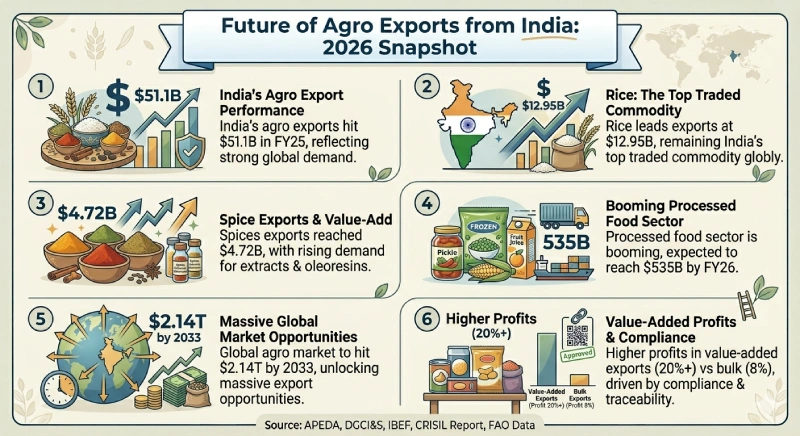
- India’s agro exports reached $51.1 billion in FY25, showing strong global demand
- Rice remains the top export with $12.95 billion value, dominating global trade.
- Spices exports touched $4.72 billion, with growing demand for extracts and oleoresins.
- Processed food exports are rising, with the sector expected to reach $535 billion by FY26.
- The global agro market is projected to hit $2.14 trillion by 2033, creating export opportunities.
- Profit margins range from 8% in bulk commodities to 20%+ in value-added exports.
- Top markets include UAE, Saudi Arabia, USA, Iraq, and Vietnam.
- Growth driven by MRL compliance, traceability, and value-added products.
- Government support via PLI scheme and ₹1.3 lakh crore agriculture budget boosts exports.
Introduction:
The trajectory of Indian agricultural trade has moved past just volume-based growth. For 2026, the Future of Agro Exports from India is defined by a hard shift into high-spec, value-added products that prioritize Maximum Residue Limit (MRL) compliance and climate-resilient crop varieties. We are seeing a market that no longer competes solely on price, but on the technical reliability of the supply chain and the traceability of the source.

The economic weight is significant.
According to the Press Information Bureau (PIB), India’s agricultural exports reached $51.1 billion in FY25, a figure reflecting a structural diversification into processed categories and specialized cereals. As we move into 2026, the real opportunity isn't just in "more" tonnage. It’s in navigating the tightening quality standards of the EU and the surging industrial demand in the Middle East and Southeast Asia.
The margin for error is shrinking. For the exporter who can master the certifications—especially for high-demand commodities like rice and spices—the commercial upside is unprecedented.
India’s Agro Export Landscape: Current Market Overview
The sheer inertia of India’s agricultural trade has shifted into high gear. This isn't just about feeding local demand anymore; it’s about a massive, surplus-driven exit into global markets. While traditional heavyweights still anchor the flows, we are seeing aggressive growth in categories that were previously considered "niche".
Key Performance Metrics & Top Commodities
- The Rice Dominance: Rice remains the undisputed king of the basket, with exports reaching $12.95 billion in 2024-25. Whether it’s Basmati to the Middle East or non-basmati to Africa, the volume is staggering.
- The Spices Surge: India exported $4.72 billion worth of spices in FY25. This isn't just raw chili and turmeric; it’s increasingly about value-added extracts and oleoresins.
- The Meat & Marine Factor: Buffalo meat ($3.69 billion) and marine products ($7.45 billion) provide a massive, stable floor for the export total.
- Emerging Categories: We are seeing a quiet but violent growth in "Other Cereals" (millets, maize) and processed fruits/juices, which collectively accounted for over $1.6 billion in the recent cycle
Top Global Markets: Where the Cargo is Heading
The destination map is becoming more technical. It's no longer just about who is hungry; it's about who has the logistical pipes to handle Indian volume. According to APEDA and DGCIS data, the top five importing nations for Indian agro products in 2024-25 were the UAE, Saudi Arabia, the USA, Iraq, and Vietnam.

The UAE and Saudi Arabia are the primary drivers for high-value Basmati and spices, while the US remains a critical market for processed foods and organic products where traceability is the only currency that matters. In 2026, Agro Export Business India is no longer just a commodity game—it’s a data game. If you don't know your curcumin levels or your MRL limits, you aren't in the trade; you're just a spectator.
Key Growth Drivers Shaping the Future of Agro Exports from India
The 2026 landscape has pivoted from shipping raw surpluses to a calculated play into global scarcity. If you're still looking at the Future of Agro Exports from India as a simple "volume play," you're reading the wrong map. Success now is about technical specificity.
The 2026 Tactical Pillars
- Policy-Driven Muscle: The Government is subsidizing the technical transition. According to the Press Information Bureau (PIB), the PLI Scheme for Food Processing has been extended through FY 2026–27 with a financial outlay of ₹10,900 crore.
- The Surge in "Specialized" Demand: The global agricultural commodity market is projected to reach US$ 2,146.35 billion by 2033, growing at a 3.64% CAGR starting in 2026. We are seeing a 20.4% jump in the share of processed food exports—a clear signal that the world wants "Ready-to-Use" Indian agro-assets.
- Budgetary Firepower: According to the Union Budget 2026-27, the Department of Agriculture has been allocated ₹1,30,561.38 crore, with a hyper-focus on coastal region crops like coconut and sandalwood. It’s a diversification strategy designed to stop India from being a "single-commodity" export risk.
- The Digital Trade Corridor: Digital B2B platforms are now the primary engine for cross-border trade, providing the traceability that the EU and US markets demand.
For the early mover, the signal is clear: the volume is there, but the profit is in the precision. According to Mordor Intelligence, India's agriculture market is expected to reach US$ 471.03 billion by 2026.
Top Agro Commodities Driving India’s Export Growth
The inertia of India’s agricultural trade has shifted into high gear for 2026. While traditional heavyweights like rice and spices still anchor the flows, we are seeing a massive realignment toward specialized, high-margin categories.
| Commodity | Export Share (Approx.) | Key Markets |
|---|---|---|
| Rice (Basmati + Non-Basmati) | ~25% | Iran, Saudi Arabia, UAE, Indonesia, Africa |
| Spices | ~11% | USA, China, UAE, Bangladesh, Germany |
| Sugar | ~7% | Sudan, Indonesia, UAE, Bangladesh |
| Marine Products | ~14% | USA, China, Japan, Vietnam |
| Buffalo Meat | ~8% | Vietnam, Malaysia, Egypt, Iraq |
Data compiled based on APEDA, DGCIS, and PIB reports (FY 2025-26).
Emerging Opportunities in Indian Agro Exports (2026 & Beyond)
The era of shipping "raw and bulk" is hitting a ceiling. For 2026, the real commercial gravity has shifted toward specialized categories where the certificate is as valuable as the cargo.
- The Organic & GI-Tagged Surge: The EU-India Free Trade Agreement (FTA) has opened a projected $60 billion opportunity for Indian organic product exporters
- The Processed Food Engine: India's food processing sector is expected to scale to $535 billion by FY26. This isn't just about canning; it’s about specialized ingredients that meet urban demand in the US and EU.
- According to USDA FAS reports, value-added agro exports and processed food products are expected to grow rapidly, currently accounting for approximately 32% of India's food market.
Is Agro Export Business Profitable in India in 2026?
The short answer is yes, but the era of "easy" profits through simple arbitrage is dead. In 2026, profitability is dictated by your position in the value chain. If you are moving raw grains, you are fighting for 5–8% margins. However, exporters focusing on value-added products—like organic-certified pulses—are seeing margins climb to 15–25%.
Profitability Matrix 2026
| Factor | Impact on Profit | Outlook |
|---|---|---|
| Global Demand | High | Surging demand for Indian non-basmati and processed foods. |
| Profit Margins | Moderate–High | 8% for bulk; 20%+ for processed/certified organic. |
| Business Risk | Medium | Managed through credit insurance and hedging. |
| Scalability | High | Massive government backing via export incentives. |
Analysis grounded in APEDA Trade Performance data and Ministry of Commerce FY26 projections
Challenges in the Future of Agro Exports from India
The trajectory of the Future of Agro Exports from India isn't without friction. While the volume is record-breaking, regulatory hurdles are becoming more technical. The primary "margin killers" in 2026 are the tightening Maximum Residue Limit (MRL) standards in the EU and North America. A single shipment failing a pesticide test doesn't just result in a loss; it blacklists the exporter.
Critical Pressure Points 2026
- Quality Consistency: Rising rejection rates due to non-compliance with international "Zero-Residue" norms
- Logistical Lag: Gaps in farm-to-port cold storage leading to 15–20% wastage in high-value perishables.
- Trade Barriers: Sudden shifts in export duties or floor prices (MEP) to stabilize domestic inflation.
- Price Volatility: Fluctuating input costs making long-term contract pricing a high-stakes gamble.
In today’s global trade environment, exporters increasingly rely on structured platforms that enable direct interaction with verified buyers across multiple countries. These systems streamline bulk trade by ensuring transparency in pricing, quantity, and payment processes, making it easier for suppliers to scale internationally. Connect with verified buyers
Conclusion:
The 2026 outlook for Indian agro exports isn't a story of "more of the same"; it’s a narrative of forced evolution. We are witnessing a structural reset where the certificate is now as valuable as the cargo. As global markets tighten their grip on MRL standards and traceability, the "bulk and raw" model is hitting a terminal ceiling.The future belongs to the technical exporter. Those who master value-added processing will capture premium 25% margins; those who ignore the data will fight for crumbs. It’s no longer an invitation for everyone—it’s a precise, technical race. Move on data, or don't move at all.
Disclaimer
The information provided in this article is based on industry reports, government data, and publicly available sources such as PIB, APEDA, DGCIS, and USDA. Export figures, market projections, and profitability estimates may vary depending on global demand, policy changes, and logistics conditions. Readers are advised to verify compliance requirements, certifications, and trade regulations before engaging in export activities.
Writer Profile
Pravarsh Sharma – Trade Export Specialist, Tradologie.com
Pravarsh Sharma is a trade export specialist at Tradologie.com, directly involved in international trade facilitation and B2B agro-commodity sourcing. With hands-on experience in global supply chains, compliance requirements, and cross-border transactions, he provides practical insights into export strategies, market trends, and trade opportunities. His focus is on helping businesses navigate global markets with clarity, efficiency, and real-world execution.