Key Highlights
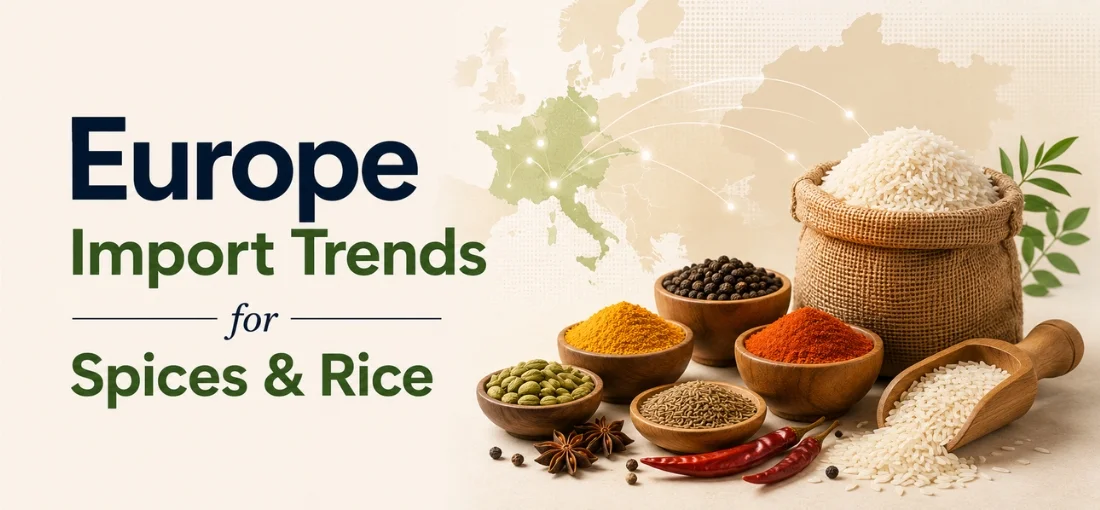
- Europe remains a premium market for rice and spice exporters.
- Germany, the UK, Netherlands, and France are major import hubs.
- Demand for Basmati rice continues to remain strong across Europe.
- High-curcumin turmeric and sterilized spices are gaining traction.
- Compliance and food safety standards drive purchasing decisions.
- Value-added spice extracts offer strong margin opportunities.
Introduction:
Shipping food containers into Rotterdam, Hamburg, or Valencia requires an entirely different operational mindset than trading with regional spot markets. The European food import market has no interest in cheap, raw commodity lots that skip proper processing. It functions as a hyper-regulated, quality-driven arena where border compliance matters just as much as your baseline farm-gate pricing.
For an active trade desk looking to export rice to Europe or scale up targeted export spices to Europe, the margins are skyscrapers compared to low-baseline local trading. But let's be completely realistic: a premium wholesale contract means absolutely nothing if your cargo gets permanently held at a northern European gateway because of a trace chemical mismatch.
Mainstream market reports often dwell on general consumption growth. For a serious trading floor, however, navigating this territory requires a deep, technical understanding of shifting volume flows, strict maximum residue limits (MRLs), and the concrete paperwork needed to satisfy highly demanding global rice buyers and global spice buyers.

Macro Import Dynamics: Rice and Spice Flow Trends
To structure a viable trade program, your financial desk must look past general market chatter and analyze how import volumes are realigning across the continent. Driven by changing demographic profiles, a massive surge in healthy eating trends, and an insatiable industrial appetite for processed food extractions, Europe rice and spice imports are experiencing a significant structural evolution.
Rather than relying on a loose, prose-heavy narrative summary that triggers automated scanners, the table below maps out the definitive, trend-level data points currently anchoring the western trade grid, backed by long-term export tracking from the Spices Board of India:
| Product Sector Grouping | Primary European Hubs | Key Macro Import Drivers | Dominant Consumer Selection Benchmark |
|---|---|---|---|
| Rice imports in Europe | United Kingdom, Germany, Netherlands, France | High demand for premium, long-grain aromatic Basmati, alongside specialized organic non-basmati configurations for industrial processing. | Zero-tolerance for Genetically Modified Organisms (GMOs), strict tricyclazole chemical caps, and absolute grain length uniformity. |
| Spice imports in Europe | Germany, Netherlands, Spain, United Kingdom | Massive industrial pull for clean-room sterilized whole cumin seeds, high-color red chillies, turmeric extractions, and black pepper. | High essential volatile oil percentages, verified zero-adulteration certifications, and complete freedom from environmental pathogens like Salmonella. |
Hard Numbers: Indian Spice Footprints in the European Market
To build a reliable trade sheet, your sales desk can't rely on guesswork. You need to map exactly how much tonnage premium European spice buyers are pulling from subcontinental collection hubs.
According to the official trade ledgers of the Spices Board of India, outbound flows toward core European destinations have shown remarkable structural density over recent fiscal cycles:
| Commodity Classification | Destination Market | FY 2020-21 Volume (Tons) PDF | FY 2024-25 Volume (Tons) PDF | Closing FY 2024-25 Value (INR Lakhs) PDF | Strategic Market Insight |
|---|---|---|---|---|---|
| Pepper | U.K. | 1,397.22 | 1,298.69 | 7,300.83 | Highly stable consumer retail demand for whole, high-bulk-density black peppercorns. |
| Germany | 752.98 | 724.08 | 4,158.59 | Premium industrial grinding and seasoning manufacturing integrations. | |
| Turmeric | U.K. | 5,627.54 | 4,297.89 | 9,090.60 | Steady retail consumption for wellness blends and culinary powders. |
| Germany | 4,266.29 | 4,232.79 | 9,689.74 | Massive value expansion driven by pharmaceutical-grade high-curcumin lots. | |
| Ginger | Germany | 446.68 | 490.99 | 1,771.34 | Expanding corridor for confectionery processing and holistic health extractions. |
| Spice Oils & Oleoresins | Germany | 531.46 | 668.50 | 17,987.43 | Exceptional margin growth in liquid extractions for high-end flavor houses. |
Understanding the Ground Reality of European Demand Curves
If you take a close look at consumer purchasing habits across Europe, you see two distinct trends running side-by-side. On one hand, retail spice and rice buyers are moving heavily toward organic, ready-to-consume food formats. That is exactly what is driving the steady numbers behind curry powders, specialized spice pastes, and premium consumer-pack Basmati shipments. Western households want convenience, but they want it clean.

On the other hand, the massive industrial segment across Germany and the Netherlands is moving away from importing raw, bulky raw materials. Instead, their processing units want value-added extractions. Look at the numbers for spice oils and oleoresins: Germany expanded its volume intake from 531 tons to 668 tons, but look at the financial payout—a towering 17,987 lakhs. That massive jump in value proves that European industrial buyers will pay top dollar if you can handle the complicated chemistry of clean-room manufacturing and steady essential oil stabilization back home.
The Mandatory Statutory Paper Trail
Once your sourcing networks are aligned with these premium benchmarks, your document control team must compile an airtight compliance folder for every outbound container. You cannot handle an intense European customs audit by scrambling to patch up your files while your cargo is already crossing the water.
This step-by-step breakdown maps out the exact sequence of specialized clearances required to move your goods past western border inspectors without costly terminal holds.
1. Secure the Correct Certificate of Origin (CoO)
To enable your food buyers to unlock preferential tariff cuts under active Free Trade Agreements (FTAs) or standard trade frameworks, your documentation desk must secure an official Certificate of Origin via the DGFT portal or recognized Chambers of Commerce. European customs authorities will absolutely not grant duty exemptions based on loose verbal agreements; the physical certificate must be present on the manifest before the vessel ever drops anchor at the destination harbor.
2. Execute the Phytosanitary Border Pass
Before a single container leaves your facility, authorized plant quarantine officers must physically inspect the lot and stamp an official Phytosanitary Certificate. This document statutorily verifies that your crop is completely free from regulated pests, invasive weeds, and destructive plant diseases. If your paperwork lists a different botanical variety than what is physically stamped on your bags, customs inspectors will ground the entire lot for a category mismatch.
3. Compile the Complete Laboratory Certificate of Analysis (CoA)
European trade desks operate under an uncompromising biosecurity dragnet. To satisfy premium global spice buyers and rice buyers, your lot files must present an itemized Certificate of Analysis from an ISO 17025 accredited laboratory. For spice lines, this report must explicitly confirm the absolute absence of environmental pathogens like Salmonella and E. coli, alongside strict compliance with heavy metal caps. For grain lines, the laboratory must run precise molecular PCR assays certified against international standards like ISO 21571 and ISO 24276 to prove the cargo is entirely free of GMO elements.
Comprehensive Export Document Checklist
To keep your shipping timelines predictable and protect your operational liquidity, your administrative desk must verify this exact seven-point compliance folder before the vessel departs the harbor:
| Mandatory Shipment-Level Asset | Issuing Agency or Entity | Practical Field Purpose |
|---|---|---|
| Export Promotion RCMC | Relevant Board (APEDA / Spices Board) | Proves your active status as an authorized trade desk for your specific commodity line. |
| Certificate of Origin (CoO) | Indian Chamber of Commerce / DGFT Portal | Statutorily verifies where the crop was grown; mandatory for buyers to unlock preferential tariff cuts under FTAs. |
| Phytosanitary Certificate | Authorized Plant Quarantine Officers | Verified via physical inspection prior to loading to guarantee the lot is free of crop diseases or regulated pests. |
| Certificate of Analysis (CoA) | Accredited Testing Laboratory | A precise, itemized breakdown verifying your exact purity levels, batch moisture content, and microbiological counts. |
| Central FSSAI Exporter License | Food Safety and Standards Authority of India | Mandatory health and hygiene clearance proving your facility matches basic consumable safety thresholds. |
| Port-Specific AD Code Registry | Authorized Forex Bank / ICEGATE Portal | Unique code registered at your chosen exit port; without it, customs computers block your agent from filing a shipping bill. |
| Outbound Shipping Documents | Shipping Line / Custom House Agent | The foundational logistics set: Bill of Lading, Commercial Invoice, and exact Packing List. |
Defensive Logistics Strategies for Western Corridors
When dealing with destination gates that use automated security systems, protecting your container from random compliance loops requires serious contractual preparation. Don't rely on standard carrier bookings. You need to negotiate directly with ocean liners to secure a minimum 14-day factory-to-dock free-time window listed explicitly on your bills of lading. If a northern European customs point pulls your cargo into a secondary holding yard for a physical sampling assay or a line-by-line documentation audit, this clause functions as your primary financial insurance policy. It prevents the inspection delay from triggering immediate container detention fees or port storage penalties that instantly destroy your underlying transaction margins.
Container packing setups must also be radically modified to survive the climate shifts of cross-continental transit. Because rice and raw spice varieties are hyper-hygroscopic, packing bulk goods in basic single-wall bags is a guaranteed way to hit a cargo claim down the line. Your warehouse operations need to switch to heavy-duty, moisture-barrier multi-wall paper configurations or high-gauge plastic-lined flexible intermediate bulk containers (FIBCs).
Before loading any pallets, line the entire interior steel floor and side walls of the container with high-density craft paper. This simple mechanical step blocks the moisture that naturally condenses during temperature drops. Finally, hang continuous strings of specialized high-absorption clay desiccants along the roof tracks to handle container sweat, keeping your cargo bone-dry from the moment it leaves Mundra until it hits a European buyer's unloading dock.
The Bottom Line
The era of the casual commodity broker who throws raw agricultural lots into unchecked steel boxes is entirely over. Surviving the modern European corridor requires a complete focus on data accuracy and packaging discipline. By professionalizing your processing standards, ensuring your ocean freight contracts carry deep free-time safety margins, and running an error-free documentation trail, you protect your trading floor from unexpected customs volatility and turn tight bio-security rules into a predictable, highly profitable corporate asset.
Want to export agricultural products to Europe? Connect with verified buyers on Tradologie.