Key Highlights
- The major types of olive oil include Extra Virgin Olive Oil, Virgin Olive Oil, Refined Olive Oil, regular Olive Oil, Lampante Olive Oil and Olive Pomace Oil.
- Extra Virgin Olive Oil is the highest commercial grade of virgin olive oil, with a maximum acidity of 0.8% under International Olive Council (IOC) standards.
- Refined Olive Oil has a neutral flavour and is commonly used in commercial cooking and food manufacturing, while Olive Pomace Oil is produced from the residual material left after initial olive extraction.
- Palm, soybean, sunflower, rapeseed and olive oil are among the major products in the global edible oils market, valued at approximately US$250.78 billion in 2024.
- Spain, Italy, Portugal, Tunisia and Greece are among the leading olive oil exporters, with Spain recording approximately US$6.28 billion in exports in 2024.
Introduction :
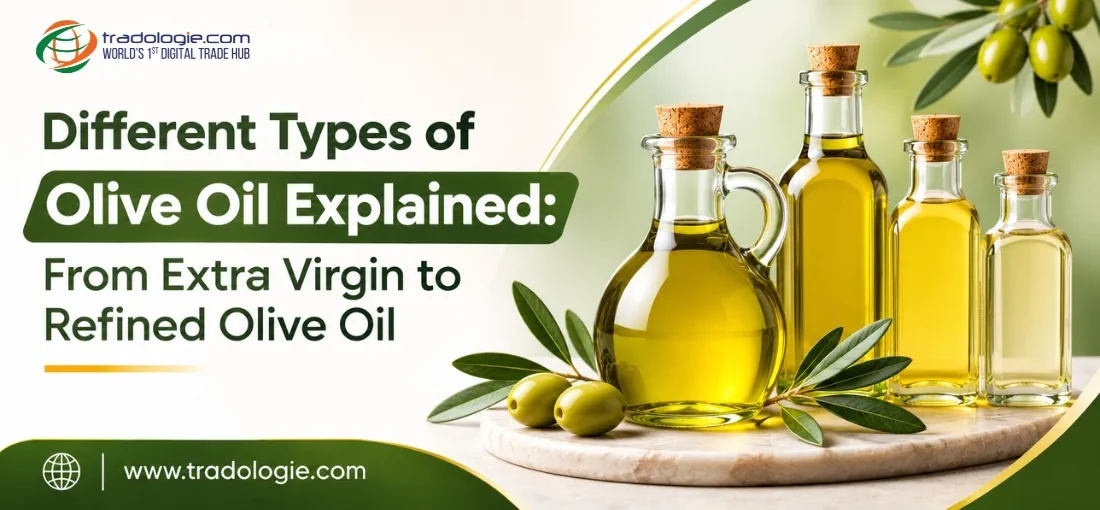
When it comes to different types of Olive oil , they come in distinct grades, each type having different production processes, quality, taste and applications. Understanding the different types will help you as a consumer, food manufacturer, importer or olive oil exporter . For example, extra virgin olive oil is generally associated with high-quality food products whilst refined olive oil is often used in commercial cooking. Finally, olive pomace oil is also available in the market.
Olive oil's significance can likewise be appreciated within the framework of the broader edible oil industry. MarketsandMarkets reports that the global edible oils market was worth about US$250.78 billion in 2024 and is expected to hit US$306.92 billion by 2029, expanding at a compound annual growth rate of roughly 4.1%. This wider market covers a number of major oils, including palm, soybean, sunflower, rapeseed and olive oil.
There are different varieties of olive oil based on how they are produced and their chemical and sensory properties. Virgin olive oil, refined oil, blended olive oil and olive pomace oil can all be found internationally.
In this guide we will examine different types of Olive oil . We will look at their grades, how they are produced and their characteristics.

Olive Oil Grades
Olive oil is produced from the fruit of the olive tree (Olea europaea). Virgin olive oil can be produced mechanically or physically without any chemical refining.
Based upon factors such as:
- Acidity
- Peroxide value (primary oxidation)
- Fatty acids and purity
- Fruity characteristics
- Bitterness and pungency
- Defects
The different grades of olive oil are determined by the International Olive Council (IOC) and other regulatory bodies. These factors include:
Whether it qualifies as extra virgin olive oil will depend on its acidity and whether it meets the relevant chemical, purity and sensory requirements.
Different Types of Olive Oil Globally
Extra Virgin Olive Oil
Extra virgin olive oil is the highest grade of virgin olive oil available commercially. This is mechanically or physically extracted directly from olives.
Extra virgin olive oil must meet stringent chemical and sensory requirements. The IOC standard specifies that it must have a maximum acidity level of 0.8g per 100g (as Oleic Acid) and comply with the relevant sensory requirements.
Qualities:
- Maximum acidity (0.8%)
- Mechanically or physically extracted.
- Not chemically refined.
- Fruity aroma and taste.
- May have bitterness and pungency depending on olive type and when harvested.
Uses:
- Salad dressings
- Dips
- Marinades
- Finishing oil
- High quality cooking oil
Extra virgin olive oil is highly important in the premium food industry. The price can vary considerably depending on where it is from, when it was harvested, what olive type it is, how it was produced, certification and packaging.
Virgin Olive Oil
Virgin olive oil is mechanically or physically extracted directly from the olive. It has less stringent requirements for chemical and sensory properties, so there may be more minor defects.
The IOC standard specifies that it can have a maximum acidity of 2g per 100g.
Qualities:
- Maximum acidity (2%).
- Not chemically refined.
- Can have minor sensory defects.
- Natural olive oil.
Uses:
- Cooking
- Food preparation
- Blending
Virgin olive oil occupies a different position in the market compared to extra virgin olive oil. Its suitability will depend on what it is being used for and the required quality specifications.
Refined Olive Oil
Refined olive oil can be produced by refining virgin olive oils that do not meet the requirements for direct consumption. During refinement, unwanted flavour, smell, colour etc. can be removed.
This can be achieved through neutralisation, bleaching and deodorising. This makes the oil easier to use, but many of its natural sensory properties are lost.
Qualities:
- Refined from virgin olive oil.
- Neutral aroma and flavour.
- Maximum acidity (0.3%) (IOC standard).
- Must meet the relevant purity and composition requirements.
Uses:
- Food manufacturing
- Commercial cooking
- Blending with virgin olive oil to create the retail category.
Refined olive oil is an important product in the industry as it offers a neutral flavour.
Olive Oil (Refined Olive Oil Blended with Virgin Olive Oil)
This type of oil is commonly sold simply as 'olive oil'. It is produced by blending refined olive oil and virgin olive oil.
The virgin olive oil will contribute some of the natural flavour and aroma.
Qualities:
- A blend of refined and virgin olive oil.
- Maximum acidity (1%) (IOC standard).
- Less flavour than extra virgin.
- More consistent sensory profile than many unrefined oils.
Uses:
- General cooking
- Frying
- Food preparation
- Restaurant kitchens
- Packaged products.
This category is widely used internationally as it combines the neutral profile of refined oil with some of the flavour of virgin oil.
Lampante Olive Oil
Lampante olive oil is a low-grade category of virgin olive oil. It does not meet the requirements for direct human consumption.
It is mechanically extracted but cannot be sold as edible virgin olive oil due to its chemical or sensory properties.
Qualities:
- Cannot be consumed directly.
- May have high acidity or significant sensory defects.
- Must be refined to produce edible refined olive oil.
The value of this type will depend on its quality, whether it requires refining and the market.
Uses:
- Refining
- Certain technical uses.
Lampante oil is an important category in the industry as it serves as a raw material for producing refined olive oil.
Olive Pomace Oil
Olive pomace oil is produced from the leftover olive pomace once the initial extraction has taken place. This contains olive skins, pulp, pieces of olive stones and residual oil.
The oil can be extracted using approved methods which may involve solvents. It can then be refined.
This type of oil differs from virgin olive oil as it is not produced exclusively through mechanical extraction.
Qualities:
- Produced from leftover olive pomace.
- Must be extracted and refined.
- Different production process.
- Available in different formats.
Uses:
- Commercial frying
- Food manufacturing
- Catering
Olive pomace oil can be found in different categories:
Crude Olive Pomace Oil
This is the oil extracted from the olive pomace. It is not a finished cooking oil.
Generally, it will need further processing to meet the requirements for refined olive pomace oil.
Qualities:
- Extracted from olive pomace.
- Not meant to be consumed directly.
- Must be refined and assessed for quality.
- Used as a raw material.
Uses:
- Refining
- Processing into other categories.
Refined Olive Pomace Oil
This is produced from crude olive pomace oil. It is refined to remove unwanted properties. It is not the same as refined olive oil which is produced from virgin olive oil.
Qualities:
- Produced from crude olive pomace oil.
- Neutral aroma and flavour.
- Maximum acidity (0.3%) (IOC standard).
- Used in blended olive pomace oil.
Uses:
- Food processing
- Commercial uses (depending on local regulations).
Olive Pomace Oil (Blended with Virgin Olive Oil)
This is a finished product. It is a blend of refined olive pomace oil and virgin olive oil.
The virgin olive oil will contribute some natural flavour characteristics.
Qualities:
- A blend of refined olive pomace oil and virgin olive oil.
- Must meet the relevant composition and quality requirements.
- Not the same as regular olive oil blended with refined oil.
- Different positioning in the market.
Uses:
- Food manufacturing
- Cooking (depending on regulations of the destination market).
Cold Extracted and Filtered Olive Oil
This is not a grade of olive oil but a production/processing characteristic. Cold extraction is when virgin or extra virgin olive oil is extracted at a temperature of less than 27°C using appropriate methods. This can be done using a centrifuge or percolation. 'First cold pressed’ is often associated with traditional hydraulic presses. There are specific labelling requirements for this in some markets such as the European Union.
Filtered olive oil has undergone filtration to remove suspended particles and moisture. Unfiltered olive oil will often appear cloudy as it contains some natural particles.
Qualities:
- Cold extraction refers to the temperature and method of extraction.
- Filtering affects clarity and suspended particles.
- Does not automatically mean it is a certain grade.
- Still needs to meet the relevant virgin/extra virgin requirements.
Uses:
- High quality packaging
- Food service
- Speciality foods
- Depending on the grade of oil.

Comparing Olive Oil Grades
| Olive Oil Type | Method of Production | Maximum Acidity (IOC) | Main Use |
|---|---|---|---|
| Extra Virgin Olive Oil | Mechanical | 0.8% | High quality foods and retail. |
| Virgin Olive Oil | Mechanical | 2.0% | Cooking and food preparation. |
| Refined Olive Oil | Refined from Virgin Olive Oil | 0.3% | Food manufacturing and blending. |
| Olive Oil (Blend) | Refined Olive Oil blended with Virgin Oil. | 1.0% | General cooking. |
| Lampante Olive Oil | Virgin extraction - Must be refined. | Not suitable for direct consumption. | Refining and technical uses. |
| Crude Olive Pomace Oil | Extracted from Olive Pomace. | N/A - Not suitable as a finished edible product. | Industrial refining. |
| Refined Olive Pomace Oil | Refined from Crude Olive Pomace. | 0.3% | Further blending. |
| Olive Pomace Oil (Blend) | Refined Olive Pomace Oil blended with Virgin Oil. | Depends on the relevant standard. | Food processing. |
Note: Acidity levels are based on the categories defined by the IOC. This does not automatically mean an oil qualifies for a certain grade. It must also meet the relevant chemical, purity and sensory requirements. Requirements can vary depending on the relevant country/region.
Olive Oil Types - Does the Olive Type Matter?
You should not confuse olive oil grades with olive types. Extra virgin, virgin and refined refer to the commercial categories based on production methods and quality requirements. Olive types refer to the variety of olive used.
Some popular olive types include:
Picual (Spain)
Picual is widely cultivated in Spain, particularly in Andalusia. The oil often has a pronounced fruity taste with bitterness and pungency. It is an important type of olive oil in the market, both domestically and for exports.
Arbequina (Spain)
Arbequina olives are known for producing oil with a mild fruity taste. This olive type can also be found in other olive producing countries. It is often used in high quality retail and blended oils.
Koroneiki (Greece)
This is one of the most well-known olive types in Greece. It is valued for producing aromatic oils with a noticeable fruity and pungent taste.
Hojiblanca (Spain)
This olive is mainly cultivated in Southern Spain. The oil can have a well-balanced taste. It is used in retail and blended oils.
Frantoio (Italy)
This is a well-known olive type in Italy. It is often associated with fruity and aromatic oils. It is used in single variety and blended products.
The final taste and quality of olive oil will depend on factors such as when it was harvested, the climate, storage, extraction and handling.
Leading Olive Oil Exporting Countries
Olive oil is a major edible oil traded internationally. Mediterranean countries play a key role.
Based on data from World Integrated Trade Solution (WITS) using UN Comtrade data for 2024, Spain exported the most olive oil (HS Code 1509 - Olive oil and its fractions, whether or not refined, but not chemically modified).
Leading Olive oil exporters included:
| Country/Region | Value (2024) | Quantity (2024) |
|---|---|---|
| Spain | US$6.28 Billion | 758.26 million kg |
| European Union | US$6.06 Billion | 611.23 million kg |
| Italy | US$3.17 Billion | 299.38 million kg |
| Portugal | US$1.65 Billion | 229.26 million kg |
| Tunisia | US$1.56 Billion | N/A |
| Greece | US$1.01 Billion | 117.91 million kg |
Source: World Bank WITS, UN Comtrade, HS 1509, 2024.
The European Union is a region and therefore should not be counted as a country. It should not be added to the totals of the individual countries.
Spain was the leading olive oil exporter due to its extensive olive growing industry and well-established processing and exporting facilities. Italy and Portugal are also major suppliers. Tunisia is also an important non-European exporter.
If looking at just virgin olive oil (HS Code 150910), Spain had approximately US4.69 billion in exports in 2024. Italy had US $ 2.72 billion and Tunisia had US$1.46 billion.
This illustrates the importance of Mediterranean countries to the international olive oil trade. However, this does not mean that one country produces better quality oil than another. You will need to consider the grade, type, year harvested, chemical requirements and sensory properties.
Things to Consider When Buying Olive Oil
When buying olive oil internationally, you should consider:
Grade
Is it an extra virgin, virgin, refined, blended or olive pomace oil?
Acidity
Does it claim to have a certain level of acidity? Ensure it meets the relevant grade requirements.
Chemical Quality
Request the relevant test results. This can include Peroxide Value, UV Absorbance etc.
Sensory Properties
If it is a virgin grade, consider the fruity, bitter and pungent properties. It should not have any unacceptable defects.
Authenticity and Purity
Check the fatty acids and sterols. Request relevant tests to determine whether it has been adulterated or blended incorrectly.
Year Harvested
Ensure you know when it was harvested, where it is from and, if relevant, what type of olive it is. Also check how it was extracted and processed.
Packaging
Olive oil can be sensitive to light, heat and oxygen. Ensure the supplier is using suitable packaging such as sealed containers, tins, dark glass bottles or food grade bulk packaging.
Storage
Ensure you know when it was produced, its best before date, storage conditions and how much shelf life it has left.
Exports
Depending on the market, request the commercial invoice, packing note, certificate of origin, certificate of analysis, health documentation and bill of lading.
Import Requirements
Ensure you know what the food safety standards, labelling requirements, customs regulations and import duties are in the destination country.
Also ensure you know what the supplier's capacity is, how much they have in stock, what port they will load from, payment terms and agreed Incoterms.
Conclusion
As shown in this guide, there are various types of olive oil available. Extra virgin and virgin olive oils are produced using mechanical extraction whilst refined olive oil undergoes further processing. Olive pomace oil is produced through a different process.
Understanding the different grades of olive oil is highly important when comparing suppliers, negotiating prices and choosing what to buy for retail, food service or industrial use. Choosing the correct product will depend on the quality you require, its intended application, the applicable regulations and the commercial requirements.
Disclaimer
Olive oil grades, acidity limits, quality specifications and international trade values are based on the standards and data referenced in this article. Requirements may vary according to the applicable regulatory authority and destination market. Exporters, importers and buyers should verify product authenticity, chemical composition, sensory properties, labelling requirements and current trade regulations before entering into a commercial transaction.