Why Corn Starch Has Become an Important Export Product from India
Key Highlights
- The global corn starch market is projected to reach USD 49.17 billion by 2032.
- India exports over 634.2 million kg of corn starch annually.
- Indian corn starch exports are valued at approximately USD 273.8 million.
- Malaysia is the largest importer of Indian corn starch.
- Food processing, paper, textile, and pharmaceutical industries drive demand.
- Modified starch is emerging as a high-value export segment.
- Southeast Asia remains the primary destination for Indian corn starch exports.
- Bioplastics and sustainable packaging are creating new growth opportunities.
Introduction:
Across global industrial commodity trade, very few agricultural derivatives serve as many manufacturing sectors simultaneously as corn starch. Driven by expanding functional applications, this plant-derived carbohydrate has transitioned from a basic functional additive into a highly sought-after trade asset. India's growing relevance in global starch trade becomes evident through recent export performance, moving standard milling operations into high-value procurement chains.
The sub-continent benefits from massive domestic raw material buffers, allowing processing plants to maintain continuous production lines throughout the year. For global procurement managers, international trade consultants, and industrial food brands, the stability of corn starch export India networks offers a reliable alternative to traditional Western supply origins. As processing industries across Asia and Europe intensify their demand for standardized thickeners, binders, and stabilizing matrices, Indian wet-milling facilities have scaled their infrastructure to clear international quality expectations. This production capacity spans both wholesale lots that are large in volume and identity-preserved specialty extractions which makes it establish a firm competitive position within the broader maize starch export India corridor.

What Is Corn Starch and Why Is It Used Across Industries?
Extracted directly from the endosperm of the maize grain through an advanced wet-milling sequence, corn starch serves as a vital texturizer and structural agent. The physical extraction separates the kernel into fiber, gluten, germ, and pure starch slurry. This raw slurry is further refined into native starch or channeled into chemical and physical altering lines to produce modified starches. Unlike native versions, modified varieties preserve clear functionality under highly challenging manufacturing environments, such as high shear, intense heat, or acidic processing loops.
| Industry | Application |
|---|---|
| Food Processing | Thickening, Emulsification & Stabilization |
| Bakery | Texture Improvement & Moisture Retention |
| Pharmaceuticals | Tablet Binding & Disintegration Agents |
| Paper | Surface Treatment, Coating & Internal Sizing |
| Textile | Warp Sizing & Fabric Stiffening Formulations |
| Adhesives | Industrial Formulations & Corrugation Bonding |
| Animal Feed | Nutrient Binding & Feed Applications |
| Bioplastics | Eco-Friendly Packaging & Emerging Uses |
Food-grade starch serves a completely different buyer segment than industrial-grade options, demanding rigid microbial monitoring and chemical purity certifications. In paper manufacturing, native starches improve structural stiffness during continuous sheet formation, while the pharmaceutical sector relies on specialized starches as premium binders to ensure uniform tablet compression.
Growing Demand Across Food and Industrial Sectors
The macro economics of global processing industries reveal a clear, upward consumption curve for uniform carbohydrate polymers. The global corn starch market stood at a valuation of USD 15.73 billion in 2018, according to data tracking from Fortune Business Insights. This worldwide baseline is projected to reach USD 49.17 billion by 2032, which is driven by steady institutional adoption and a massive manufacturing migration toward bio-based sustainable raw materials. It is advancing at a compound annual growth rate (CAGR) of 8.55%.This projected growth highlights that corn starch is securing an essential position within premium industrial and clean-label consumer markets.
Evolving consumption patterns show that food processing and pharmaceutical manufacturing are driving the bulk of this value-added expansion. Industrial buyers are shifting away from synthetic binders over regulatory compliance mandates, replacing chemical alternatives with modified starch options. This long-term retail and factory adoption provides a highly stable demand environment, shielding starch millers from the wild price swings common to basic edible grains.
Corn Starch Export India: Market Position and Trade Performance
India's manufacturing competitiveness and growing export capacity have transformed the country into a primary liquidity anchor for international grain procurement networks. Sourcing desks no longer treat South Asian milling centers as secondary suppliers; they view them as core pillars of global volume security.
According to WITS trade statistics, India's annualized trade performance reflects a highly resilient baseline:
- Export Value: USD 273.8 Million
- Export Quantity: 634.2 Million Kg
This intense volume footprint positions India among the leading global exporters alongside established agricultural giants like the USA, Turkey, Germany, France, and Romania. The scale becomes clearer when processing infrastructure is evaluated. Indian wet-milling complexes have automated their separation and refinement loops, allowing factories to continuously optimize yield qualities. By offering reliable product specifications and competitive pricing positions, corn starch exporters India have successfully built long-term buyer relationships across multiple continent-spanning distribution networks.
Procurement flows trace the specific industrial manufacturing footprints of high-velocity emerging economies. WITS trade statistics map out a clear geographical concentration of buyers, with Southeast Asia acting as the primary hub for Indian cargo:
| Target Market | Export Value from India |
|---|---|
| Malaysia | USD 98.18 Million |
| Indonesia | USD 72.27 Million |
| Vietnam | USD 36.99 Million |
| Thailand | USD 20.88 Million |
| South Korea | USD 8.58 Million |
Southeast Asia’s dominance in consumption relates directly to the region's massive food processing and industrial paper manufacturing ecosystems. Malaysia and Indonesia combine to absorb over USD 170 million in Indian trade value, utilizing the bulk inflows to feed large-scale confectionery, noodle production, and packaging plants. This high-volume consumption pattern shows that regional manufacturing demand is structurally dependent on Indian primary milling lines, allowing exporters to project forward capacity with minimal market friction.
Food Grade, Industrial Grade and Modified Starch
Commercial sorting lines must segregate starch extractions into distinct product classifications to match specific industrial compliance standards. Sourcing houses evaluate cargo based on strict regulatory and functional guidelines:
| Product Type | Core Industrial Application | Sourcing Parameter |
|---|---|---|
| Food Grade | Foods, Beverages & Confectionery | High purity, strict microbiological limits, low moisture |
| Pharmaceutical Grade | Medicines, Capsules & Pill Binding | High compressibility, zero trace contamination, white index |
| Industrial Grade | Paper Milling & Textile Sizing | High viscosity stability, starch paste clarity |
| Modified Starch | Specialty Manufacturing & Retort Packs | Enhanced freeze-thaw stability, acid resistance |
Traders targeting the corn starch food grade export pipeline must secure clean-label certifications, ensuring the absence of heavy metal or sulfur dioxide residues. Conversely, the modified starch export sector focuses heavily on technical indicators like cross-linking efficiency and carboxymethylation levels that satisfy advanced buyers who require precise viscosity performance during thermal industrial processing.

How Corn Starch Is Exported from India
Bypassing entry barriers into high-value international ports requires executing a highly standardized, sequential wet-milling and logistical pipeline. Quality control protocols must remain absolute at every stage of the processing run.
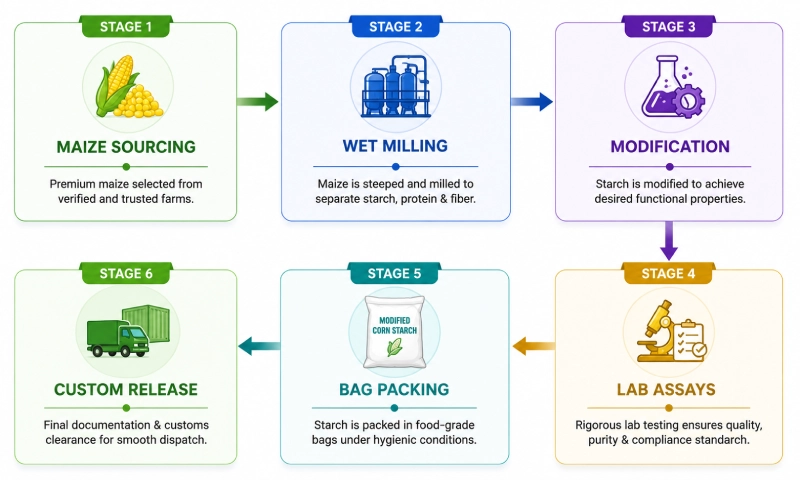
| Stage | Activity | Operational Focus |
|---|---|---|
| 1 | Raw Material Sourcing | Procurement of premium, non-GMO maize lines from regional farming hubs. |
| 2 | Starch Extraction | Wet-milling separation to isolate the pure starch slurry from fiber and germ. |
| 3 | Processing | Hydrothermal or chemical treatment to generate native or modified starch formats. |
| 4 | Testing | Laboratory screening for moisture limits, viscosity, mesh size, and ash content. |
| 5 | Packaging | Sealing into multi-wall paper bags or high-density polypropylene jumbo bags. |
| 6 | Documentation | Compiling government health certificates, customs files, and origin declarations. |
| 7 | Shipment | Organizing multi-modal transport via dry-bulk containers or specialized freight. |
Moisture stabilization is the primary operational defense against degradation during marine transit. Processing mills must dry the starch uniformly to hold moisture levels below 13.0%, completely eliminating the threat of internal caking or microbial growth while inside shipping containers.
Documents Required for Corn Starch Export India
Customs clearance at international border gates is heavily dependent on technical document precision. Sourcing houses must build a flawless regulatory folder to avoid costly demurrage delays at ports of destination.
| Document Type | Operational Purpose | Regulatory Framework |
|---|---|---|
| IEC Code | Export Authorization | Non-negotiable baseline for legal exit from India |
| GST Registration | Tax Compliance | Validates commercial fiscal reporting |
| Commercial Invoice | Shipment Value | Declares total value for import duty assessment |
| Packing List | Cargo Details | Breaks down itemized container weights and dimensions |
| Bill of Lading | Shipment Evidence | Serves as official contract of carriage and title transfer |
| Certificate of Origin | Customs Requirement | Proves geographic origin for bilateral trade benefits |
| Quality Certificate | Buyer Requirement | Independent assay confirming mesh size, viscosity, and grade |
| Insurance Documents | Risk Coverage | Protects trade capital against marine transit damage |
Corn Starch Price Per Kg in Export Markets
Pricing strategies on an industrial trade desk reflect processing grades and purification inputs rather than simple commodity spot fluctuations. Value-added finishes command a distinct pricing spread across global markets.
| Product Type | Indicative Export Price Range | Primary Market Positioning |
|---|---|---|
| Industrial Grade Corn Starch | USD 0.45 – USD 0.60 per kg | Bulk paper and textile milling operations |
| Food Grade Corn Starch | USD 0.65 – USD 0.85 per kg | Standard food processing and beverage lines |
| Modified Starch | USD 1.10 – USD 1.85 per kg | Specialty manufacturing and retort food lines |
Calculations for a forward quotation must incorporate raw maize input costs, enzyme prices, packaging formats, and international ocean freight matrix variations. Native variations trade at volume-driven commodity levels, whereas modified or pharmaceutical extractions capture a higher return due to strict compliance standards and specialized plant investments.
Disclaimer: Export prices are indicative only and may vary depending on purity specifications, destination market, packaging requirements, order volume, certifications, freight rates, and prevailing market conditions.
Why Modified Starch Export Is Growing
The rapid expansion of the modified starch export sector represents a clear market migration toward technical ingredient solutions. Standard native starch often fails to maintain chemical integrity when exposed to extreme manufacturing friction or low-temperature storage.
By executing cross-linking or esterification processes, Indian factories alter the polymer chains, significantly boosting the carbohydrate's performance profile. This structural enhancement is critical for the modern ready-to-eat food sector, where sauces and gravies must withstand intensive freeze-thaw cycles without breaking down or synergising.
Furthermore, the advanced adhesives and textile sectors prioritize modified variants due to their high film-forming capabilities and uniform paste clarity, opening up high-margin, long-term contracting opportunities for specialized processors.
Emerging Opportunities for Corn Starch Exporters India
Sourcing teams intending to maximize their commercial footprints under corn starch export India parameters should focus directly on value-added industrial applications. The volume potential within Southeast Asian retail and manufacturing zones continues to offer an excellent environment for expanding processing capacities.
The global push for eco-friendly consumer goods has created an active niche for starch-based polymers within the emerging bioplastics sector. Indian wet-milling houses can capitalize on this macro demand by supplying high-purity, thermoplastic-compatible starches directly to packaging innovators in South Korea and Malaysia.
Building direct relationships with corporate procurement directors rather than relying on unverified spot aggregators allows exporters to secure steady, multi-year supply volumes. Once a mill establishes that it can regularly deliver zero-variance mesh sizing and immaculate microbial profiles, buyers will absorb a premium price point to secure long-term raw material consistency.
What the Export Numbers Reveal
A deep interpretation of India's annual performance—moving over 634.2 million kilograms of volume valued at USD 273.8 million—reveals clear consolidation trends. Sourcing patterns show that international consumption is no longer localized; it requires a highly centralized agricultural engine to sustain continuous manufacturing runs in developing territories.
The intensive concentration of trade toward Malaysia, Indonesia, and Vietnam proves that South Asian wet-milling centers have successfully integrated into the East Asian industrial supply chain. This structural dependency highlights that regional food processing and paper manufacturing networks calculate their monthly output based on the predictability of Indian rail and port dispatches. For a forward-looking agribusiness fund, this steady intake signals that investing capital in advanced starch modification loops is backed by consistent, multi-tier industrial consumption patterns.
Conclusion
The corn starch export India sector has successfully moved past the phase of basic, low-margin agricultural milling. The category continues to experience structural growth as international food processing and industrial manufacturing demands clean, uniform texturizers.
While alternative agricultural suppliers face volatile crop yields, India’s vast domestic production footprint offers a secure anchor for global supply lines. As the global regulatory environment continues to favor bio-based, natural ingredient solutions, the demand within the maize starch export India channel is positioned for long-term expansion. Processing houses that prioritize absolute chemical purity, invest in automated modification lines, and maintain strict documentation compliance are the entities positioned to capture the highest commercial returns from this global market realignment.
Want to export corn starch in bulk? Register as a seller on Tradologie today and connect with genuine buyers.




.webp "Top 10 Distribution Strategies in Global Bulk Trade: An Agricultural Perspective")
-in-agro-trade-how-it-works-types--tips.webp "Letter of Credit (LC) in Agro Trade: How It Works, Types & Tips")