Key Highlights
- India’s organic farming market is valued at around USD 1.64 billion
- NPOP certification is the base requirement for organic exports from India.
- EU Organic and USDA NOP certifications are critical for global market access.
- Organic farming conversion period generally takes 2 to 3 years.
- Transaction Certificates are mandatory for every organic export shipment.
- Europe remains one of the strictest organic compliance markets globally.
- Residue free and traceable products command premium export value.
- India EU FTA is expected to boost organic agro export opportunities.
Introduction:
Grains of basmati rice or non-basmati varieties sitting inside containers at Mundra or Nhava Sheva aren't just food; they are pure capital in transit. But that capital belongs to absolutely nobody until a specific sheet of paper receives an official stamp. In the high-stakes world of agricultural shipping, everything hinges on one document: the bill of lading in export trade. It is the legal bridge between a warehouse in Punjab and a buyer in Rotterdam.

Administrative box-checking is how a lot of people view the B/L in export trade, but that's a dangerous mistake. It is your ultimate defense against non-payment, port demurrage, and maritime fraud. Perishable goods don't give you the luxury of time; a single day's delay due to a clerical error on your shipping documents can turn a high-grade shipment of onions or grapes into a total loss. This guide uncovers the operational mechanics, complex formats, and distinct classifications of the Bill of Lading specifically through the lens of a food and agro exporter.
What is a Bill of Lading? The Three Fundamental Pillars
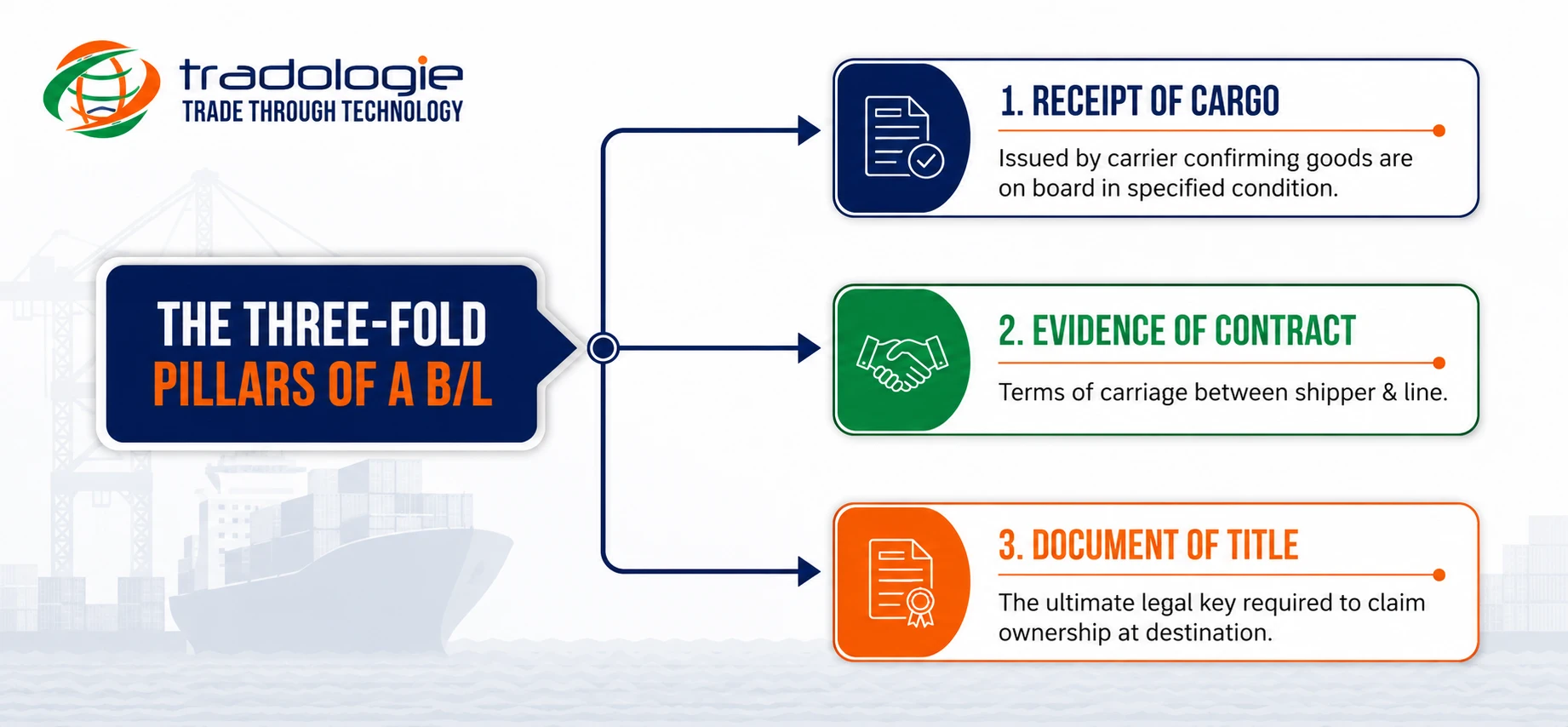
To understand what is bill of lading, you have to look past its appearance as a standard manifest. It isn't just a receipt. Legally, under international maritime law and the Indian Carriage of Goods by Sea Act, this document serves three distinct, non-negotiable functions.
1. The Official Receipt of Cargo
Once your containers cross the ship's rail, the carrier issues this document to confirm that the specific tonnage—say, 500 metric tonnes of premium durum wheat—has been received on board. If the line signs it as a "Clean Bill of Lading," they are legally acknowledging that the bags or bulk cargo appeared to be in good, merchantable condition upon loading.
2. Evidence of the Contract of Carriage
The text printed on the reverse side of a standard bill of lading in export forms the contractual backbone of the transit. It outlines exactly where the carrier’s liability starts, where it ends, and how compensation is handled if the vessel encounters rough seas or a cooling system fails in a reefer unit.
3. The Document of Title
This is where the real commercial power lies. The B/L is the legal key to the cargo. Whoever holds the original, endorsed Bill of Lading legally owns the goods inside the container. Without presenting this document to the customs agent and shipping line at the destination port, the foreign buyer cannot unlock the shipment.
Inside the B/L Format in India: The Critical Data Fields for Food Exporters
A flawed bill of lading format India setup is one of the leading causes of payment delays under Letters of Credit (L/C). When shipping food products, certain fields require absolute, uncompromising accuracy.
- Shipper/Consignor: Your registered corporate name and address, matching your Import Export Code (IEC) and APEDA registration exactly.
- Consignee: This field dictates ownership. If you are shipping under a Letter of Credit, this field will rarely bear the buyer’s direct name. Instead, it will typically read "To the Order of [Name of the Issuing Bank]". This ensures the bank retains control of the grain until the buyer pays.
- Notify Party: Usually the actual buyer or their customs broker. They need to be alerted the moment the vessel anchors so they can prepare for customs clearance.
- Description of Goods: This requires extreme care. For example, if you are exporting basmati rice, the description must match the exact verbiage used in the commercial invoice and the Letter of Credit. If the L/C specifies "Indian Long Grain Basmati Rice Crop 2025," writing simply "Basmati Rice" on your B/L can cause a banking discrepancy, freezing your funds.
- Temperature and Vent Settings: For fresh produce like mangoes, bananas, or chilled meat, the exact reefer settings must be explicitly printed on the face of the Bill of Lading. A variation of even 1°C can ruin a cargo of bananas. Having it clearly stated on the B/L ensures the shipping line is held legally accountable for maintaining those conditions.

Types of Bill of Lading: Navigating the Classifications
Agro exporters don't use a single template for every shipment. Depending on your payment terms, destination, and shipping method, you will need to utilize distinct types of bill of lading.
1. Straight Bill of Lading
Risk levels are entirely dictated by how you release cargo at the destination port. A straight Bill of Lading is non-negotiable. The cargo is consigned directly to a specific buyer, and no one else can claim it.
- The Risk Profile: In many jurisdictions, the shipping line can release a straight B/L cargo to the named consignee without even demanding the physical presentation of the original paper, provided they prove their identity. Therefore, you should never use a straight B/L unless you have already received 100% advance payment from the buyer.
2. Order Bill of Lading (Negotiable B/L)
The golden standard for international trade. By marking the consignee field as "To Order" or "To Order of Shipper," the document becomes a negotiable instrument. You can transfer ownership of the agricultural cargo while it is actively floating on the ocean simply by signing (endorsing) the back of the document. This type of B/L is absolutely mandatory for any transactions settled via bank collection or Letters of Credit
3. Master Bill of Lading (MBL) vs. House Bill of Lading (HBL)
Exporters often stumble over this distinction, but it breaks down to who owns the vessel versus who coordinates the box.
- Master B/L: Issued directly by the actual ocean carrier (think Maersk, MSC, or CMA CGM) to either the freight forwarder or a high-volume cargo owner.
- House B/L: Generated by a Non-Vessel Operating Common Carrier (NVOCC) or a forwarder to clear the specific shipper's load.
- The Trade Advice: Letters of Credit demand extreme vigilance here. Conservative central banks in markets like Bangladesh or Saudi Arabia frequently insert clauses that outright ban House Bills of Lading to wipe out intermediary risk. If your L/C says "Ocean Bill of Lading," go for the Master line document to stay safe.
4. Combined Transport / Multimodal Bill of Lading
When your processing facility sits somewhere inland—say, near agricultural belts around Punjab or Madhya Pradesh—the container starts its journey long before touching the coast. If you ground a container at an Inland Container Depot (ICD) like Dadri or Tughlakabad, it travels by rail or truck to the seaport. This specific transport document covers that entire journey from the landlocked terminal to the destination port under one clean umbrella of carrier liability.
5. Clean vs. Claused (Dirty) Bill of Lading
Inspectors at the ship's rail watch how cargo arrives. If the carrier notes leaky syrup barrels, torn gunny sacks of rice, or compromised crates during stuffing, a note goes on the document face—phrases like "30 bags stained and damp." This instantly creates a Claused or Dirty Bill of Lading.
- The Banking Impact: For an L/C transaction, this is a death sentence. Under international banking rules (UCP 600), banks will completely reject a claused B/L. You will not get paid. The cargo must be pristine at handover.
| Bill of Lading Type | Core Operational Mechanics | Trade Strategy & Risk Profile |
|---|---|---|
| Straight B/L | Non-negotiable format. Cargo releases directly to the named consignee upon identity verification. | High risk if unpaid. Use ONLY when 100% advance payment is settled. |
| Order B/L | Negotiable instrument. Consigned "To Order," allowing title transfer via endorsement on the reverse side. | The gold standard for global trade. Absolutely mandatory for Letters of Credit (L/C). |
| Master B/L (MBL) | Issued directly by the physical ocean carrier (e.g., Maersk) to the exporter or freight forwarder. | Highly preferred by international banks. Minimizes middleman handling risks. |
| House B/L (HBL) | Issued by an NVOCC or freight forwarder to the actual shipper instead of the ocean line. | Must verify bank acceptance under L/C terms first to avoid compliance discrepancies. |
| Multimodal B/L | Combined transport document covering inland transit (rail/road from ICDs) to final ocean port. | Highly efficient for landlocked agro-processing hubs across inland India. |
| Clean vs Claused | Clean confirms cargo received in apparent good order. Claused notes external packaging defects. | A Claused B/L triggers immediate bank rejection under standard Letter of Credit terms. |
B2B Operational Mechanics: The Journey of a B/L in Agro Exports
The handling of a B/L in export trade requires strict process discipline. Let's trace how the document moves from generation to final payment release.
Step 1: The Draft Review (The Mate's Receipt Stage)
Once your containers are loaded onto the vessel, the chief officer issues a temporary document called a Mate's Receipt. Based on this receipt and your shipping instructions, the line generates a draft copy of the Bill of Lading. Do not rush this step. Review every letter, seal number, container code, and metric weight calculation against your invoice. A single transposed digit in a container number can leave your cargo stuck in customs at a foreign port for weeks.
Step 2: The Original Set Release
Once you approve the draft and the vessel sails, the line prints the final copy. This is usually issued as a set of "3 Originals and 3 Non-Negotiable Copies." Presenting any one of the three originals at the port of destination invalidates the remaining two. This measure prevents multiple parties from claiming the same cargo.
Step 3: The Telex Release Alternative
If you are shipping to a nearby destination—such as moving onions from Mumbai to Dubai—the ship will often arrive before the physical paper documents can be couriered to the buyer's bank. To avoid heavy port storage charges, you can request a Telex Release.
- How it works: You surrender the physical original B/Ls back to the shipping line at the port of origin. The line then sends an instant digital message to their destination office, authorizing them to release the cargo to the buyer without demanding the original paperwork.
- The Rule of Thumb: Only authorize a Telex Release if you have already secured your payment. Once that release message is sent, you lose all legal control over the cargo.
B2B Insights: Mitigating Perishable and Commodity Risks
Agro trade carries unique risks that standard dry-good exports never face. Your documentation approach must adapt to protect your margins.
Managing Weight Shrinkage Discrepancies
Moisture changes things out on the open sea. Bulk commodities like sugar, corn, and pulses dry out and shrink inside a steel box over a three-week voyage. You might stack exactly 25,000 kg of product at Nhava Sheva, only to find the scale reads 24,820 kg at a cold North European port.
To keep buyers from slamming you with short-shipment claims, make sure your forwarder stamps the document with clauses like "Shipper's Weight, Load, and Count" or "Said to Weigh." This shifts the legal baseline, showing that the line logged your weight numbers at origin without guaranteeing how much water evaporates in transit.
Navigating Global Trade Platforms
Managing piles of physical papers across three different time zones slows down your cash conversion cycle. It blocks cash flow. That is why modern, high-volume agro exporters are moving away from traditional courier chains.
They are plugging directly into digital procurement platforms like Tradologie.com to align their supply chains. Doing this forces transparency into the documentation loop, matches your shipping metrics directly with vetted global buyers, and eliminates the manual typing errors that cause bank rejections in the first place.
Summary Verdict for Agro Exporters
In the fast-moving arena of agricultural trade, your bill of lading in export functions as your shield, your proof of work, and your title deed all at once. If you treat it like an afterthought, you risk dealing with delayed payments, port fees, or cargo abandonment at distant ports.
Whether you are coordinating shipments of fresh produce via high-spec reefer units or managing bulk grains through international trade lanes, true operational security comes down to precision. Always align your chosen types of bill of lading with your specific payment terms, verify every line on your Indian B/L formats, and secure your funds before surrendering your original titles to the maritime supply chain.
Disclaimer
The shipping procedures, documentation requirements, and trade practices mentioned are for informational purposes only and may vary based on shipping line policies, banking terms, destination country regulations, and international trade laws. Exporters should verify all requirements with freight forwarders, banks, customs authorities, and shipping carriers before execution.




-export-from-india-types-price--global-markets.webp "Jaggery (Gur) Export from India: Types, Price & Global Markets")