Key Highlights
- Bangladesh is one of the top buyers of Indian agricultural products.
- Non-Basmati rice, spices, and oil meals dominate bilateral agro trade.
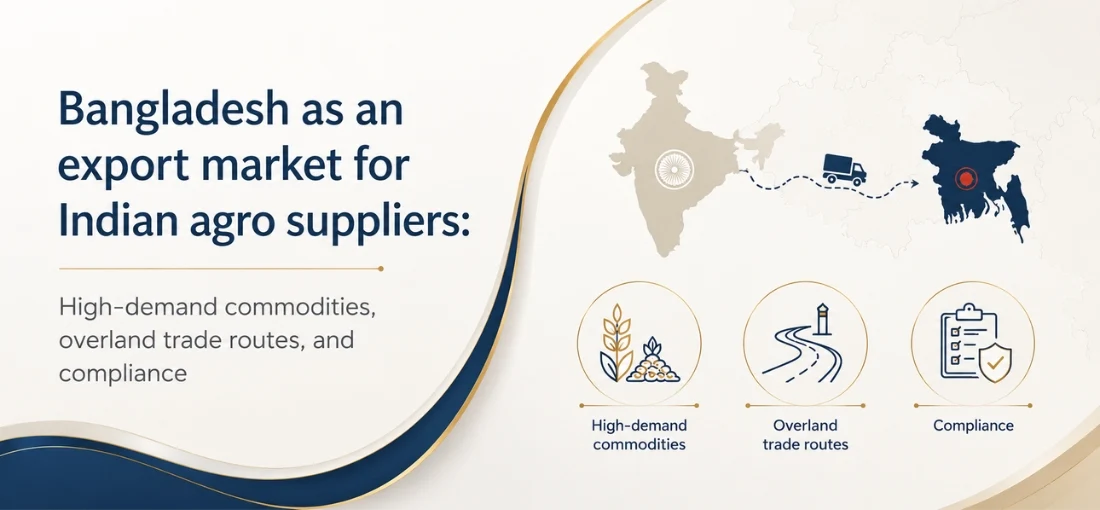
- Shared borders provide a major logistics advantage for Indian exporters.
- Overland routes significantly reduce transit time and freight costs.
- Proper documentation and BSTI compliance are critical for smooth clearance.
- Bangladesh offers strong long-term opportunities for agro commodity exporters.
Introduction:
When Indian agro export businesses scan global maps to map out their next big Indian agriculture exports from India, the usual instinct is to look far west toward the Middle East or check out major grain hubs across Europe. But wait a minute. Look right next door. Across the eastern line, Bangladesh food market has steadily built up an incredibly massive consumer appetite. For anyone serious about exporting food in bulk, dealing with a neighbor like this isn't some casual, alternate option anymore. It is a major destination that deserves attention in your planning.
The food exports to Bangladesh run on basic everyday realities: a shared taste in food, immense populations living side by side, and a proximity that completely changes how you think about shipping. When local crops hit a rough patch or food costs start climbing in Dhaka, the quickest relief valve on the map is the Indian farming sector.

Gauging the Appetite: Market Size and Hidden Potential
Let's look at the numbers first, but without that typical, statistical report talk. The Bangladesh food sector sounds quite promising right now. Although the direct data for its food market size isn’t available. But, if you look specifically at the foodservice side of things, the market size is sitting right around USD 4.56 billion this year. What is even more interesting is how fast it is climbing; analysts expect it to reach up to USD 8.28 billion by 2031, growing at a really steady compounding clip of 13.25% year on year according to Mordor Intelligence.
What is driving this massive pull? It is a classic combination of an expanding urban middle class, rising disposable incomes, and a younger workforce that is rapidly changing how it buys and consumes food. People simply have more money in their pockets, and thus they are demanding higher quality, safer packaging, and a continuous and different variety of dietary options.
A look at the wider landscape of India agricultural exports 2024-25 shows exactly where this puzzle fits together. Take a glance at India's agri export statistics from the Directorate General of Commercial Intelligence and Statistics (DGCI&S). Bangladesh sits comfortably as a top-five buyer for Indian food lines. Out of a total global export basket worth more than $53 billion, the Indian food exports to Bangladesh accounts for a notable $2,402.71 million. That means roughly 4.51% of all Indian agricultural goods leaving domestic borders head straight into this neighboring market. It serves as a dependable anchor for regional trade.
Key Trade Layout: Primary Commodities Entering Bangladesh
We can look at the physical commodities driving the highest value to understand exactly how this multi-million dollar trade breaks down on the ground. While requirements fluctuate with seasonal harvests, specific core items consistently dominate the cross-border freight corridors.
| Key Agro Commodity Group | Indian Export Value to Bangladesh | Bangladesh Share of India's Total Export Category | Primary Driving Factor in Bangladesh Market |
|---|---|---|---|
| Non-Basmati Rice | $536.00 Million | 8.21% | Fills seasonal deficits and cushions domestic staple price inflation |
| Spices | $328.43 Million | 7.57% | Heavy industrial demand for local food processing and consumer kitchens |
| Oil Meals | $217.77 Million | 16.20% | Critical protein feedstock for booming domestic poultry and fish farms |
The Big Three: High-Demand Commodities Driving the Trade
The Bangladeshi market doesn't just buy a single specialized niche product; it pulls in a wide variety of goods across the entire agricultural spectrum. However, if you look at the top agricultural exports from India to Bangladesh, three massive categories continuously steal the spotlight.

1. The Staple Engine: Grains and Essential Food Items
Grains come first. Bangladesh produces massive amounts of rice every year, yet its internal consumption is so immense that any minor weather disruption or seasonal shortfall immediately opens the floodgates for imports. When it comes to non-basmati varieties, Indian exporters are frequently the first line of defense.
Premium segments tell an interesting story too. Basmati rice exports from India have carved out a highly lucrative, upscale niche inside the urban restaurants and premium retail spaces of Dhaka and Chittagong. High-income urban consumers are willing to pay a premium for authenticated, fragrant long-grain varieties for festive occasions and fine dining, making this a high-margin lane for premium millers.
Beyond rice, look at the bottom row of the core India agro products export report data. For commodities like oil meals—which feed the rapidly expanding local poultry and aquaculture industries—Bangladesh is an indispensable buyer. It snaps up $217.77 million worth of oil meals, commanding a dominant 16.2% share of India's total outbound volume in that category.
2. The Flavor Profile: Spices in Bulk
Walk into almost any kitchen in Dhaka, Kolkata, or Mumbai, and the underlying aroma is identical. Because of this culinary crossover, the Indian spices export market meets a highly receptive, steady group of buyers over the border.
The transaction numbers are heavy. Bangladesh buys around $328.43 million worth of spices directly from Indian processors, which translates to a solid 7.57% slice of India's global spice trade. Wholesale markets and local food factories in Bangladesh depend on these consistent weekly shipments of dried chilies, turmeric, and custom blends to keep their production lines moving without price spikes.
3. Cold Chain Horizons: Marine and Meat Products
While land-locked grains dominate the conversations, frozen and chilled items are quickly scaling up. The demand for high-quality proteins is skyrocketing in Bangladesh's urban centers. Looking at the broader data, marine products export from India represents a massive $7,405 million global trade lane, with the USA and China taking the largest shares.
However, a growing slice of processed marine inputs, specialized fish feed components, and high-quality frozen proteins are moving across the eastern border to satisfy local processing industries. Similarly, Indian buffalo meat and miscellaneous processed food items find a highly consistent market among Bangladeshi food manufacturers who require reliable, cost-effective raw materials for their local consumer brands.
The Proximity Edge: Why Logistics Here Are Unbeatable
In global trade, freight costs routinely kill your margins. If you are shipping a container to Europe or North America, you end up at the mercy of volatile ocean rates, canal hold-ups, and weeks of transit time where your capital sits dead on the water.
With Bangladesh, geography changes the entire game. It gives Indian suppliers a logistical edge that no global competitor can match.
We are talking about a shared border which is as large as 4,000 kilometres. This means that instead of thinking in terms of weeks on an ocean liner, your logistics team is thinking in terms of hours on a truck or a rail wagon. In fact, there is no surprise that processing hubs in West Bengal, Bihar, or even Uttar Pradesh can deliver their shipment to the Bangladeshi wholesale market in just within 24 to 48 hours or so. This fast turnaround keeps your inventory moving, prevents cash from getting locked up, and limits any chance of perishables spoiling on the road.
Most of this cargo relies on established land corridors. Border points like Petrapole and Benapole manage the bulk of the daily truck traffic.
But if you want a reliable alternative to road congestion, land customs stations like Ghojadanga, Hili, and Changrabandha provide vital access points right into different sectors of Bangladesh. For major grain suppliers, train logistics are a massive help. Getting allocation for direct rail rakes that run straight from Indian farming regions into Bangladeshi state warehouses saves you from trucking shortages and border bottlenecks entirely.
Navigating the Customs Maze: Compliance and Strategy
Proximity is great, but don't assume you can coast through border checks without your paperwork being absolutely perfect. Land ports operate on strict rules. If an exporter makes a simple typo on an invoice or certificate, trucks will sit in a line for days, and detention fees will quickly eat your margins alive.
To keep things moving, your operations team needs a clean execution plan:
- Flawless Documentation: Every single shipment requires an official, original Phytosanitary Certificate from national plant protection authorities. If you are shipping processed foods or bulk spices, your lab work must show that pesticide traces slide safely under the thresholds set by the Bangladesh Standards and Testing Institution (BSTI).
- Letters of Credit (L/C) Verification: Banking rules in Bangladesh are strictly enforced for imports. You need an official, bank-vetted Letter of Credit opened before your cargo hits the border gates. Have your finance team double-check the reputation and SWIFT lines of the issuing bank in Dhaka to prevent any hitches when it's time to collect payment.
- Woven Packaging Standards: Overland logistics mean your bags get handled multiple times, often in changing weather. Cheap packaging won't survive. Stick to thick, multi-wall woven polypropylene bags fitted with tight inner liners to protect bulk grains and spices from dampness and tearing during border cross-docking.
Technical Verdict
When you look at the total landscape of global agro trade, the smart capital isn't always chasing the furthest horizon. Sometimes, the most resilient, highly profitable trade lanes are the ones running right next door.
By aligning your export strategy with Bangladesh’s booming $40-billion-plus food market, mastering the local overland border compliance details, and leveraging the short, rapid shipping loops of land port logistics, your trading firm can build a highly consistent, predictable revenue pipeline that delivers steady growth year after year.
Want to export food products to Bangladesh? Connect with verified buyers on Tradologie today.
Disclaimer
The market data, trade statistics, compliance requirements, and export opportunities discussed are for informational purposes only. Import regulations, BSTI requirements, customs procedures, tariff structures, and banking rules may change over time. Exporters should independently verify all commercial, regulatory, and documentation requirements before exporting agricultural products to Bangladesh.