
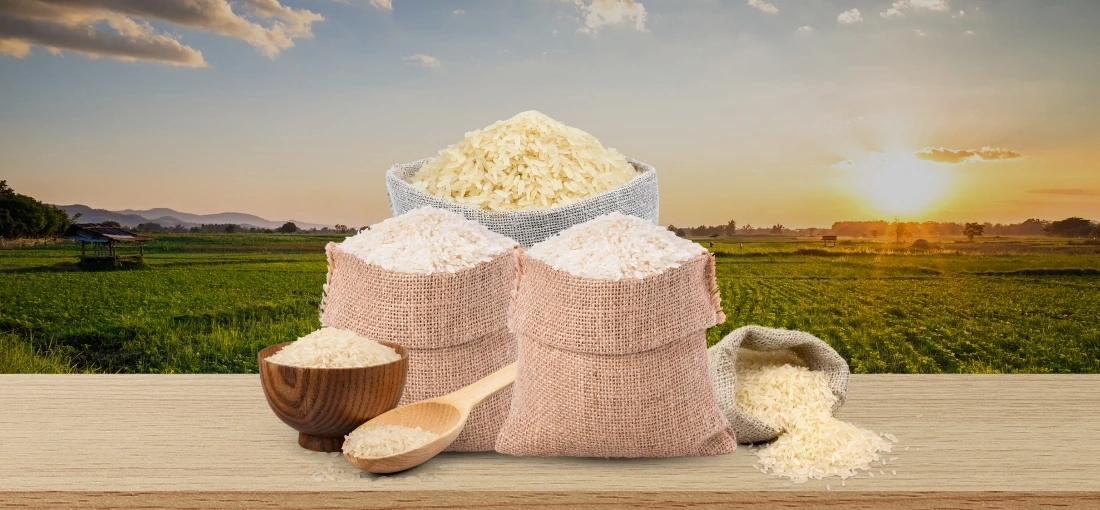
Raw rice refers to harvested rice grains which have been less processed and are normally stripped to have only the outer husks removed, leaving part of the inside bran and germ intact.
It is the primary staple food source for more than half of the population in the entire world and is an intensive source of carbohydrates. The unrefined form of rice is used as raw material in different value-added goods such as parboiled rice, white rice, or brown rice by rice manufacturers, rice millers, and international rice suppliers.
In technical terms, raw rice is that variety of rice which has not been subjected to any heat process prior to milling. It is commonly known by the names “white rice” or “non-basmati raw,” depending upon its variety.
The production involves a straightforward mechanical process:

Simply put, raw rice is "untreated" rice. Unlike parboiled rice, which is soaked and cooked in its husk, raw rice is harvested from the field, dried and processed.
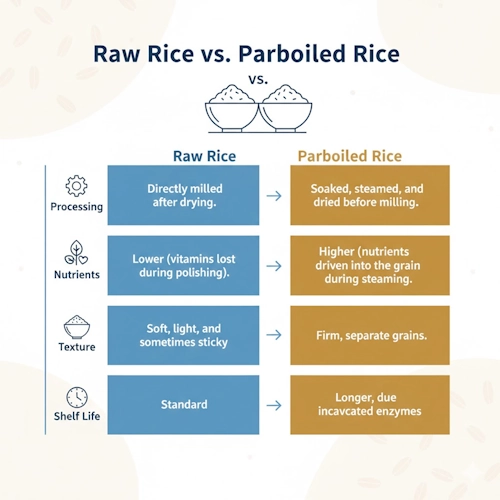
Key Distinctions:
| Feature | Details | Parboiled Rice |
|---|---|---|
| Processing | Directly milled after drying. | Soaked, steamed, and dried before milling. |
| Nutrients | Lower (vitamins lost during polishing). | Higher (nutrients driven into the grain during steaming). |
| Texture | Soft, light, and sometimes sticky. | Firm, separate grains. |
| Shelf Life | Standard. | Longer, due to inactivated enzymes. |
Raw rice is used across various sectors:
Raw rice is a very versatile ingredient and has applications beyond being a side dish. Raw rice is a very valuable ingredient used to create products for the gluten-free sector because of its flavour-free character and anti-allergic properties, which are ideal for high-quality bread and pasta products. Raw rice is also used to produce very valuable convenience food products such as rice flakes (poha), puffed rice, and milk derived from this product because consumers are looking for dairy- and vegan-friendly products.
The processed use of raw rice is made possible by its distinctive chemical content, especially the presence of fermentable sugar and unique starch granules. In the beverage sector, it is a critical "adjunct" in brewing and is mainly used as the base for the production of rice wine and ethanol. Currently, with the rise in emphasis on sustainability, rice starch and rice husks have become critical materials for bioplastics, a biodegradable substitute for environmentally friendly materials for packing and disposable cutlery.
Raw rice has an important place in worldwide agricultural systems for its dense form of energy, which makes it an excellent energy provider for farm animals. Raw rice is commonly used in high-energy feed formulation for chickens and pigs, acting as an economical substitute for carbohydrates in cases of market fluctuations of corn or wheat price. Moreover, raw rice processing provides valuable by-products such as De-Oiled Bran (DOC), which is an enormous worldwide product rich in protein content and is widely used to improve cattle feed quality.
Long Grain
Long grain rice is slim and elongated in shape, with grains regularly above 6.61 (mm) in length. Because of the higher amylose starch content, when cooked, long grain rice will remain firm, fluffy, and separate in texture. In the B2B sector, premium aromatic varieties such as Basmati-known for its 2x elongation-and Jasmine are leading choices, complemented by more volume-oriented non-basmati workhorses such as IR-64 and PR-11. These are preferred for key international export markets in the Middle East and into Europe for applications requiring integrity at the grain level, such as biryani, pilafs, and fried rice.
Medium Grain
Medium grain rice, such as the popular Indian Sona Masoori or Spanish Bomba, features a shorter, plumper kernel [roughly 5 to 6(mm) long]. It strikes a balance between the fluffiness of long grain and the stickiness of short grain due to a higher concentration of amylopectin. The cooked grains are soft, moist, and a little sticky; hence, this variety is best suited to preparations where flavor absorption is required without becoming mushy. It is the staple of everyday consumption in South India and is widely used in Mediterranean cuisines for paella and risotto-style preparations.
Short Grain
It can be defined by the high amylopectin content. It is almost as wide as it is long and may even appear round or oval in shape. The distinctive starch profile gives it a notably sticky, creamy texture, particularly great for clumping naturally, therefore serving as the "gold standard" for sushi, rice puddings, and traditional Asian desserts. Varieties such as Japonica, or the aromatic Gobindobhog of West Bengal, are highly regarded for this cohesive quality. In industrial applications, short grain is frequently sought after for its superior binding properties in processed food molding.
Quality Grades (Broken Percentage)
In global trade, rice quality is strictly classified by the percentage of "broken" kernels allowed in a batch, which directly dictates the market price and application. 5% Broken is considered a premium "Table Grade" product, consisting of 95% full-length head rice, suitable for high-end retail and restaurants. 25% Broken is a mid-tier "Economy Grade" often used for institutional catering or food aid programs where visual perfection is less critical than caloric volume. 100% Broken consists entirely of fragments; while not used for standard meals, it is a high-demand commodity for beer brewing, rice flour milling, and pet food manufacturing.
Paddy fields, or standing water, are used to grow raw rice in tropical and subtropical regions.
Production & Manufacturing : Rice cultivation is a resource-intensive process that is primarily concentrated in tropical and subtropical regions where "paddy" fields are submerged in standing water. The water dense environment is essential for the plant's 120-day growth because it hydrates and controls weeds. Production is concentrated in regions such as the Indo-Gangetic plains, the Mekong Delta, and the Yangtze River basin, where the soil naturally retains water.
Environmental Factors : The quality and volume of a harvest are dictated by the management of soil health and water resources. Nitrogenous fertilisers are the primary drivers of growth; while they increase protein content and grain size, farmers must avoid over-fertilisation, which can lead to "chalkiness"—an opaque, brittle area in the grain that reduces market value. Additionally, soil salinity is a critical factor; while rice is relatively salt-sensitive, moderate salinity can actually improve the eating quality and aroma of certain varieties, though it often comes at the cost of a lower overall yield. Regular irrigation is non-negotiable, as even brief periods of drought during the reproductive stage can result in significant "shattering" or unfilled panicles.
Quality Factors & Milling Efficiency : The process from field to market is controlled by milling efficiency, or the proportion of whole grains (head rice) recovered from raw paddy. The grain becomes brittle and cracks when pressed by the abrasive milling stones if it is too dry; if it is too wet, it becomes pliable and "pulverises" during the husking process. Achieving the standard 14% benchmark ensures that the grain is maintaining a high-quality, polished appearance.
Raw rice is a high-volume commodity in international trade.
The raw rice market globally is fueled by rise in population and food security strategies. The key player in this market is India, which momentously controls its exports to regulate prices locally. The latest trends in this market reflect a growing requirement for raw organic rice and fortified rice (minerals added back to polished rice) in the West.

Raw rice is characterised as that which, in its natural form, maintains its nutrient-rich bran and germ intact. It is available in different lengths of the grain, classes of grain, and quality grades. It is a value-added, health-related food product and an industrial raw material for further processing. Being at the top of the global exporter list, there is a huge demand for whole-grain products. Thus, raw rice is a significant global agricultural commodity.
Businesses seeking quality raw rice, either for sourcing or export opportunities, it is fundamental to know its grain specifications, storage requirements, and market dynamics for successful trade operations.
Tradologie is a platform that connects buyers and sellers worldwide, along with industry insights and procurement solutions for agro-commodities.
The raw rice trade is generally volume-oriented. Most shipments move at the container level or higher, though quantities can vary depending on market conditions.
Usually around 26 MT, which is one fully filled container. Smaller quantities are uncommon in bulk trade.
Register on Tradologie as a buyer (it’s free), post your requirement, and negotiate directly with exporters based on live, real-time quotes. Once terms are aligned, the order is finalised.
Most trades are done on Letter of Credit at sight. In some cases, escrow-based payments with a partial advance are also used, depending on the deal and buyer–seller understanding.
The platform is free for buyers and allows direct negotiation with verified suppliers. You see real offers, no hidden margins, and full transparency through the process.
Typically around 1 month, but timelines depend on documentation readiness, payment completion, vessel availability, and port conditions on both ends.
Yes. Buyers usually specify broken %, packing size, and destination port upfront. Suppliers quote based on those exact requirements.