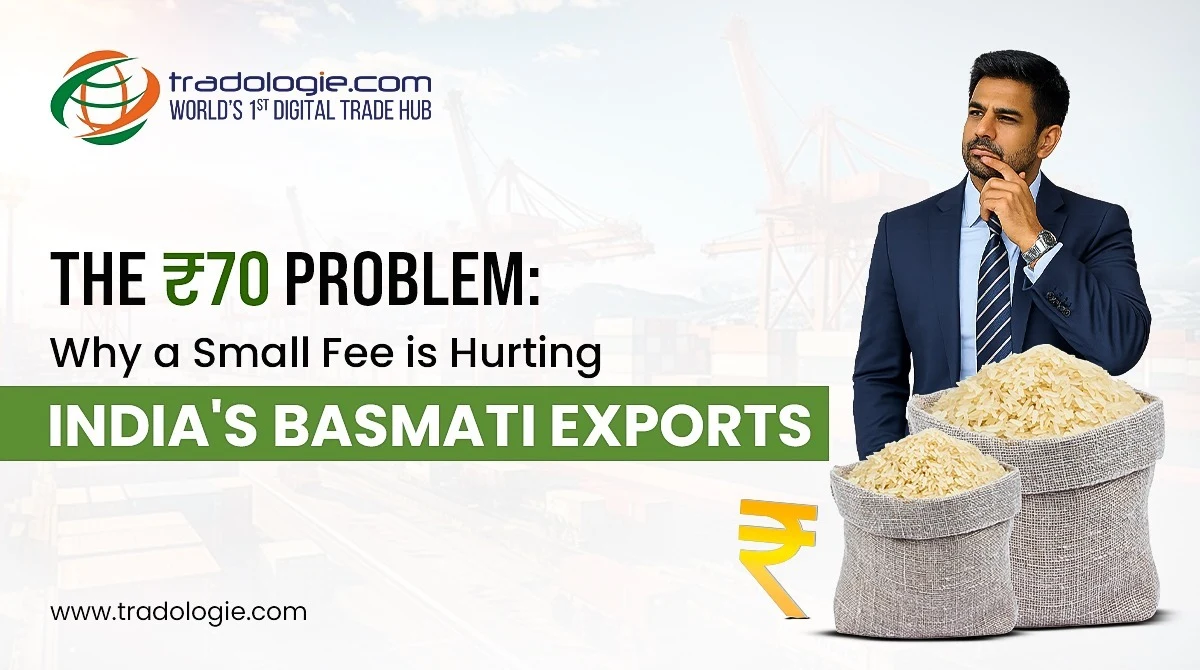
At first glance, a fee of ₹70 per tonne looks very small in the international rice trade. It seems like a minor administrative cost. But for Indian Basmati rice exporters, this fee has become a pressing concern.
What is meant to be a small contribution to the Basmati Export Development Fund (BEDF) is now compounding the stress on small and medium-scale exporters. Here is a breakdown of why the Haryana Rice Exporters Association and industry leaders are urgently asking the Central Government and APEDA to withdraw this fee.
How the Fee Increased
It is easy to assume this fee has always been a standard cost of doing business. However, industry leaders note it was originally intended as a temporary contribution. When looking at the history of the Basmati Export Development Fund (BEDF) levy, the recent sudden hike from ₹30 to ₹70 (+ 18% GST) has turned a promotional fund into a heavy financial burden:
| Period | Fee per Tonne | The Context |
|---|---|---|
| Early 1990s – 2005 | ₹10 | Introduced by APEDA for promotion and record-keeping when exports were small. |
| May 2005 – 2012 | ₹0 (Suspended) | The BEDF Board stopped collecting because the corpus reached a healthy ₹10 crore. |
| 2013 | ₹50 (Temporary) | Re-introduced briefly to support the fund. |
| 2014 – July 2025 | ₹30 | Lowered after industry feedback. Remained the stable, standard rate for over a decade. |
| August 2025 | ₹70 + GST | APEDA abruptly raised the RCAC fee to ₹70/MT (effective burden ~₹82.60). Industry associations argue this was not discussed in the June 2025 BEDF Board meeting, especially since the fund already held ~₹25 crore. |
| April 2026 (Ongoing) | ₹70 + GST | Despite continuous protests and fresh appeals from the Haryana Rice Exporters Association (HREA) highlighting high freight costs and tight capital, the fee remains in force. |
Why Exporters Cannot Pay This Right Now
Exporters are asking to remove the fee because the global market is very tough right now. They are facing many problems that, combined with the levy, are wiping out their profits:
- Geopolitical Tensions: Trade has been negatively impacted by tensions in the Middle East, including the US-Iran conflict and disruptions in important shipping lanes like the Strait of Hormuz. Over 60–70% of India's Basmati exports target the Middle East and Gulf markets.
- High Shipping Costs: Exporters pay higher costs for late shipments, rerouting, and warehouse storage. Increased insurance costs, high freight rates, and significant additional fees are being imposed by shipping companies.
- Lack of Funds: The working capital of exporters is stuck. They buy paddy in season and have to hold stocks for a long time. With delayed payments from buyers, blocked money overseas, and less government support for MSMEs on loan interest, exporters are running out of cash.
The Impact on Farmers
Continuing this ₹70 fee will cause a chain reaction. By adding an avoidable cost, it makes Indian Basmati rice more expensive and less competitive in the global market.
If Indian exporters lose business to other countries due to high prices, they will buy less paddy. This will eventually force down the prices paid to local farmers, passing the financial loss directly onto them.
What Needs to be Done
Industry associations have clearly shared these problems with the Ministry of Commerce and Industry. In order to manage their finances and maintain India's dominance in the international Basmati trade, they require immediate, practical relief rather than the removal of all regulations.
Exporters are looking at every option to reduce expenses, boost productivity, and fortify direct buyer relationships in order to safeguard margins during these difficult times while the industry awaits a ruling from the Ministry of Commerce and APEDA.
How Tradologie Can Help You
Finding practical strategies to reduce your operating expenses is essential as the sector negotiates these regulatory obstacles. At Tradologie, we are dedicated to assisting Indian exporters of Basmati rice in safeguarding their profit margins and expanding their enterprises in the face of worldwide instability.
With a $15 billion turnover, we are a top digital trade platform that connects you directly with verified foreign buyers, doing away with traditional middlemen entirely. We assist you by transferring your export operations to our efficient ecosystem.
- Eliminate Intermediary Fees: By eliminating the commissions that usually reduce your margins, you can keep a larger portion of your earnings.
- Secure Better Pricing: Negotiate more equitable market prices for your Basmati rice by working directly with a worldwide network of verified buyers.
- Improve Cash Flow: The significant working capital strain brought on by conventional, delayed payment cycles is lessened by secure, quicker, and more dependable digital payments.
Don't let export taxes and growing logistics costs ruin your hard-earned profits. Use Tradologie to optimize your supply chain to mitigate these financial pressures and keep your export business highly competitive on the global stage.




.webp "Extended Philippine Rice Ban: Challenges for Vietnam’s Exports and Opportunities in New Markets")