The Philippines may be looking at Telangana as a bulk rice supplier, but the bigger story is whether Telangana can turn its production strength into a durable export business.
The conversation between Telangana and the Philippines over increasing rice exports looks, at first glance, like a fairly straightforward trade proposition. Telangana has rice to sell. The Philippines needs rice. On paper, the two sides seem to fit rather neatly into each other's requirements.
But that would be missing the bigger picture.
The real question is not whether Telangana has enough paddy to sell. It does. The more important question is whether the state can convert that production strength into a reliable, competitive and internationally credible rice-exporting ecosystem.
That is what makes the latest discussions between Telangana Irrigation and Food & Civil Supplies Minister N Uttam Kumar Reddy and Philippine Agriculture Secretary Francisco P Laurel Jr particularly worth watching.
The talks in New Delhi were centred on the possibility of increasing rice shipments from Telangana to the Philippines, while also looking at broader opportunities in agricultural trade. Telangana put forward its production capacity, modern milling infrastructure and ability to supply sizable volumes of quality rice on a sustained basis. The Philippine side indicated that it would look into the possibility of sourcing larger quantities from the state.
That sounds encouraging. It is. But there is little sense in getting ahead of the market before the market itself has spoken.
Telangana already has the production base
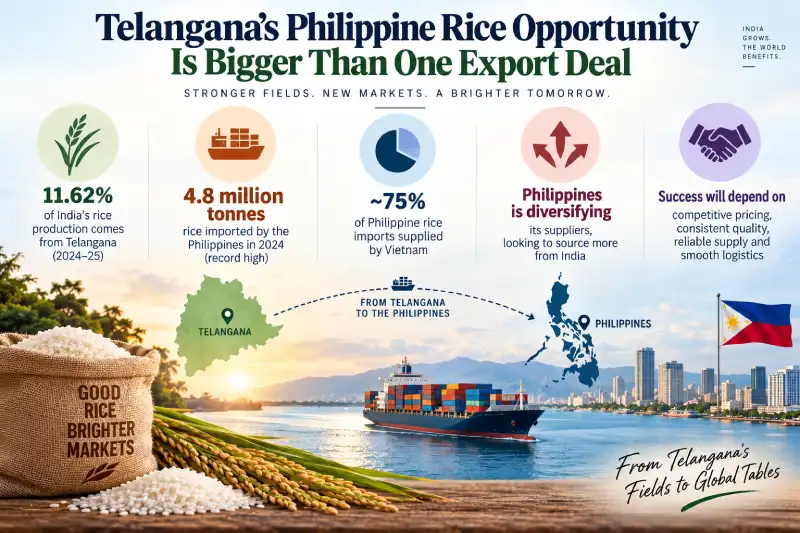
There is a sizable market sitting on the other side of the Bay of Bengal. The Philippines imported a record 4.8 million tonnes of rice in 2024, according to its Department of Agriculture. Yet the market has been heavily concentrated. Vietnam supplied roughly 75% of Philippine rice imports that year, or around 3.56 million tonnes. Thailand was another major supplier, while India remained a comparatively smaller source.
That concentration is precisely where India's opportunity lies.
And Telangana has a fairly strong starting point.
According to APEDA, Telangana accounted for 11.62% of India's rice production in 2024–25, making it the second-largest rice-producing state in India after Uttar Pradesh. India produced 150.18 million tonnes of rice during the year.
That is no small production base. More importantly, it means Telangana is not starting from square one if it wants to build a serious export business. The farms, procurement network and processing capacity already exist to a significant extent.
But here is an important distinction that should not get lost in the excitement: Telangana's 11.62% share of India's rice production is not the same thing as its share of India's rice exports.
Production statistics and export statistics measure different things. A state can be a major producer without automatically being a major exporter. Between the farm and the foreign buyer sits an entire chain of procurement, aggregation, milling, testing, certification, logistics, financing and compliance.
And that chain will ultimately decide whether this Philippine opportunity works.
The Philippines is looking beyond Vietnam
The Philippines has been actively looking to diversify its sources of rice. Its Agriculture Department has encouraged importers to explore bulk rice suppliers beyond Vietnam and has identified India and Pakistan among countries that could play a greater role. So Telangana is not knocking on a completely closed door. It is approaching a buyer that has a strategic reason to look for additional suppliers.
That is where the conversation moves from agriculture to trade.
The real competition will be reliability, not just volume
The Philippines is an especially price-sensitive market. In July 2024, the country reduced its rice tariff from 35% to 15%, contributing to lower imported-rice prices. The government subsequently introduced and adjusted a maximum suggested retail price for imported rice as global prices changed.
That makes one thing abundantly clear: Telangana cannot approach the Philippines simply by saying, “We can produce more.”
The buyer will ask a rather different question: Can you give me the right rice, at the right quality, at the right landed price, and keep doing it?
That is a much harder proposition.
Freight costs will matter. Port connectivity will matter. Milling efficiency will matter. Quality consistency will matter. Certification will matter. So will the ability of exporters to understand precisely what Philippine importers want in terms of varieties, specifications and packaging.
The September discussions reportedly touched upon varieties, quality standards, pricing, procurement, logistics, certification and sanitary and phytosanitary requirements. That is actually more significant than the headline commitment to explore larger purchases. These are the nuts and bolts that determine whether a trade conversation becomes a trade relationship.
There is a policy risk that exporters cannot ignore
There is another wrinkle that Telangana should keep firmly in mind.
Rice is not just another commodity in the Philippines. It is deeply connected with food security, consumer prices and farmer incomes. The country has shown more than once that domestic conditions and political priorities can quickly change the way rice imports are handled.
In 2025, the Philippines temporarily suspended imports of certain milled rice varieties, while APEDA later issued an advisory concerning rice exports to the Philippines in January 2026.
For an exporter, that is not a footnote. It is a warning.
Telangana should certainly pursue the market, but it should not build an export strategy that becomes excessively dependent on a single overseas destination. International agriculture is full of examples where a promising market can suddenly become difficult because of tariffs, import restrictions, domestic harvests, food-security concerns or political intervention.
The bigger question is what happens to the farmer
There is also a domestic question that deserves much more attention than it usually receives in export announcements: What does greater overseas demand actually mean for Telangana's paddy farmers?
In theory, the chain is attractive. More exports could create stronger external demand, open up additional procurement opportunities and potentially improve price realisation for farmers. But none of that happens by itself. The eventual benefit will depend on how procurement is organised, what margins are absorbed by milling and transport, and, at the end of the chain, how much of the additional export value actually reaches the producer.
If Telangana wants to become an export-oriented rice hub, that farmer-to-exporter connection needs to be strengthened rather than treated as an afterthought.
And perhaps the state should think beyond bulk rice altogether.
Telangana should think beyond bulk rice
There is an opportunity to understand the Philippine market more closely and supply varieties suited to local consumption, alongside milled and parboiled rice. Over time, the ambition could extend to packaged consumer rice and other value-added rice products. That is where the economics can become more interesting: instead of competing only as a bulk commodity supplier, Telangana can gradually capture more value from processing, branding and market-specific products.
That would also make the export strategy more resilient.
A state that only sells bulk rice remains largely exposed to international commodity prices and freight economics. A state that develops specialised varieties, branded products, processed foods and stronger buyer relationships has more room to manoeuvre.
It is a subtle difference, but over time it can make a very large difference to the value captured within the state.
India gives Telangana an important advantage
India's existing position gives this strategy some credibility. APEDA reports that India exported 20.19 million tonnes of rice worth US$12.47 billion in 2024–25 and has remained the world's largest rice exporter, accounting for roughly 30–35% of global rice exports in recent years.
Telangana therefore does not have to convince Philippine buyers that Indian rice is an unknown commodity. It can build on an export ecosystem that already exists at the national level.
But Telangana now needs to build its own credentials within that ecosystem.
That means better milling, stronger quality certification, traceability, export logistics, farmer–mill linkages and market intelligence. It means developing direct relationships with overseas buyers rather than waiting for opportunities to arrive through intermediaries. And it means treating sanitary and phytosanitary compliance as part of the export business from day one, not as paperwork to be sorted out after a buyer has been found.
The Philippine deal should be treated as a test case
Ultimately, the Philippines should be viewed as a test case.
If Telangana can consistently move rice from its farms through procurement and milling to an Indian port, across the sea and into Philippine warehouses at a competitive landed price, while meeting every quality and regulatory requirement along the way, then the state will have demonstrated something much bigger than its ability to supply one country.
It will have demonstrated that Telangana can become a serious agricultural export hub.
That is why the Philippine opportunity deserves attention. The story is not really about whether Telangana can produce another million tonnes of rice. It is about whether the state can make its existing production base work harder in global markets.
The Philippines may be the immediate destination. But the larger prize is an export system that can serve many destinations.
For Telangana, therefore, the ambition should not simply be to sell more rice to the Philippines. It should be to become the kind of supplier that Philippine buyers — and eventually buyers elsewhere — can depend on year after year.
In the global food trade, volume may open the door. Reliability is what keeps it open.