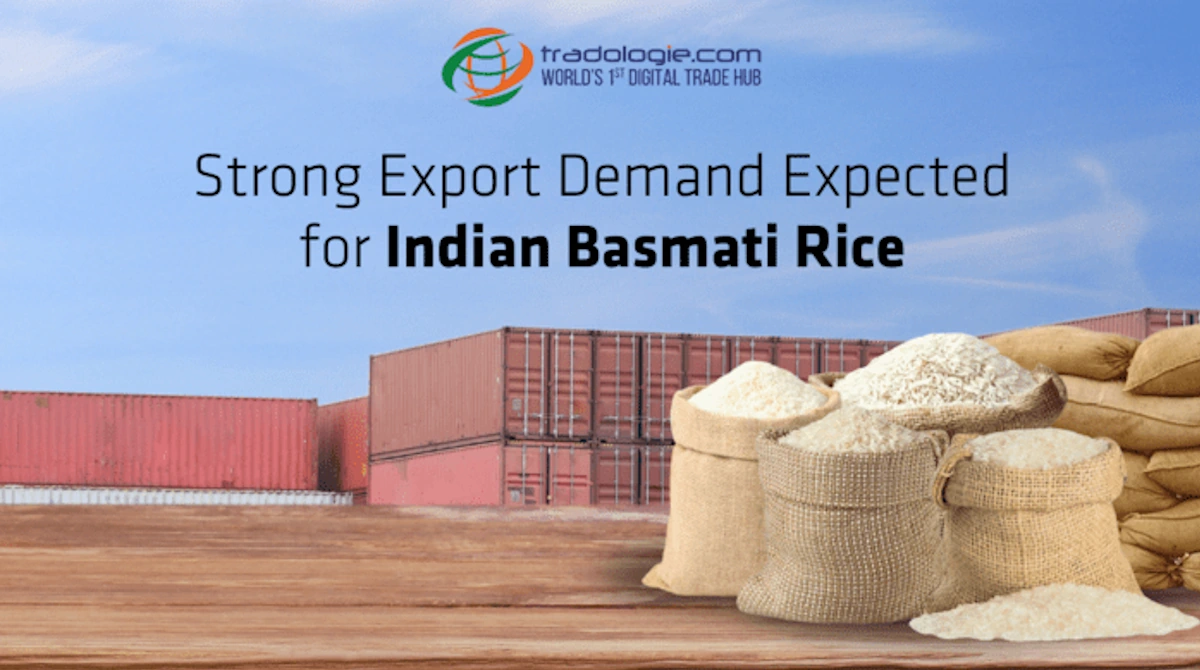
This year's strong export demand for Basmati is expected to benefit farmers of aromatic varietals ahead of the sowing season, as they enjoyed record prices for their harvest last year. They might be able to avoid any surplus scenario that often arises following a successful year by having a calibrated production.
Exports of basmati rice increased by 15% to a record high of 5.24 million tonnes (mt) in the 2023-24 fiscal year from 4.56 mt in the previous fiscal year. Exports of aromatic rice increased to a record high of ₹48,389 crore versus ₹38,525 crore, or $5.83 billion above $4.78 billion, in value terms. The profit per unit has also increased.
Given the increased rejection of Pakistan's Basmati rice for violating the EU's maximum residue level (MRL) standard and the likelihood of India's designation as a Geographical Indication (GI), Indian shipments of aromatic rice to the EU might rise by 0.5 million metric tons during the current fiscal year.
Geo-political situation
APEDA data indicates that India sold 152,881 tonnes of Basmati rice valued at $166.81 million to EU nations in 2023-24, a decrease from 164,138 tonnes valued at $210.97 million in 2022–23.
The prevailing geopolitical landscape in West Asia suggests that there would be a rise in the export of Basmati rice suppliers during the forthcoming season. As the quality of our exports from India improves, so will our exports to Europe. India may acquire Basmati GI from European authorities as soon as possible. This would greatly boost our exports to international markets, according to S Chandrasekaran, an authority on foreign trade policy and the author of a book on Basmati GI.
Basmati Rice Production in India: Punjab Surpasses Haryana in 2023 Amidst High Prices and Yield Losses
APEDA, the government's agri-export promotion agency, has commissioned a paper that states that during Kharif 2023, India produced 9.85 million metric tons of Basmati rice from 2.1 million hectares (mh) of land. Last year, the price of traditional type basmati paddy crossed Rs 6,500/quintal, as more export demand was expected in the wake of Middle East tensions.
The APEDA report has verified the expected decrease in Haryana's output from the previous year, which made Punjab the leading exporter of Basmati rice. According to the report, Punjab produced 3.84 mt of Basmati rice, while Haryana produced 3.68 mt. Floods and strong rains caused output losses even though Haryana's Basmati area grew from 0.66 mh to 0.78 mh in 2023. However, the record area under Basmati in Punjab last year was 0.81 mh, up from 0.59 mh in 2022.
Conclusion
In conclusion, Indian Basmati rice growers have a bright future thanks to robust export demand and possible GI recognition in the EU. Punjab is now the biggest producer, even if Haryana has seen some yield decreases. Exports of Basmati rice have a bright future overall because to favorable market circumstances and well-thought-out production scheduling.
If you want to export or import agro commodities in bulk, Tradologie.com is the best B2B platform. It facialites the bulk transactions without any middlemen through its state-of-the-art SaaS platform. Visit www.tradologie.com to explore B2B export opportunities and stay updated with the latest trends in the industry.
To register as a seller, click here. To register as a buyer, click here.
To stay updated with the latest happenings in the agro-trade industry, follow Tradologie.com across all social media channels.