The regulatory and fiscal landscape for the Indian agricultural export sector has reached a highly critical milestone, offering a massive structural window of opportunity for processing mills, aggregation networks, and international trading houses. In a strategic move to maintain trade momentum and safeguard global supply continuity, the Spices Board has officially announced the extension of its flagship central sector program.
The Spices Board Scheme titled ‘Sustainability in Spice Sector through Progressive, Innovative and Collaborative Interventions for Export Development (SPICED)', which was originally approved for implementation during the 15th Finance Commission Cycle up to FY 2025-26, has been officially extended up to September 30, 2026, or until the approval date of the proposed successor scheme under the 16th Finance Commission Cycle, whichever occurs earlier.
For cardamom exporters looking to expand their presence in international markets, this timeline extension is an essential catalyst. The primary objective of the SPICED Scheme focuses heavily on expanding the cultivation footprint and improving the baseline productivity of both Small and Large Cardamom varieties. More importantly for corporations, it builds a highly reliable framework to generate an exportable surplus of top-grade commodities through targeted post-harvest infrastructure improvements, rigorous export promotion drives, and a deliberate push to increase the share of high-margin, value-added spices within the overall national export basket.
Simultaneously, the program enforces extensive quality compliance testing on outgoing cargo shipments to satisfy international bio-security standards while funding deep capacity-building and skill-development workshops for value chain stakeholders.

The Macro-Economic Reality: The Historic Growth Profile of Indian Cardamom
Building a scalable, long-term international trade operation under the extended fiscal framework requires shifting away from generic sales methods and directly targeting the real-world demand indicators driving the sector. According to official export statistics tracked alongside APEDA historical customs records, Indian spice exports continue to maintain a highly concentrated, premium presence in the global market, with Indian spices export lines for cardamom experiencing historic surges.
By analyzing the definitive performance charts of the cardamom category, agri-enterprises can easily align their processing capacities with active global buying corridors.
1. Small Cardamom: The Growth Accelerator
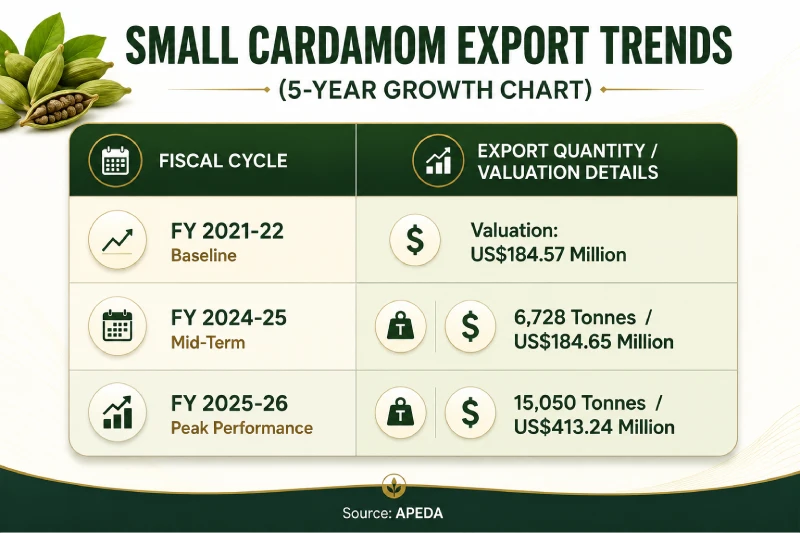
The international demand for small cardamom exports scaled exceptionally high during the 2025-26 window, providing an aggressive growth curve across the broader agricultural export layout. Industry tracking shows that overall cardamom exports picked up major volume velocity, with outbound quantities jumping from 6,728 tonnes in 2024-25 up to a notable 15,050 tonnes in 2025-26.
This dramatic rise in physical shipping volume directly transformed the financial matrix, as total export revenues more than doubled by climbing from US$184.65 million to US$413.24 million over the same fiscal period.
Evaluating the market from a macro five-year view shows even deeper strength. The overall valuation of Small Cardamom shipments surged by roughly 124%, starting from a baseline of US$184.57 million in 2021-22 and closing at US$413.24 million in 2025-26.
This long-term upward trajectory positions the crop as a frontrunner among India's most dynamic agricultural shipments, opening up significant profit pipelines for verified green cardamom exporters who can deliver the vibrant capsule colors and uniform grading sheets demanded by overseas buyers.
2. Destination Analysis: Sourcing Trends for Small Cardamom
Exporters looking to build sustainable, repeating trade lines must focus their primary shipping allocations on the specific geographic destination hubs driving these large procurement mandates:
- The UAE Market Surge: The UAE established itself as the leading destination for India's Small Cardamom volume, with its local importing desks pulling in 3,941 tonnes worth US$117.68 million in 2025-26. This marks a massive jump from the 2,328 tonnes valued at US$69.51 million recorded during the 2024-25 trade run.
- Saudi Arabia Highest-Value Play: Saudi Arabia took the lead as the highest-paying market by financial return. Inflows to the Kingdom climbed sharply from 1,458 tonnes worth US$41.72 million in 2024-25 to a massive 3,994 tonnes valued at US$123.32 million in 2025-26, representing an impressive, nearly threefold value spike.
- Bangladesh Regional Velocity: Bangladesh turned into one of the fastest-growing regional buyers for the crop. Inbound volumes rose rapidly from a modest 439 tonnes worth US$4.38 million in 2024-25 to an institutional-scale 2,840 tonnes valued at US$48.22 million in 2025-26, showing an expansive surge in neighboring demand.
- United States Stable Realization: The United States functioned as a highly predictable, high-value destination. While its intake metrics remained stable at 470 tonnes worth US$15.44 million in 2025-26 compared to 482 tonnes valued at US$11.54 million back in 2021-22, the financial data reveals a much stronger value return per shipped tonne for exporters.
3. Large Cardamom: Higher Price Realizations
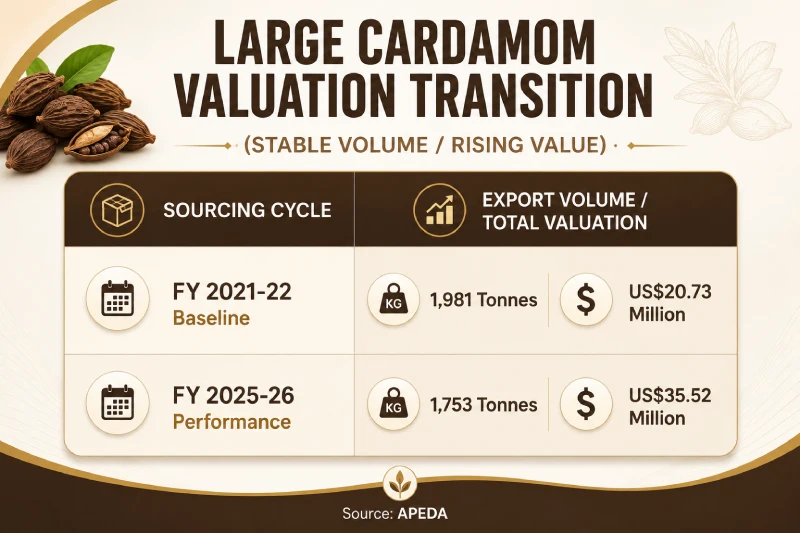
The underlying trade data for large cardamom exports emphasizes a highly profitable economic reality for specialized agricultural suppliers. Overall trade revenues climbed steadily, moving from a baseline of US$20.73 million in 2021-22 up to US$35.52 million in 2025-26.
What makes this performance incredibly attractive for processing plants is that this revenue growth happened while total physical volumes remained flat, moving within a tight band between 1,753 and 1,981 tonnes over the five-year stretch. This flat-volume, rising-value dynamic indicates much higher international market pricing for premium black cardamom exports.

Breaking down the primary destination hubs shows clear buyer concentration:
- The UAE Dominance: The UAE completely controlled the buying space for this variety, taking in 1,132 tonnes worth US$20.31 million in 2025–26, which represents well over half of India's total global Large Cardamom export valuation.
- Saudi Arabia Expansion: Sourcing lines to Saudi Arabia expanded by more than three times over the five-year cycle, with intakes growing from 40 tonnes worth US$0.54 million in 2021–22 to 133 tonnes valued at US$3.04 million in 2025–26, highlighting excellent sales momentum across the Gulf region.
4. The Gulf Core Focus
APEDA data shows that the Gulf region stands out as the primary, high-value destination for Indian Cardamom exports. The UAE, Saudi Arabia, Kuwait, Oman, Iraq, and Bahrain consistently rank as the leading institutional importers for both Small and Large Cardamom varieties. This heavy regional focus reinforces India's deep, structural trade ties with Middle Eastern markets, providing spice exports from India with a highly reliable, high-premium commercial network.
Bypassing Traditional Barriers: The Digital Shift in Global Trade
While the extension of the Spices Board program and robust global demand provide a highly supportive environment, independent agricultural suppliers can easily damage their export margins if they rely on outdated, high-friction client acquisition networks to export spices from India.
Historically, companies have spent immense sums traveling to international trade expos or purchasing unverified, static directories that are frequently clogged with dead contact data and historic customs records. Even worse, turning your supply lines over to traditional commission-based brokers can obscure your market visibility, as these agents often hide the true identity of the end-buyer to protect their position in the middle, leaving you completely exposed to counterparty risks and credit defaults during transit.
To bypass these friction points, the modern agricultural trade has shifted toward specialized digital procurement infrastructure. Digital platforms like tradologie.com have stepped in to solve these structural transparency challenges, operating as a clean, real-time B2B trade lane built to streamline transactions along global agricultural corridors.
How Tradologie facilitates global cardamom trade:
- Direct Access to Verified Buyers: Tradologie provides direct access to verified import-ready bulk cardamom buyers who want to procure bulk commodities. You skip the guesswork and hook straight into active spice procurement managers.
- One-to-One Live Negotiation: You can negotiate with the bulk cardamom importers live one-to-one, finalizing trade deals without any interference in pricing by the platform. This pure price discovery allows you to protect your exact export margins.
- Deeply Verified Sourcing Requirements: Sourcing requirements are verified using Tradologie's AI-assisted verification process together with internal verification procedures. The platform thoroughly checks the financial health and active licensing of the cardamom importers before allowing them to upload buying requirements.
- End-to-End Export Facilitation: You get complete end-to-end export facilitation support through a dedicated trade manager until your transactions are finalized.
- Capital Protection and Secure Escrow: Tradologie supports secure payment mechanisms such as Letters of Credit (LC) and a certain percentage of Advance Payment setups and balance against proof of dispatch, insulating your cash flow from international trade risks.
Summary: A Strategic Blueprint for Cardamom Exporters
The official extension of the SPICED Scheme represents a critical structural window for the Indian spice exports sector. By linking the Spices Board's extensive quality compliance frameworks and post-harvest infrastructure incentives directly with advanced B2B digital procurement platforms, international suppliers can confidently eliminate transaction vulnerabilities. Success in this rapid-growth cardamom economy depends entirely on execution efficiency and precise quality management.
By taking advantage of central sector compliance benefits, optimizing origin processing to pass strict international residue labs, and managing your corporate sales through digitized trading pipelines that provide robust payment security, your business can successfully secure the stable, long-term global contracts that form the bedrock of sustainable agricultural trade.