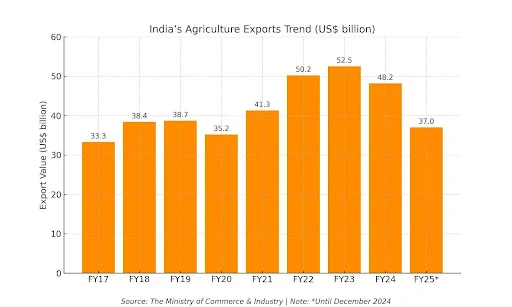
India's agriculture exports, pegged at US$ 37 billion till FY25,* reflect a measurable decline from the FY23 peak of US$ 52.5 billion. While data is until December 2024 and the drop may partially stem from softening global prices and geopolitical fluctuations. The prices might stabilise in the future. The real issue lies deeper—in how India structures its export playbook.
The government's ₹20 lakh crore target, as articulated by Union Minister Piyush Goyal, presents not just a fiscal ambition but an inflection point to reconsider India's approach: from high-volume commodities to high-value, processed agri exports.
The Volume-to-Value Pivot
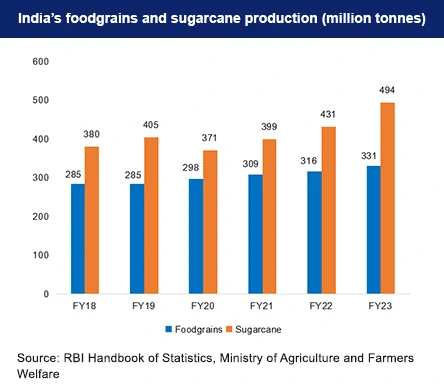
For years, Indian agriculture exporters have leaned heavily on staples like non-basmati rice , wheat, and sugar to drive outbound trade. These goods still occupy significant weight in the export basket, but they offer limited margin flexibility. As global competition tightens and price convergence continues, this model is showing signs of fatigue.
This is not to say grains and bulk commodities are no longer relevant—they are. But treating them as the sole export engines may no longer yield sustainable growth. What's needed now is a transition towards margin-focused trade, where packaging, processing, and positioning take precedence over mere volume.
Export Markets: Broad Reach, Shallow Engagement?
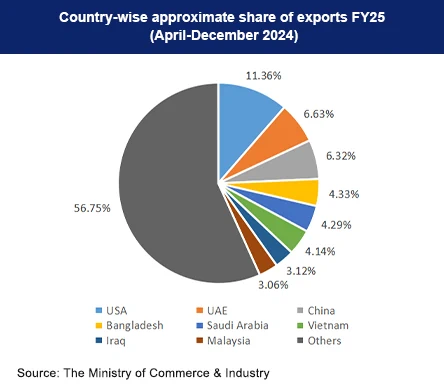
According to data from April to December 2024, the USA accounted for 11.36% of India's agri exports, followed by UAE (6.63%), China (6.32%), and Bangladesh (4.33%). However, a staggering 56.75% of exports were spread across an undifferentiated “Others” category, indicating a lack of strong bilateral export corridors.
This level of dispersion might initially seem like diversification, but on closer look, it reflects a reliance on fragmented, price-driven transactions rather than long-term strategic trade relationships. For agriculture exporters aiming to scale, moving from opportunistic selling to structured market engagement is imperative.
Cluster-Led Production: From Patchwork to Infrastructure
A recurring pain point for India's agriculture exporters has been the absence of post-harvest integration. Despite leading global production in crops like bananas, mangoes, and potatoes, less than 1% of these reach international buyers. Much of the produce is lost not due to lack of demand, but due to the absence of processing zones, cold storage, and export-grade packhouses.
The cluster development approach recommended by APEDA and ICRIER offers a more grounded path forward. By focusing on high-potential zones—Jalgaon for bananas, Ratnagiri for mangoes, Banaskantha for potatoes—and developing them into export-centric agri-manufacturing zones, India can reduce supply inefficiencies and boost export readiness.
These aren't just production belts—they are logistics-integrated supply hubs designed to meet global compliance and enable high-frequency exports.
Processing: The Next Trade Multiplier
Increasingly, global agriculture importers are showing a preference for processed and shelf-ready agri products—whether it's retort-packed mango pulp for food service sectors or vacuum-sealed vegetables for retail chains. India's exporters are beginning to respond, but this opportunity remains underleveraged.
For example, the export of jamun to the UK and Punjab litchis to Gulf markets demonstrates what's possible when exporters align products with destination market demand. Similarly, the global resurgence in millets, spurred by India's proactive campaign during the International Year of Millets, opens doors for high-protein, climate-resilient grains.
If agriculture exporters can align product development with consumer trends in high-margin markets, processed goods could drive the next major upswing in India's agri trade.
B2B Infrastructure: Moving from Buyer Hunt to Buyer Access
A persistent bottleneck for exporters, especially MSMEs and FPOs, is buyer discovery. Trade exhibitions and third-party agents only go so far—and often result in uncertain outcomes and delayed closures.
Digital platforms such as Tradologie.com have emerged as effective alternatives, enabling sellers to:
- Engage with verified importers across 100+ countries
- Negotiate prices live, without reliance on intermediaries
- Access multilingual trade assistance and full-cycle transaction support
This shift towards digital B2B matchmaking is particularly important for agriculture exporters who want to expand without stretching overhead or relying on unpredictable channels.
Policy Support Must Be Execution-Ready
Government incentives around production-linked processing, cluster-based value chains, and infrastructure grants are certainly moving in the right direction. But execution remains the true differentiator. Exporters frequently face hurdles around logistics documentation, trade finance, and standards harmonization, which dampen scalability.
A few steps can accelerate outcomes:
- FTA alignment for processed agri goods
- Faster certification protocols for food safety and traceability
- Marketing support for Indian agri brands in GCC, ASEAN, and EU territories
- Establishment of dedicated agriculture export cells within trade consulates
Each of these initiatives may seem incremental, but collectively, they define whether the Rs 20 lakh crore goal remains aspirational or becomes achievable.
Final Thought: Trade Will Reward Intent Backed by Infrastructure
India's agriculture export growth is no longer just about growing more—it's about exporting better. The scope for value creation is evident. Exporters who restructure their operations around processing efficiency, branding, and market positioning will command better margins, deeper buyer relationships, and policy tailwinds.
If India wants to lead in global agri trade not just by quantity but by quality, the Rs 20 lakh crore vision must be met with execution on ground, investment in cold chains, and a digitally connected export ecosystem. The intent is clear. The opportunity is tangible. The differentiator now will be how swiftly and smartly it's delivered.





.webp "Ukraine's Grain Exports This Season Are Over 20% Higher Than Last Year")
.webp "The Government Plans to Bring in a New Agriculture Export Policy")