The dynamic nature of global agricultural trade is clearly highlighted in the latest trade indicators released by the Commerce Department. The data reveals a dual-track economic reality for the South Asian agricultural landscape. While the overall merchandise trade deficit has expanded due to a fast-moving import cycle, specific high-performing staple sectors continue to show strong performance on the international stage.
At the absolute center of this movement is the grain processing industry. India agricultural exports are increasingly leaning on structural crop advantages, with rice exports stepping up as a key economic driver even as several other prominent farm commodities experience short-term shipment moderation.
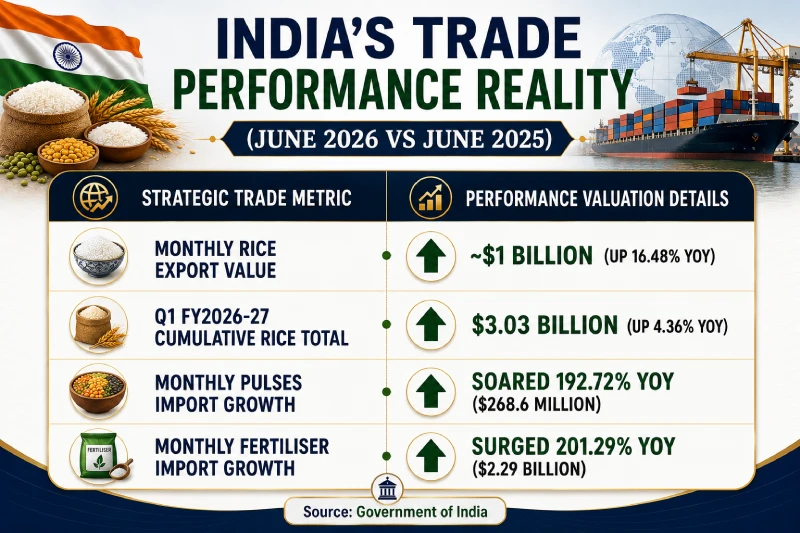
India's rice exports hit nearly $1 billion in June 2026. This marks a 16.48% jump compared to the $858.8 million recorded in June 2025. This fantastic growth in grain shipments came at a crucial time. This is because it is helping to balance out the lower numbers seen in other major farm categories like tea, coffee, spices, and oilseeds.
Simultaneously, the domestic supply chain recorded an aggressive surge in the arrival of essential inputs and staple foods, highlighted by a notable 192.72% year-on-year increase in India's pulses imports and a 201.29% jump in total fertiliser inflows.
For commercial enterprises operating across the export import trade, these shifting volume trends demonstrate the need for reliable, transparent B2B export import networks to navigate structural domestic demand gaps and volatile international buying cycles.
The Export Matrix: Rice Anchor Against Agricultural Softness
During the April-June quarter, cumulative rice shipments reached $3.03 billion, registering a 4.36% increase over the corresponding period last year. This consistent demand suggests continued international interest in Indian rice. Competitive pricing, availability, and reliable supplies may have contributed to the export growth, even after the market normalized following historical adjustments to export frameworks.
This strong grain performance helped offset declines in several other agricultural export categories, supporting overall agricultural export earnings against drops in other high-profile crop categories:
- Tea Shipments: Fell 19.21% during the month, dropping to $67.2 million from $83.1 million in June 2025.
- Coffee Allocations: Slipped 7% to $171.3 million from $184.3 million a year earlier.
- Spices & Oilseeds: Registered notable downward revisions alongside cashew and oil meals.
- Fresh Produce Growth: In contrast, fruit and vegetable exports edged up by a modest 1.31%, moving to $261.1 million from $257.7 million.
From a macro perspective, this concentration highlights a structural reliance on a single core crop stream, which can create concentration risks if global pricing dynamics or international grain policies shift unexpectedly. Furthermore, within the everyday B2B agriculture trade, the trade data suggests relatively stronger global demand for staple grains such as rice compared with several premium agricultural commodities.

The Non-Agricultural Catalyst: Broader Export Foundations
Looking at the broader manufacturing and industrial picture for June 2026, it is important to note that electronics shipments grew 18.93% to hit $4.93 billion. Chemical exports climbed 19.42% to reach $2.77 billion at the same time. The gems and jewellery sector saw a massive 34.64% jump and rose to $2.41 billion.
This solid momentum pushed total merchandise exports for the first quarter of FY2026-27 up to $129.32 billion—a 15.92% increase—while non-petroleum exports rose 12.44% to hit $106.30 billion.
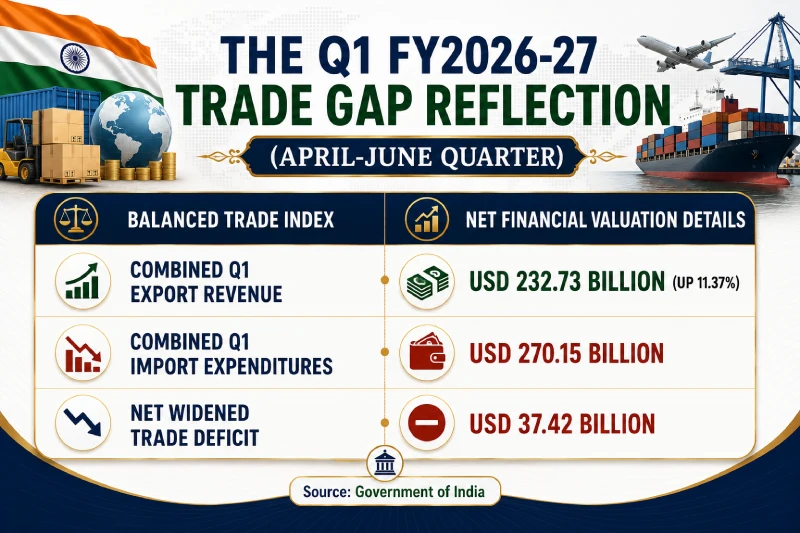
When you combine both goods and services, total exports for the April-June quarter reached $232.73 billion, growing 11.37% year-on-year. For the month of June alone, services exports saw a minor increase, moving up to $33.03 billion from $32.11 billion in the previous year.
The Import Surge: Structuring the Necessity Pipeline
Even with steady export growth, merchandise imports climbed much faster in June, jumping from $54.08 billion to $70.84 billion. This rapid increase pushed the first-quarter import total up to $270.15 billion. As a result, India's trade deficit practically doubled, widening to $37.42 billion for the quarter compared to $20.85 billion during the same period last year.
Within the agricultural commodity trade, this import trends may indicate that the economy is importing baseline necessities while exporting value-added surpluses.
The Pulse Deficit Challenge
Vegetable oil imports declined 2.58% in June. This may, to a large extent, reflect changes in domestic production, inventories, prices, or import demand. Imports of pulses nearly tripled, in contrast. India imported $268.6 million worth of pulses during the month. This pushed the cumulative April-June quarter total to $716.8 million.
This dramatic shift highlights the persistent, structural supply-demand deficit that forces local processing facilities to continually source bulk legumes from key production regions like Australia, Canada, Russia, Tanzania, and Myanmar to satisfy domestic protein needs.
Record Fertiliser Accumulation
Imports of fertilisers that cover both finished products and essential raw materials surged 201.29% in June to reach $2.29 billion. This figure compares with $760.9 million in June 2025. Fertiliser inflows climbed from $2.10 billion to $3.84 billion for the April-June quarter.
The surge could reflect inventory build-up ahead of the upcoming sowing season and increased agricultural input requirements. Higher fertiliser availability has the potential to support crop productivity in the coming seasons, helping secure the production foundations for upcoming export cycles of rice, wheat, and sugar.
Bypassing Traditional Bottlenecks: Digitizing the Commodity Corridor
As the widening trade deficit puts pressure on margins and volatile import-export waves create local price risks, independent agricultural mills and suppliers may experience lower profitability if they rely on slow or non-transparent client acquisition channels.
Historically, companies have spent immense sums traveling to international trade expos or purchasing unverified, static directories that are frequently clogged with dead contact data and historic customs records. Even worse, turning your supply lines over to traditional commission-based brokers can obscure your market visibility. In some transactions, intermediaries may limit visibility into the end buyer, which can reduce market transparency, leaving you exposed to counterparty risks and credit defaults during transit.
To bypass these friction points, digital procurement platforms are becoming increasingly important in facilitating global agricultural trade, operating as a clean, real-time B2B trade lane built to streamline transactions along global agricultural corridors.

How Tradologie facilitates global commodity trade:
- Direct Access to Verified Buyers: Tradologie provides direct access to verified import-ready buyers who want to procure bulk commodities.
- One-to-One Live Negotiation: You can negotiate with the buyers live one-to-one, finalizing trade deals without any interference in pricing by the platform. This pure price discovery allows you to protect your exact export margins.
- Verified Sourcing Requirements: Sourcing requirements are verified using Tradologie's verification process together with internal verification procedures. The platform checks the profile and active licensing of the buyers before allowing them to upload buying mandates.
- End-to-End Export Facilitation: You get complete end-to-end export facilitation support through a dedicated trade manager until your transactions are finalized. Your account team helps you handle strict phytosanitary checks and clear port authorities without delays.
- Capital Protection and Secure Escrow: Tradologie supports secure payment mechanisms such as Letters of Credit (LC) and Escrow setups, insulating your cash flow from international trade risks.
Summary: A Strategic Blueprint for Trade Operators
The recent trade metrics reflect an economy executing rational trade specialization: exporting commodities where it holds a strong comparative advantage, particularly rice, while importing essential inputs and foods where domestic production remains insufficient, such as pulses and fertilisers. Because agriculture remains a reliable foreign exchange earner for the country, this wider trade deficit is unlikely to trigger immediate, broad restrictions on agricultural exports unless domestic food inflation becomes an issue.
For forward-thinking trade operators and agribusinesses, navigating this high-velocity environment requires moving past slow physical brokerage loops.
By understanding active global demand trends, tracking shift indicators across pulse and input markets, and managing your corporate sales through digitized trading pipelines that offer robust payment security, your enterprise can confidently establish a secure, scalable, and highly profitable presence within the global food system.