The 2026 agricultural trade map is being redrawn by a commodity that doesn't just fill plates—it anchors national stability. While the "talking heads" were busy mourning the disruption of global supply chains, India’s onion exporters decided to flip the script. In a market choked by rising freight and regional friction, India’s onion shipments didn't just grow; they increased by nearly 40% year-on-year in March 2026. This isn't a fluke. It's a demonstration of India’s ability to leverage its production muscle when the rest of the world is running dry.

The Raw Numbers: March 2026 Intel
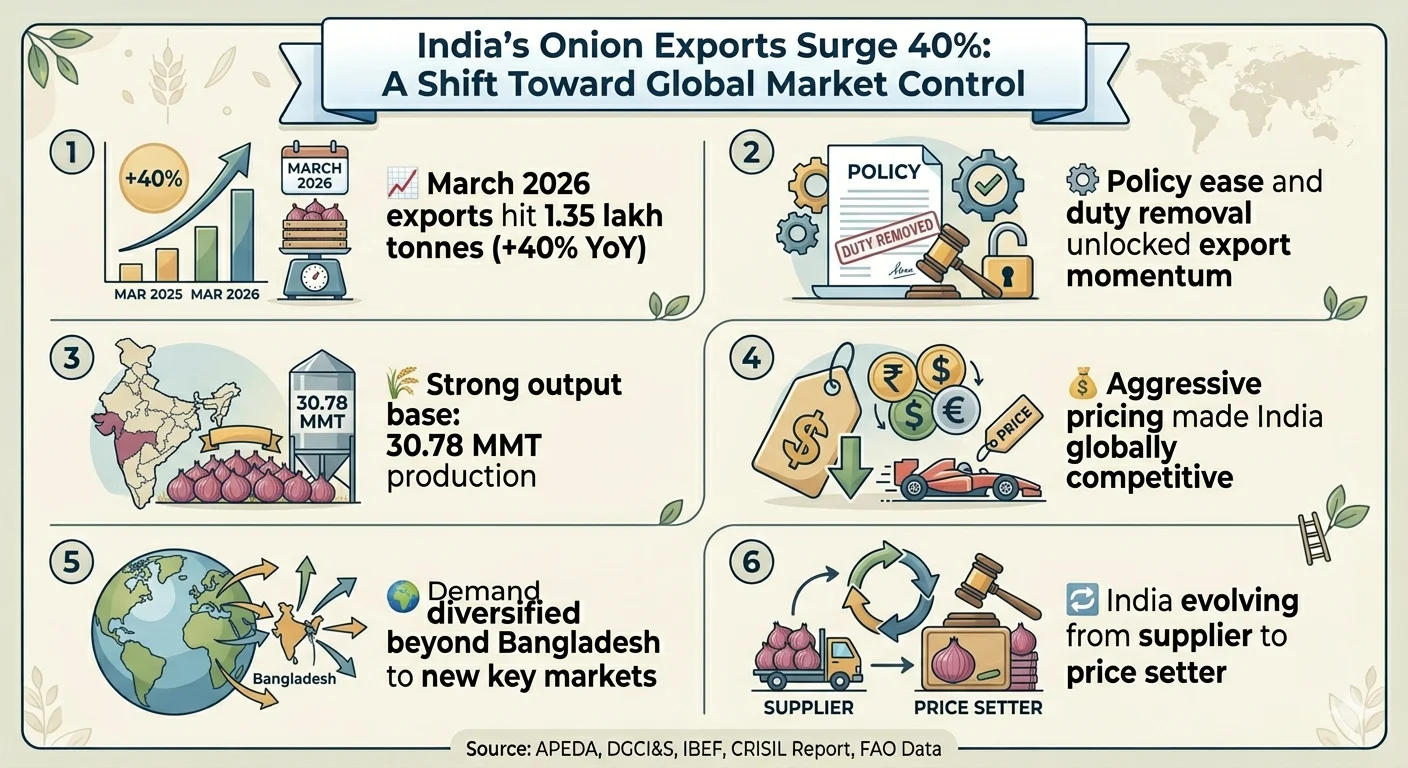
The March 2026 data is a middle finger to the competition. Moving 1.35 lakh tonnes in a single month is a massive logistical flex. This surge isn't just about moving volume; it’s about India effectively re-establishing itself as the regional price setter while competitors are still trying to figure out their shipping routes.
The Three Engines Driving the Surge
This 40% growth wasn't a gift; it was engineered through three brutal tactical shifts:
- Policy Normalization: The "stop-start" era of export bans and Minimum Export Prices (MEP) is dead for now. The 20% export duty was scrapped, giving exporters the green light to flood the zone with zero friction.
- The Production Anchor: With an annual output sitting at a robust 30.78 million metric tonnes (MMT), India is sitting on a mountain of stock that has transformed from a domestic weight into a global trade weapon.
- Price Aggression: Indian traders are currently undercutting global rivals with surgical precision, ensuring that even with bloated shipping costs, Indian onions remain the most aggressive play on the board.

Market Shift: Killing the Single-Buyer Trap
The biggest win in the March 2026 data isn't the volume—it's the diversification. For too long, India was a "one-trick pony," dangerously over-leveraged on the Bangladesh corridor. But the 2026 playbook has changed.
When Dhaka tightened its belt, India didn't blink. Instead, we pivoted with high-velocity precision into new hubs. Malaysia (21%), UAE (19%), and Sri Lanka (17%) have emerged as the new apex buyers. This isn't just growth; it’s a total redistribution of demand that makes the Indian export machine more resilient than ever before.
Global Context: Thriving in the Friction
While the Gulf is a mess of trade volatility and freight spikes, India’s onion tonnage is moving. The "price premium" in markets like the UAE is effectively a tax on those who don't have India’s supply muscle. While other origins are struggling with yields, India is anchoring food security for nations across the Southeast Asian and Gulf corridors.
Impact: Who Wins in the 2026 Corridor?
- Exporters: The shift to high-margin markets in the GCC is a massive payday for those who can clear the technical audit trails and meet the rigorous quality standards.
- Bulk Importers: Southeast Asian buyers now have a caloric insurance policy that doesn't depend on regional spot-buy luck.
- The Domestic Game: The indirect pressure of strong global demand ensures that the domestic surplus doesn't lead to a farm-gate price crash, protecting the bottom line for the entire value chain.
The Risks: The Ghost in the Machine
Don't get it twisted—the trade is still a "high-friction" game. Sudden policy pivots or currency swings can still turn a profitable contract into a logistical nightmare overnight. In 2026, if you don't have the stomach for volatility, the agro-trade will eat your margins before the first vessel leaves the dock.
The Bigger Trade Insight: India Holds the Bread
India’s agro-exports have graduated. We are no longer just a volume-heavy regional player; we are a demand-resilient powerhouse. This 40% surge is the early signal of a structural shift where India doesn't just fill the plate—it owns the corridor.
The Final Word: Forward Outlook
While the "Standard AI" talking heads focus on short-term spikes, the smart money sees structural change. India is leveraging its massive tonnage to bankroll a total takeover of the regional agro-corridor. We’ve found our touch; now the rest of the world has to figure out how to keep up.