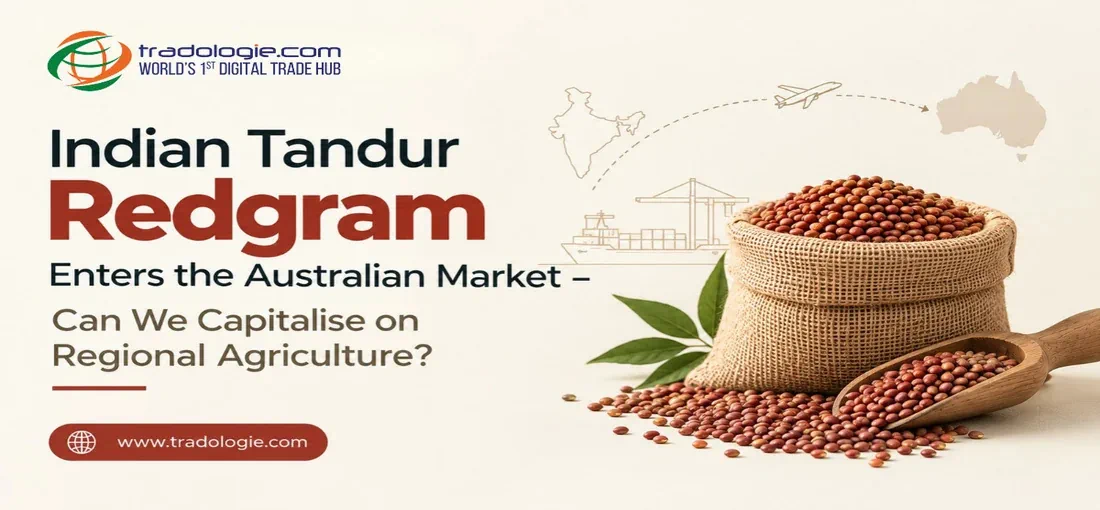
While exporting 2.5 tonnes of redgram won't immediately transform the global agricultural landscape, sometimes it isn't the volume we are exporting at present that we should be looking at.
This first consignment of GI-tagged Tandur Redgram from Telangana, facilitated by the Agricultural and Processed Food Products Export Development Authority (APEDA), will be a meaningful step in the right direction and was exported by Durga Exports and Imports under their brand AMMAAS.
While it may appear like a modest quantity to be exporting, it can be seen as a stepping stone towards establishing a sustainable relationship with buyers.
It shows that we can take a regional agricultural product and demonstrate that we can actually sell it thousands of kilometres away with commercial viability.

India Has More to Offer!
For a long time, we have talked about the strength of our Indian agricultural exports due to substantial export volumes, competitive pricing, etc. These are all key factors in succeeding in the bulk market. However, we do have a diverse range of agricultural produce with distinctive attributes rooted in the regions where they are cultivated.
Tandur Redgram is a compelling example. As stated in the APEDA announcement, it is primarily cultivated in the four mandals of the Tandur region in Telangana. Its distinctive characteristics are linked to the region’s rich black soil, attapulgite clay mineral and limestone deposits. It has also been the first agricultural product from Telangana to receive a Geographical Indication (GI).
Having a GI means we can leverage the regional characteristics of the pulses to help us differentiate ourselves from other suppliers.
However, having a GI doesn't necessarily mean we will command premium prices or generate increased demand. We will need to ensure buyers recognise that the product is high quality, competitively priced and readily available. This means we have an opportunity to distinguish ourselves, but it is down to the exporters to translate this into a tangible commercial opportunity.
A Strategic Starting Point
Australia is a logical market to begin with. We have a sizeable population from India and there is an established South Asian grocery market. This means we can target local buyers looking for Indian pulses. We have access to Indian food distributors, wholesalers and niche retailers.
However, we shouldn't restrict ourselves to just exporting to the Indian community.
We should aim to cultivate relationships with importers and distributors who can generate repeat business. Understanding how they source their pulses, their preferred packaging sizes, which price points work and whether they have a compelling reason to buy our product because of its distinctive qualities.
While the first consignment won't answer all these questions, it gives us an opportunity to assess the product's reception in the market.
If we receive positive feedback, we can build on this foundation. If buyers have any concerns about pricing, packaging or availability, we can learn from this and use it to refine our next consignment.
Think of this first consignment as the beginning of a long-term commercial relationship.

India's Pulse Export Market
Looking at the overall figures:
According to DGCIS, In FY2025-26, India exported approximately 10.01 lakh metric tonnes of pulses worth US$969.53 million. Significant quantities went to China, the UAE, Bangladesh, the United States and Sri Lanka.
This means we have an established export market. We have buyers, networks and experience. Tandur Redgram doesn't have to start from scratch. It can leverage the existing relationships and capabilities within India's pulse export industry.
Overall:
| Trade Indicator | Why it Matters |
|---|---|
| India's Pulse Exports = US$969.53 million (FY2025-26) | We have an established industry to facilitate our entry into new markets. |
| First Tandur Redgram Consignment to Australia = 2.5 MT | We can test the product with buyers. |
| GI | We can leverage its geographical characteristics to differentiate the product. |
| Processed & Branded Product | We can generate additional value through processing and packaging. |
Sources: APEDA Pulse Export Statistics, Government of India Announcement (28th October 2026).
While we have a strong overall export market, Tandur Redgram will still need to establish its own demand, price positioning and distribution channels. However, it can leverage our existing expertise in exporting this category of product.
Can We Do More Than Just Export in Bulk?
While exporting in bulk is fine, and an essential part of agriculture, it is often the most straightforward way for many exporters to increase volumes. However, we do have a product with a recognised regional identity, so we can explore alternative avenues.
By offering consumer-ready packaging, branded pulses, grading and ready-to-cook pulses, we can access new channels. Retailers may be interested in pulses with a distinctive origin story, and distributors can explore selling to customers who already appreciate Indian pulses.
While these are just opportunities to explore, we do need to consider the additional costs of processing, packaging, marketing and retailing. We wouldn’t want to commit substantial resources without establishing that there is sufficient demand.
However, if we shift more of the processing, packaging and branding activities to India, we can generate greater economic opportunities. We can create jobs for processors, packaging companies, regional aggregators and food businesses.
We don't want to abandon bulk exports, but we should explore how we can leverage the product to develop a more compelling value proposition.
Will Farmers Benefit?
Perhaps the most important question to ask.
Having a GI can enhance recognition for the product, but a farmer won't necessarily earn more money from it. It depends on the supply chain and how much of the additional value we can pass on to them.
If we generate more overseas demand, we need to ensure we have reliable procurement processes, clearly defined quality standards and equitable pricing to ensure our farmers aren't missing out and the bulk of the benefits isn't going to the middlemen.
We also need to ensure we preserve the regional identity.
As reported by The New Indian Express (20th October 2026), Telangana is looking to register around 65,000 farmers who grow GI-tagged Tandur Redgram using its digital traceability system. This can help reinforce confidence in the product's origin if implemented effectively.
This is important because we won't derive any benefit from having a geographical identity unless buyers have confidence in it. As demand grows, sustaining that confidence will be essential.
The Real Challenge
Many times, we hear about how great it is to export, but the real challenge begins afterwards.
Will the Australian importer place another order? Can we maintain consistent quality? Will the price remain competitive after freight, handling and distribution costs? Can we scale without compromising the product’s identity while ensuring our farmers receive a fair return?
This will determine whether we can establish repeat business with Tandur Redgram.
We also need to consider Australia's import requirements. The BICON system on the Australian Department of Agriculture website outlines the biosecurity and import requirements for each commodity. We need to ensure our product complies with these requirements.
This is an essential part of exporting, but we also need to ensure we have commercially viable pricing, a dependable supply, strong relationships with buyers and a clear understanding of how our product can fit into the market.
If we start receiving repeat orders, Tandur Redgram can become a compelling example of how we can export regional agricultural products with a distinctive identity.
India Should Think Differently About Our Agricultural Exports
We have a diverse range of agricultural produce, which is a significant advantage. We have the capability to produce and export to international markets, so we should look to establish stronger commercial identities around our products. As stated in the APEDA Farmer Connect overview, we export our agricultural products to over 200 countries and regions. This can serve as a foundation for cultivating new markets and introducing products that may not currently have a strong international presence.
Rather than assuming we need to export more of the same, we can sometimes explore opportunities to develop new buyers for our regional products. Build a reputation around our products and generate additional value within the country.
While the first shipment to Australia doesn't establish that this approach will work, it gives us an opportunity to test it.
The real milestone will be when we start receiving repeat orders, farmers begin to see the benefits and Tandur Redgram starts to establish its presence in the international market.