
Indian rice prices have climbed to a more than one-year high. That may sound like good news for exporters, but the reality on the ground is a little more complicated. Higher prices can bring better returns. They can also make it harder to win orders.
There is a question worth asking when rice prices start moving up. Who is actually benefiting?
The exporter selling rice today may be getting a better price than a few weeks ago. But the same exporter could also be paying more for paddy, spending more to finance inventory and facing a buyer who is suddenly less willing to commit. Somewhere between the farm gate and the final shipment, the apparent advantage can begin to disappear.
That is the part of the current market that deserves closer attention.
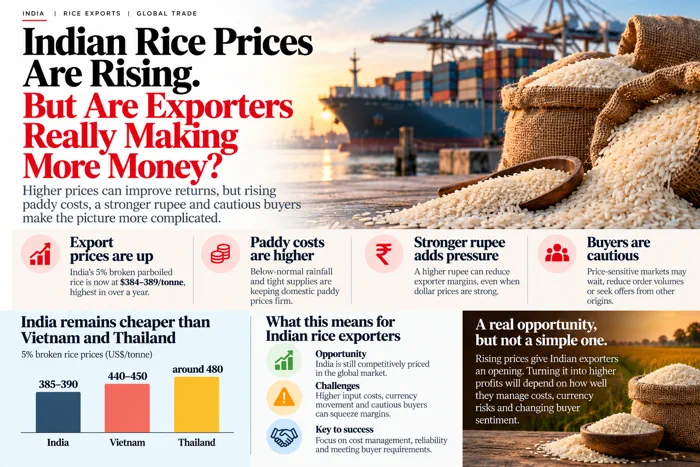
India's 5% broken parboiled rice was quoted at $384-389 per tonne this week, compared with $378-384 a week earlier. White rice of the same broken percentage was trading at $385-390 per tonne. Prices have climbed to their highest levels in more than a year, with tighter domestic supplies and a stronger rupee among the factors influencing the market.
The immediate reaction might be that Indian rice exporters are in a stronger position. I would be a little cautious about drawing that conclusion just yet.
The trouble starts with the cost of buying rice
The pressure is building well before the rice reaches the port.
Below-normal rainfall in several states has raised concerns about production, and domestic paddy prices are staying firm amid limited supplies. For exporters and millers who need to procure fresh stock, this matters more than the headline export price.
Think about the sequence. An exporter receives an inquiry from an overseas buyer, works out a quotation and begins arranging the required quantity. If paddy prices rise before the purchase is completed, the original calculation may no longer hold. The exporter then has to renegotiate, accept a thinner margin or walk away from the order.
None is an ideal outcome.
Of course, not everyone is in the same position. An exporter who bought stock earlier, at a lower price, may now have some room to negotiate. Someone entering the market today has a different problem altogether. They must buy at current rates and still offer a price that makes sense to an international buyer.
This distinction often gets lost when market reports describe rising prices as a positive development for exporters. The market quotation tells us what rice is being offered for. It does not tell us what the exporter paid for it, how much financing the stock requires or what remains after the shipment is completed.
And that is where profitability is decided.

India is cheaper than Vietnam and Thailand. For now, that helps.
There is, however, a genuine advantage for Indian suppliers.
Vietnamese 5% broken rice has climbed to $440-450 per tonne, while Thai rice has reached around $480 per tonne. Against those offers, Indian white rice at $385-390 remains considerably cheaper.
For an importer buying thousands of tonnes, that difference is difficult to ignore. Rice is a price-sensitive commodity, particularly in markets where governments, distributors and large buyers have to balance procurement costs against consumer affordability.
India therefore has an opportunity to remain competitive even as its own prices rise.
But there is a catch. A lower quotation does not automatically translate into a confirmed order. Buyers look at quality specifications, shipment schedules, payment conditions, freight and the seller's ability to deliver the promised quantity. Price matters enormously, but it is not the only consideration.
And buyers have choices. If Indian quotations continue rising, some may postpone purchases, reduce the quantity they order or seek fresh offers from other origins. Others may continue buying because their stocks are running low and they cannot afford to wait.
The response will depend on the destination market and the buyer's immediate requirements. That is why it would be premature to assume that India's current price advantage will necessarily translate into a surge in export orders.
It gives Indian exporters an opening. They still have to convert it into business.
A stronger rupee is not necessarily good news for every exporter
Currency movements add another complication, and one that deserves more attention than it sometimes receives.
When the rupee strengthens, Indian goods can become more expensive for overseas buyers if dollar quotations are adjusted to reflect the exchange-rate movement. At the same time, exporters receiving payments in dollars may get fewer rupees when they convert those earnings, depending on the rate at the time of conversion.
The effect on an individual exporter depends on how the transaction is structured. A business that has already secured its procurement costs and managed its currency exposure may be relatively comfortable. Another, buying expensive stock and receiving payment later, could find that its margin is being squeezed from two directions.
This is not an argument against a stronger rupee. It is simply a reminder that export competitiveness and exporter profitability are not quite the same thing.
For businesses planning to export rice from India , the practical lesson is straightforward: the dollar quotation alone is not enough. Procurement costs, conversion rates, financing expenses and the timing of payments all need to be considered before committing to a price.
A contract that looks profitable when the offer is made may look rather different by the time the money comes in.

Buyers are not necessarily disappearing. They may simply be waiting.
There is another assumption worth challenging: that rising prices automatically indicate stronger demand.
Sometimes they do. But prices can also rise because supplies are tighter, even when buyers are reluctant to pay more. The distinction is important in the present market.
In Vietnam, traders have pointed to expectations of renewed Philippine purchases from November. Thailand has also seen support from vessel arrivals and additional buying activity. These developments help explain the firmness across Asian rice markets, but they do not mean that every major importing country will suddenly increase its purchases.
For Indian exporters, the more useful question is what individual buyers are doing.
A buyer running short of inventory may accept a higher price because waiting carries its own risks. Another with sufficient stocks may decide to sit out the market for a few weeks. A large importer might continue purchasing but negotiate smaller lots or ask for more time before confirming the next shipment.
From the seller's side, these differences matter. An inquiry is not an order, and an order is not necessarily a profitable shipment.
If buyers are asking for quotations but taking longer to confirm them, exporters should pay attention. It could be a sign that the market has reached a point where the cost of waiting is being weighed against the cost of buying.
That is a different situation from one in which buyers are competing to secure supplies.
For those exporting rice in bulk, the real test is the margin
The current market makes one thing particularly clear: procurement discipline matters just as much as selling ability.
Consider two exporters quoting the same price to an overseas buyer. One has already purchased stock at lower rates. The other still needs to buy the rice at today's prices. On paper, they are offering the same product at the same price. In reality, their margins may be very different.
This is why exporters looking to export rice in bulk need to think beyond the immediate market quotation. Securing reliable supplies, calculating the full cost of delivery and matching procurement with confirmed demand can make a substantial difference when prices are moving quickly.
There is also a risk in assuming that rates will keep rising. An exporter who buys heavily at elevated prices in anticipation of further increases may be left holding expensive inventory if demand slows or new-crop arrivals improve.
Equally, waiting indefinitely for prices to fall can mean missing orders that could have been fulfilled profitably.
There is no perfect answer. Each business has a different inventory position, financing capacity and appetite for risk. But in a market like this, making large commitments based solely on the direction of prices is a gamble, not a strategy.
The next few weeks will tell us more than this week's prices
Three things deserve watching. The first is the availability of new-crop paddy. If supplies remain tight, domestic procurement costs could stay elevated. If arrivals improve, some of the pressure may ease. Exporters should avoid treating either outcome as a certainty.
The second is actual buying activity. Are overseas buyers confirming orders at higher prices, or are negotiations dragging on? Are shipment volumes holding up? These are more useful signals of underlying demand than a rising quotation on its own.
The third is the price gap between India and competing origins. India's advantage over Vietnam and Thailand remains substantial at the quoted levels. But if Indian prices rise faster than competing offers, that advantage will narrow. How much room remains will depend on what happens across all three markets.
None of these developments can be predicted with certainty. That is precisely why exporters need to keep their procurement decisions tied to real demand rather than expectations alone.
Higher prices are one thing. Better business is another.
Indian rice exporters have reasons to remain cautiously optimistic. Their prices are still competitive against the quoted offers from Vietnam and Thailand, and buyers who need supplies may continue to find Indian rice attractive.
But a rising market does not reward everyone equally.
Exporters holding lower-cost inventory may be well placed to benefit. Those buying fresh stock face a tougher calculation, particularly if overseas buyers begin resisting further price increases. The stronger rupee adds another variable, while uncertainty over domestic supplies makes it harder to plan procurement with confidence.
My view is that this is a market for careful execution rather than aggressive speculation. Secure the stock where the economics work, quote with a clear understanding of costs, and do not confuse an interested buyer with a confirmed sale.
The coming weeks may bring further price increases. They may also bring a period of consolidation if supply improves or buyers step back. Either way, the exporters best placed to navigate the market will be those who understand their margins before they commit to a shipment.
Because, at the end of the day, the rice trade is not about who quotes the highest price. It is about who can buy, sell and deliver at a price that leaves a business worth running.
Want to export or import rice in bulk globally? Register as a buyer or seller on Tradologie today.