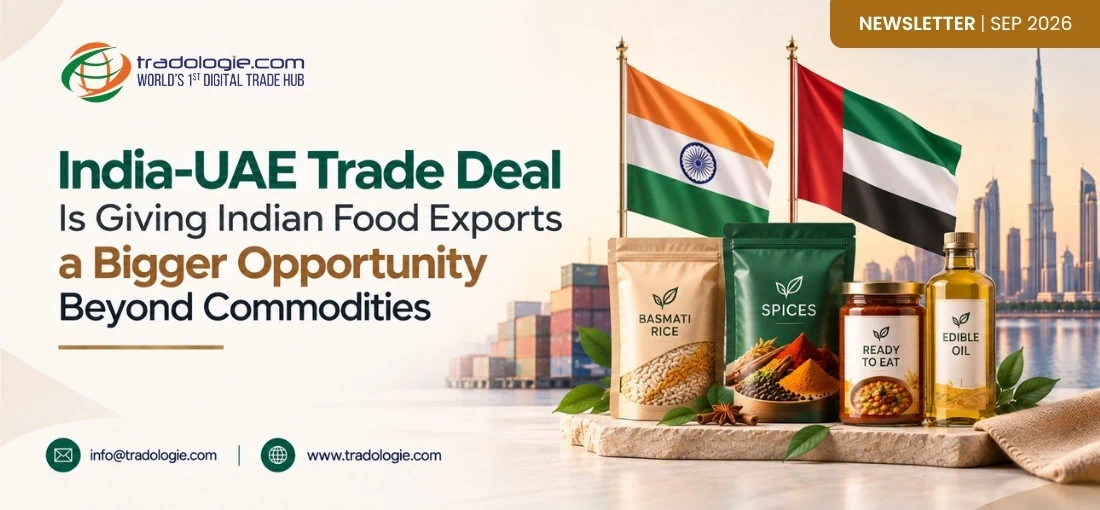
The UAE opportunity is no longer only about shipping more agricultural produce. For Indian exporters, the bigger prize may be in processing, packaging and building food brands that can travel far beyond the farm gate.
India's food export story may be entering a more interesting phase. The India-UAE Comprehensive Economic Partnership Agreement (CEPA), which came into force in 2022, has already opened substantial preferential market access, with the UAE eliminating tariffs on 97% of its tariff lines covering about 99% of Indian exports by value. The latest focus on food trade points towards something more significant: the opportunity to move beyond exporting agricultural commodities and export FMCG food products, packed foods and other valued added products to the UAE.

That distinction matters. India has never really lacked agricultural production. What it has often struggled to capture is the value that comes after the crop leaves the farm. A bag of raw agricultural produce and a finished food product made from that same agricultural base may contain very different amounts of economic value.
The UAE could become an important market for closing that gap.
The opportunity is moving from what India grows to what India can make
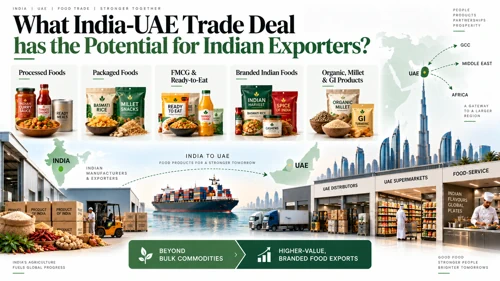
The Department of Commerce has been highlighting opportunities across processed food preparations, biscuits and bakery products, chocolates, preserved potatoes, cashews, dried chillies and other food categories, alongside emerging areas such as organic and GI-tagged foods, ready-to-eat products, millet-based foods, plant-based products and ethnic and fusion beverages.
That is a considerably broader opportunity than simply exporting another container of raw agricultural produce.
And there is a reason this matters now.
Indian food manufacturers have spent years building capabilities in processing, packaging, preservation and product development. Many of these companies are already selling successfully in the domestic market. The question is whether they can take those products into international markets at scale.
The UAE provides a natural place to try.
Why the UAE is more than just another export destination
The UAE is a major consumption market, but its importance to Indian food exporters goes beyond its own population.
Its logistics infrastructure, distribution networks and position within the Gulf make it a commercially useful base for reaching wider Middle Eastern markets. The Department of Commerce has previously noted that the India-UAE CEPA is expected to support exports not only to the UAE but also to the wider Middle East and Africa.
That changes the calculation for an Indian food manufacturer.
A company does not necessarily have to think of the UAE as the final destination. It can be thought of as the first serious international market from which its products can build a presence across a wider region.
For a packaged-food company, that distinction can be enormous.
This is where processed food becomes more interesting than bulk commodities
There is nothing wrong with commodity exports. Rice, spices, pulses and other agricultural products remain important parts of India's export basket.
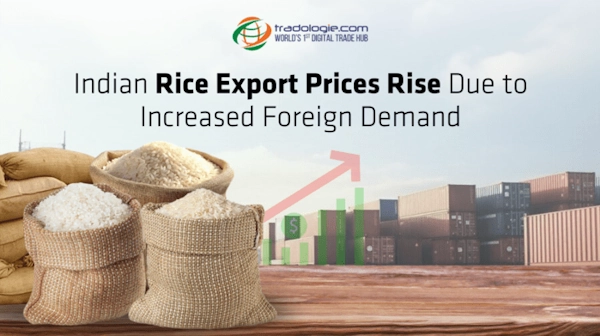
But commodity markets are often highly price-sensitive. Weather changes, production estimates, government policies and competing origins can move prices quickly. The recent movement in Indian rice prices is a good example of how closely agricultural exports remain tied to crop conditions and global supply expectations.
Processed food operates differently.
When an Indian company takes a raw agricultural product, processes it, packages it and sells it under a brand, it is no longer competing only on the price of the underlying commodity.
It is selling convenience, taste, packaging, formulation, quality and brand recognition.
That gives the exporter more ways to differentiate.
This is why the opportunity to export processed food to the UAE may ultimately be more important than simply increasing the tonnage of raw agricultural exports.

Indian food brands have a chance to move up the value chain
Consider what happens when a millet leaves an Indian farm.
As a raw commodity, its value is largely determined by quality, supply, demand and the prevailing international price. But turn that millet into a breakfast product, snack, flour, ready-to-eat meal or beverage, and the commercial equation changes.
The same logic applies to potatoes, chillies, fruits, nuts and several other agricultural products.
Processing creates another layer of value.
Packaging creates another.
Branding creates another.
Distribution creates another.
That is the real economic opportunity behind the push to export packed food.
India is not merely trying to sell more of what it already produces. It has an opportunity to earn more from the same agricultural ecosystem by moving further along the value chain.
The new categories are particularly interesting
Organic and GI-tagged products are especially interesting because they give Indian exporters something that cannot always be replicated simply by offering a lower price.
A GI-tagged food carries a connection to its geographical origin and traditional identity. Organic products appeal to a different set of consumer expectations. Millet-based foods fit into the global interest in healthier and alternative grains, while plant-based and ready-to-eat products speak to convenience and changing consumption habits.
APEDA's own focus areas include ready-to-eat and ready-to-cook products, organic foods, GI-tagged agri-food products, ethnic Indian foods, millet-based products and plant-based alternatives.
These are not necessarily mass commodities.
They are products that can be positioned.
And positioning is where Indian food businesses can potentially capture considerably more value.
But easier market access will also make the market more competitive
This is the part exporters should not overlook.
An FTA can open a door. It cannot guarantee that every company walking through it will succeed.
Once access improves, buyers have more choices. UAE importers and distributors can compare Indian products against suppliers from other countries and, increasingly, compare Indian suppliers with one another.
The conversation therefore moves beyond price.
Can the exporter maintain the same quality from one shipment to the next? Is the packaging suitable for the market? Does the product have the required certifications? Is the shelf life adequate? Can the manufacturer supply consistently? Can the company meet delivery schedules?
These questions become particularly important when you export FMCG food products , because an FMCG buyer is not purchasing a one-off shipment and walking away. The buyer may be building a retail business around the product.
Reliability becomes part of the product itself.
The UAE could help Indian brands become regional brands
There is another opportunity hiding behind the trade numbers.
An Indian food company that successfully enters the UAE is not merely gaining one export market. It is potentially gaining a reference market.
Once a product has established itself with a UAE importer or distributor, the company has a stronger foundation from which to approach other Gulf markets. That can be especially useful for smaller manufacturers that do not have the resources to build separate sales operations across every country.
In that sense, the UAE can function as a bridge between Indian manufacturing and Middle Eastern consumption.
And that makes the opportunity particularly relevant for SMEs.
A small food manufacturer may not be able to compete with a global multinational on advertising expenditure, but it can compete with a differentiated product, good packaging, consistent quality and the ability to respond quickly to a niche market.
Exporting packed food is ultimately a different business from exporting a commodity
This shift requires exporters to think differently.
When you export packed food , you are not simply filling a container. You are sending a finished consumer proposition into another market.
The packaging has to work. The label has to work. The shelf life has to work. The price has to work. The distribution model has to work.
And the brand has to give the importer a reason to believe that consumers will actually pick it up from the shelf.
The same is true when companies export branded food products . The product may originate from the same agricultural ecosystem as a commodity export, but its commercial identity is completely different.
That is precisely why the UAE opportunity is worth watching.
India's next food-export opportunity may be in the middle of the value chain
For years, the conversation around agricultural exports has often revolved around producing more and exporting more.
The next stage could be slightly different.
Process more. Package better. Brand intelligently. Export further.
The India-UAE CEPA provides a favourable market-access framework, but the larger opportunity lies in what Indian businesses do with that access. If manufacturers use it to export processed food, build distribution relationships and establish recognisable Indian food brands, the benefit can extend well beyond one country's import demand.
That is why the UAE opportunity should not be viewed simply as another destination for Indian agricultural exports.
It could become a testing ground for a more ambitious Indian food-export model—one in which the country does not stop at exporting what it grows, but increasingly exports what it creates from what it grows.
And that is a much more valuable proposition.
Conclusion:
The India-UAE trade agreement gives Indian food exporters an opportunity to think beyond conventional commodity shipments and compete in higher-value segments. From processed and packaged foods to branded FMCG, millet-based, organic and GI-tagged products, the scope is considerably wider. The real advantage, however, will belong to exporters who can combine competitive pricing with consistent quality, strong packaging, regulatory compliance and reliable supply. The UAE can therefore serve not just as an export destination, but as a launchpad for Indian food brands seeking a larger regional presence.