Key Highlights
- India's black tea exports reached a record high in FY 2025-26.
- Orthodox black tea is driving export growth and higher margins.
- China, Iraq, and the UAE are major growth markets.
- Strict residue compliance has strengthened India's global reputation.
- Proper packaging and moisture control are critical for exports.
- Early sourcing and lab testing help secure premium buyers.
Global soft commodity desks are watching a quiet shift in where international bulk tea importers source bulk tea. With orthodox supplies tightening in traditional exporting regions, buyers across the Gulf, Central Asia, and East Asia have turned aggressively toward South Asia.
That shift pushed Indian tea exports across all categories to an all-time high in FY 2025-26, moving 282.11 million kilograms and bringing in ₹8,718.83 crore (roughly $988 million).
The big factor behind that total isn't standard bag-grade CTC—it's black fermented and partly fermented tea (HS 090240). Tea exports from India moved 233.3 thousand tonnes in FY 2025-26, pulling in a record $746.2 million.
If you plan to export tea from India , don't treat this as just a one-off spike. Compare $746.2 million to where the market sat five years back in FY 2021-22—around $570.8 million—or even FY 2024-25 at $692.0 million on 216.7 thousand tonnes. Value per kilogram held firm even as physical volume surged. That is a clear signal: global bulk tea buyers are willing to pay for reliable, high-grade leaf, opening a serious window for trade desks that move fast.
Keep reading this informative piece of blog, if you want to export tea in bulk , this blog will provide you all the vital information related to the recent development in the Indian tea production and market.

Where the Real Profit Is In Tea Exports From India: The Orthodox Shift to China and the Gulf
Take China. They dominate global green tea, yet Chinese trading houses are buying up premium Indian orthodox lots for specialty consumer lines and commercial blending.
That dynamic completely changes an exporter's leverage at domestic auctions. When you aren't stuck relying solely on Middle Eastern bulk tea buyers to clear your warehouse, you don't have to discount your inventory to move volume. You hold the leverage at the bidding table.

Tighter Residue Rules Turned Out to Be a Commercial Advantage
A few seasons ago, pesticide residue scares and loose documentation caused painful cargo rejections at destination ports. That headache is mostly behind us now.
Many experts strongly believe that the Strict Maximum Residue Limit enforcement by the Tea Board of India, along with the digital GI traceability for Darjeeling and regional Assam teas, has acted like a very effective market filter. Basically, it stops cheap and unauthorised blends from decreasing the value overseas.
Destination customs clear accredited cargo faster now. For serious trade houses, these strict regulatory checks aren't red tape—they're a competitive moat against low-tier brokers who can't pass a lab assay.
What This Means for Estate Bidding and Local Auctions
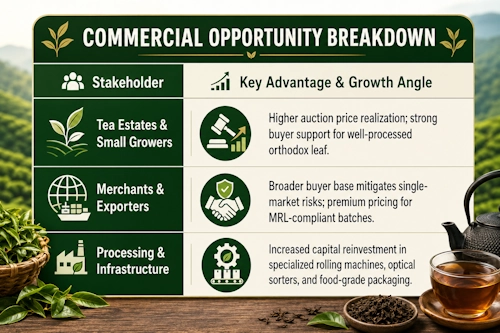
- Auction Floor Support: Aggressive bidding from overseas buyers in Kolkata, Guwahati, and Siliguri sets a solid baseline price. Bought-leaf factories pay small tea growers better green-leaf rates when export demand is active.
- Diversified Risk: Diversification in the market and end customers. Well, we all have heard it many times. The same goes for tea exports from India. Thus, diversifying shipments across China, North America, and a variety of CIS nations means that in case of a political slowdown in one nation, your shipment won’t collapse.
- Factory Hardware Upgrades: With orthodox grades fetching far higher returns than standard CTC, garden owners are putting money back into gentle rollers, precise drying floors, and organic compliance to capture premium overseas contracts.
Logistics Reality: Moving Bulk Cargo Without Ruining the Leaf
Moving tea is nothing like moving wheat or rice. Tea leaf acts like a sponge for ambient humidity and smells. One mistake in container setup destroys the entire lot before the vessel even clears the bay.
Direct Sourcing and Grade Verification
Buy straight from registered auction channels or set up private estate contracts. Be explicit in your purchase specs—specify whether you need Whole Leaf (FTGFOP), Brokens (FBOP), or Fannings for tea-bag applications.
Lab Testing Before Cargo Leaves the Yard
Pull composite samples from every packed batch before sending trucks to the port. Run them through NABL-accredited labs for chemical residues, heavy metals, and moisture content. Keep moisture under 6.5% if you want to avoid port rejections in Europe or North America.
Moisture Barriers Are Non-Negotiable
When you intend to export tea in bulk , standard dry containers need thermal or heavy kraft liners. Period.
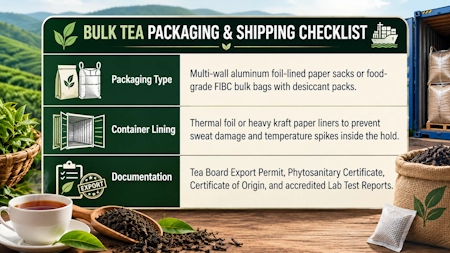
Bulk tea suppliers who try saving a hundred dollars by skipping container liners usually pay for it later in mold damage, off-flavors, and denied insurance claims at the discharge port.
To Sum Up:
Record trade years set a high bar, but global demand isn't cooling off. B2B bulk tea buyers want clean, traceable, well-packaged orthodox leaf and they are ready to pay for it. Bulk tea sellers who lock in estate supply early, run strict pre-shipment lab assays, and back their shipments with proper container insulation will lock down the best-paying long-term buyers this season.
Disclaimer
Statistical data referenced comes from published releases by Tea Board India, the Press Information Bureau (PIB), and the Department of Commerce. Quality standards, MRL allowances, and import documentation rules vary by destination country and remain subject to official regulatory updates.