When the Directorate General of Foreign Trade (DGFT) moves on a sensitive agri-commodity tariff line, trade desks take notice. Creating a temporary zero-duty Tariff Rate Quota (TRQ) against the normal 100% Basic Customs Duty (BCD) on raw sugar imports to allow a 1-million-tonne import quota until October 31, 2026, is a classic market intervention.
Domestic wholesale spot prices ran up nearly 40% in just eight weeks, driven by tighter mill-gate availability and an impending festival demand spike. With domestic supplies tightening, the government pulled the standard lever: opening a temporary, zero-duty Tariff-Rate Quota structure.
This is the first time in nearly a decade that India has stepped in as a major buyer of raw sugar. It offers a classic case study in how border-tax policy, physical refining logistics, and global commodity pricing interact across physical and futures markets.

The Domestic Math: Tariff Suspension and Port-Based Refining Logistics
Under standard sugar trade conditions, India's sugar sector is one of the most heavily insulated agricultural markets globally. The 100% duty acts as a firewall:
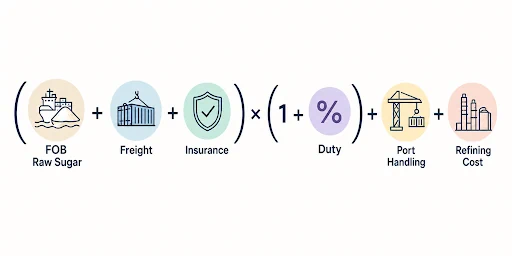
With that 100% tariff in place, import parity was generally unviable for conventional domestic sugar imports , leaving the domestic market dependent on internal production cycles, state-mandated Fair and Remunerative Price (FRP) economics, and monthly domestic release quotas.
By taking the duty to zero, the government instantly altered the import parity calculus.
Standalone, port-based refiners configured to process bulk VHP (Very High Polarization) raws gain access to a temporary import-arbitrage window.
There is an immediate physical cushion in play: roughly 300,000 tonnes of already-imported raw sugar and related refinery stocks can potentially be mobilised into the domestic market.
The remaining balance of the 1-million-tonne TRQ is likely to rely primarily on Center-South Brazil origins. Given vessel chartering timelines, berth availability at Santos, and a roughly two-month sailing transit across the Cape to western Indian ports like Kandla or Jaigarh, much of the physical breakbulk volume will arrive closer to September and October. That timeline matches the peak festive consumption window.
The Market Dynamics: London and New York Pricing vs. Spot Levels
The announcement produced an interesting dynamic: domestic wholesale prices softened while the prompt contracts on ICE Raw Sugar (No. 11, New York) and White Sugar (No. 5, London) jumped up to 4%.
INDIA TRQ POLICY ANNOUNCEMENT
- Raw Sugar Imports ↑
- Market Supply ↑
- Domestic Spot Price ↓
GLOBAL IMPACT
- Net Global Demand ↑
- Brazilian FOB Raws ↑
- ICE Futures (No.11) ↑
This divergence reflects the mechanics of global agricultural supply:
- Domestic Spot Compression: The arrival of port-refined sugar increases physical pipeline liquidity, limiting the pricing leverage of inland cooperative and private mills in Maharashtra and Uttar Pradesh. Consumer-facing food and beverage processors, confectioners, and bulk sweet manufacturers gain direct relief from runaway ingredient inflation.
- Global Equilibrium Shifts: Adding an incremental 1-million-tonne demand pocket to the global balance sheet can shift the international export pricing curve outward.
- The Brazil Freight Bottleneck: Brazilian millers operate with a swing capacity between ethanol and raw sugar crystallization. Siphoning off prompt CS Brazil vessels for the Indian subcontinent could leave competing destination markets in the Middle East, North Africa, and East Asia bidding up prompt FOB premiums and dry-bulk supramax charter rates.

Historical Context: Tariff Adjustments as a Balance Valve
This tariff suspension follows a well-established pattern of using import/export policies to balance the domestic market. A look at historical customs tariff notifications illustrates how duty rates track domestic cane cycles:
| Timeline | Tariff Mechanism | Policy Objective |
|---|---|---|
| 2014-2015 | BCD raised from 15% to 25%, then 40% | Stemming global surplus inflows and supporting mill-gate prices |
| 2016-2018 | Imports surged (~2.14M to 2.40M tonnes), duty later raised to 50% and 100% | Clearing domestic shortfalls via Brazil, then restoring protection as local output recovered |
| 2022-2023 | Export restrictions and quotas introduced | Capping export volumes to protect domestic availability and ethanol-blending targets |
| 2026 | Zero-duty TRQ on 1M tonnes raw sugar | Providing immediate supply to curb a 40% domestic price run-up ahead of festival demand |
The mechanism remains consistent: in periods of structural surplus, export subsidies and high import barriers insulate farm economics; in periods of supply deficits, duty waivers can act as a targeted intervention.
Market Outlook: A Three-Stage View
From an international sugar trade perspective, this zero-duty TRQ represents a tactical balance-sheet adjustment rather than a structural, multi-year bull cycle:
1. Immediate Reaction: The market prices in the new demand shock, lifting front-month ICE futures and firming Brazil-origin physical cash premiums.
2. Execution Phase (Through October 2026): Refiners execute maritime bookings, unload vessel tonnage, and process raws into refined whites. This redistributes global physical inventories without expanding net global production.
3. Post-October Horizon: The medium-term outlook hinges on the 2026-27 Indian sugarcane crop estimates, monsoon performance across the Deccan plateau, and the government's target for its Ethanol Blended Petrol (EBP) program. If cane crushing indicates a healthy recovery, the temporary zero-duty window will likely expire, returning imports to the normal tariff regime. If deficits persist, discussions around TRQ extensions will return to the trading floor.
For now, the policy manages a tight domestic supply window, shifting immediate inventory pressures to the global market.
Conclusion:
At the end of the day, this move shows just how quickly local policy tweaks can shake up the entire global market. Dropping that 100% tariff gives Indian buyers a much-needed break from runaway prices right before the busy festive rush, putting consumer relief and industrial food makers ahead of domestic mill profits. But on the global stage, soaking up a million tonnes of raw sugar tightens available export supplies, nudges futures prices higher, and hands serious leverage to Brazilian millers. Once October rolls around, everyone will be watching India's monsoon patterns and early harvest numbers to see if this import window shuts tight or stays open a little longer.