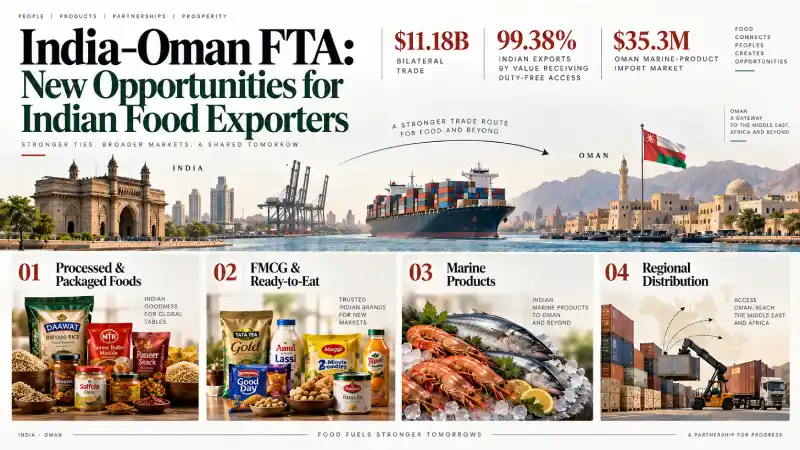
India and Oman did not need a trade relationship to be created from scratch. It was already there, and it was growing. Bilateral trade reached $11.18 billion in FY2025–26, up from $10.61 billion the year before. Indian agricultural exports to Oman have also increased steadily, rising from $364.67 million in 2020 to $556.34 million in 2024. For businesses looking at India-Oman Food Trade, the opportunity is becoming even more interesting as the new India–Oman FTA improves market access and creates fresh possibilities to export food products to Oman.
What has changed is the commercial framework around that relationship.
India and Oman signed their Comprehensive Economic Partnership Agreement (CEPA) on 18 December 2025 in Muscat, and the agreement entered into force on 1 June 2026. For Indian exporters, the headline is significant: the pact provides duty-free access to 99.38% of India's exports to Oman by value, covering 98.08% of Oman's tariff lines. Under the earlier MFN arrangement, only 15.33% of India's exports entered Oman duty-free.
For India-Oman food exports, that is more than a tariff story. It could change which Indian food products make commercial sense in the Omani market.
India already has a place on Oman's food shelf
The interesting thing about the India-Oman Food Trade is that India was already an important supplier before the CEPA came into force.
India was Oman's second-largest agricultural supplier, accounting for 10.24% of Oman's agricultural imports in 2024. Indian products already moving into the market include basmati and parboiled rice, bananas, potatoes, onions, soybean meal, cashews, biscuits, butter, condiments, bovine meat and eggs.
So the new agreement is not opening a door that nobody has entered before.

It is making an existing corridor potentially more competitive.
For an exporter, that distinction matters. There is already a buyer base, established logistics, familiarity with Indian products and an existing trading relationship between the two countries. The CEPA adds another reason for buyers to look at Indian suppliers.
The real opportunity may be beyond bulk commodities
India's agricultural exports have traditionally been strong in commodities. Rice, onions, potatoes, spices and other products have travelled from Indian farms to international markets for years.
But there is another opportunity sitting further down the value chain.
Take a potato. Exporting the raw product is one business. Processing it, preserving it, packaging it and selling it as a finished food product is another.
The same applies to grains, fruits, spices, nuts and other agricultural produce.
The India-Oman trade agreement creates room for greater movement of processed and value-added foods, including biscuits, bakery products, preserved potatoes, confectionery, condiments and ready-to-eat foods.
A 40-tonne biscuit shipment from Varanasi to Oman following the implementation of the CEPA is an early example of the kind of trade that could become more common.
And this is where the story becomes bigger than tariffs.
India has an opportunity to earn not just from what it grows, but from what it makes from what it grows.
This could be particularly useful for India's FMCG sector
For Indian FMCG companies, Oman presents a somewhat different opportunity from the traditional commodity market.
A rice exporter may be negotiating a bulk shipment with an importer. An FMCG company is trying to put a branded product onto a shelf and, eventually, into a consumer's regular shopping basket.
That requires a different kind of export strategy.
The company needs suitable packaging, shelf life, labelling, certifications, competitive pricing and a distributor or retail partner capable of developing the market.
This is why the possibility to export FMCG food to Oman is particularly interesting for Indian manufacturers that have already built successful products in the domestic market.
A biscuit brand, ready-to-eat food manufacturer, condiment company or packaged snack producer does not have to create a product specifically for Oman from nothing. It can take an existing product and determine how best to position it for the Omani market.
The CEPA potentially makes that conversation more commercially attractive.
Marine products could be one of the quiet winners
There is another part of the agreement that deserves more attention.
Shrimp, fish and cuttlefish now receive zero-duty access into Oman, compared with duties of up to 5% earlier.
India exported only around $10 million worth of marine products to Oman in 2025, while Oman's marine import market was valued at approximately $35.3 million.
That gap tells its own story.
India does not need to create demand from scratch. There is already an import market, and Indian exporters currently account for only part of it.
If Indian marine exporters can meet the required quality, certification, cold-chain and delivery standards consistently, the tariff advantage gives them another reason to compete more aggressively.
This is a good example of how a trade agreement works in practice. The opportunity is not necessarily created by the agreement itself. Sometimes, it simply makes an existing opportunity easier to pursue.

But not every food product gets the same advantage
This is where exporters need to be careful.
A trade agreement can sound transformational when reduced to one headline tariff number. The reality on the ground is more nuanced.
Sensitive categories including cereals, dairy, fruits, vegetables, edible oils and spices remain protected or have calibrated market access. So an exporter cannot assume that every Indian food product suddenly receives the same treatment.
The product-specific tariff schedule matters.
So does compliance.
Omani buyers will still look at quality, certifications, packaging, consistency, shelf life, delivery schedules and price. A lower tariff can improve the economics of a product, but it cannot compensate for poor execution.
In fact, easier market access can make competition tougher.
When the economics improve, more Indian suppliers are likely to look at the same opportunity.
Oman could become more than an end market
Perhaps the most interesting long-term angle is geography.
Oman has important logistics hubs at Sohar, Duqm and Salalah, giving it a strategic position along major maritime trade routes. That means an Indian exporter can potentially look at Oman not only as a destination for its own products but as part of a wider regional distribution strategy.
This becomes particularly relevant for food businesses.
A company that establishes a relationship with an importer or distributor in Oman may eventually be able to explore neighbouring Gulf markets and, depending on the business model and logistics arrangement, East African markets as well.
That is why export food products to Oman should not necessarily be viewed as a one-country strategy.
For some businesses, Oman could become the first step towards a broader regional presence.
From volume to value
There is a larger economic argument behind all of this.
India does not necessarily need to export more tonnes of agricultural products to increase the value of its food exports. It can also increase what each tonne is worth.
Processing does that.
Packaging does that.
Branding does that.
And distribution does that.
The shift from bulk agricultural commodities towards processed, packaged and branded foods is therefore worth watching closely. It allows manufacturers to capture a larger share of the value created between the farm and the final consumer.
For companies looking to export FMCG food to Oman, this could be especially important because the finished product carries a brand, a proposition and a consumer experience—not just a commodity price.
The next phase of India-Oman food trade will be about execution
The CEPA gives Indian exporters a better commercial starting point. But a tariff advantage is only useful when a company can turn it into an order.
That means understanding the Omani market, identifying the right buyers or distributors, preparing products to meet market requirements and maintaining consistent supply once the business begins.
For India-Oman food exports, the fundamentals have not changed.
The opportunity has.
India already has an agricultural base. It already has established food exporters. It already has products that Omani consumers and businesses buy.
Now the trade agreement gives more of those businesses a reason to look at Oman seriously.
And perhaps the biggest opportunity is not simply to send more Indian food to Oman.
It is to see whether an Indian food product can enter through Oman, find its place on a shelf, build a customer base and eventually travel further into the region.
That would turn the India–Oman FTA from a tariff concession into something much more meaningful: a platform for Indian food businesses to build a larger presence in the Gulf.