When the Directorate General of Foreign Trade (DGFT) issued Notifications 34 and 35 on August 24, formally shifting specified wheat grain and milled flour products from "Prohibited" to "Free," trading desks across Mumbai, Singapore, and Dubai took note. After four years of administrative gates, India had dismantled its quantitative walls.
The announcement covered everything from Durum wheat and common wheat (HS 10011900 and 10019910) to bulk flours—atta, maida, semolina, rava, and wholemeal blends under HS 11010000. To general market observers, the reaction is predictable: India is the world's second-largest wheat producer, so open borders must equal an immediate export flood.
Trade realities operate on price parity, storage carrying costs, and freight spreads. Removing a regulatory prohibition is a legal clearance; whether physical grain actually loads onto bulk vessels depends entirely on whether Indian wheat can land at a competitive price against competing origins.
The policy shift is less about an immediate export surge and more about establishing a critical price-sensitive swing origin for regional buyers.
The Domestic Cushion: Why New Delhi Moved Now
New Delhi's decision was grounded in domestic balance sheet management rather than export ambition.
When the export ban was erected in May 2022, domestic supply cushions were thin, global prices were turbulent, and government procurement had slumped. By mid-2026, the domestic inventory picture had shifted. Official harvest estimates for 2026 sat around 120.2 million tonnes—even if conservative trade estimates hovered closer to 110.6 million.
By August 1, Food Corporation of India (FCI) buffer stocks had reached roughly 50.5 million tonnes. That is nearly 46% higher than the previous year and the highest inventory level recorded in five years.
Holding grain is expensive. Excessive public inventory ties up fiscal capital, occupies limited covered warehousing, increases infestation and moisture deterioration risks, and depresses harvest-time prices for farmers. The phased relaxations earlier in the year—first 2.5 million tonnes of grain and 500,000 tonnes of processed products in February, followed by another 2.5 million-tonne tranche—tested whether the domestic market could absorb outflows without stoking domestic food inflation.
Moving from controlled quotas to an unrestricted "Free" category signals that policymakers are comfortable using external demand as a pressure-release valve for surplus grain.

The Parity Problem: Export Permission vs. Commercial Viability
The core economic reality of agricultural trading is straightforward: export permission does not guarantee export volume.
For months, Indian wheat has faced a clear FOB price disadvantage. Domestically, minimum support prices, state levies, and local mandi demand kept Indian wheat priced around $280 per tonne FOB. Competing origins told a different story. Argentine supplies were moving near $200 per tonne FOB, while Black Sea wheat was regularly landing in Asian ports at delivered prices that undercut Indian offers.
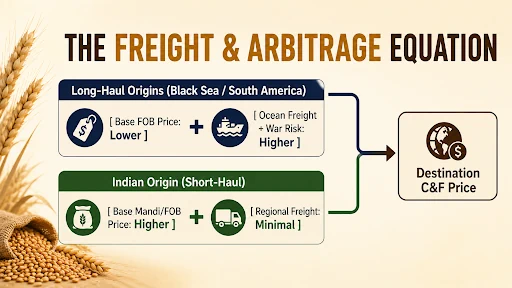
Because of this spread, initial post-notification shipments have remained modest, tracking around 60,000 tonnes. A miller in Chattogram or a feed blender in Jakarta will not purchase Indian grain out of convenience; they buy whichever origin provides the lowest landed cost per protein point.
Until global pricing moves or domestic prices soften, the policy change primarily establishes an export-parity floor beneath domestic mandis rather than sparking an immediate rush to load vessels at Kandla or Mundra.
Geopolitical Friction Shifts the Arbitrage
Physical trade flows are dynamic, and geopolitical developments have begun altering these cost calculations.
Renewed strikes against port infrastructure and grain terminals in the Black Sea have injected risk premiums back into Ukrainian and Russian shipments. Between early July and late August, benchmark Chicago wheat futures climbed more than 17%. War-risk insurance premiums for Black Sea vessel charters have ticked upward, and vessel availability is tightening.
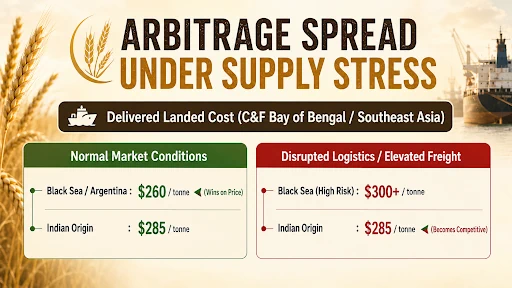
Indian grain does not need to become cheaper in absolute terms to win business. It only requires competing origins to become expensive or logistically uncertain enough to close the delivered spread.
As landed costs for alternative supplies climb past $290 to $300 per tonne C&F in nearby destinations, India's freight proximity suddenly offsets its higher domestic procurement costs.
The Near-Neighbor Advantage: Why Bangladesh Matters First
If bulk grain shipments accelerate, they will not head toward Europe or North Africa. They will cross the eastern border into Bangladesh.
Bangladesh imports substantial volumes of milling wheat annually. Sourcing from the Black Sea or South America involves four to six weeks of ocean transit, substantial demurrage exposure, and large financing costs for Panamax-sized cargoes.
India offers distinct logistics advantages to this corridor:
- Short sea routes from Paradip, Vizag, or Haldia.
- Direct cross-border rail rakes from central and northern production belts.
- Smaller, flexible parcel sizes that reduce working-capital burdens for private Bangladeshi millers.
When the landed spread between Indian wheat and deep-sea origins narrows to within $10 to $15 per tonne, Bangladeshi buyers often choose Indian origin simply to reduce transit times and pipeline inventory risks. Trade desks are already reporting active enquiries across this specific corridor.

Flour Milling: Capturing the Value-Added Margin
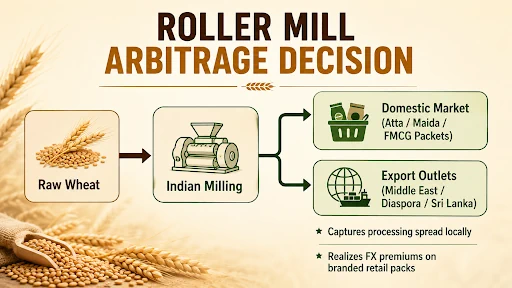
Raw wheat is a low-margin commodity play. Exporting packaged flour allows Indian millers to capture processing margins at home, avoid secondary import duties that certain destinations place on raw grain, and serve high-margin retail consumer channels.
Key demand centers for processed products include:
- The Gulf and Middle East: Serving institutional bakeries, catering operations, and expatriate retail distribution.
- South Asian Neighbors: Meeting immediate flour deficits in Sri Lanka, Nepal, and Bangladesh.
- Western Diaspora Corridors: Supplying branded consumer atta packs into ethnic retail channels in North America and the UK.
For private millers in coastal belts, this policy opens a choice: sell bulk flour into competitive domestic markets or export to capture foreign-exchange premiums on processed goods.
Outlook: India as the Region's Swing Supplier
The economic impact of India's wheat liberalization will unfold across distinct stages rather than a single sudden wave.
PROJECTED TRADE PHASES
Phase 1: Immediate (Months 13)
└── Price testing; targeted rail/vessel shipments to Bangladesh; modest bulk outflows.
Phase 2: Medium-Term (Months 3-12)
└── Global price dependent; acts as swing supplier if Black Sea stress persists.
Phase 3: Structural Shift
└── Private trading desks re-establish regional forward contracts and supply lines.
In the near term, trade volumes will remain measured. High domestic prices and healthy government procurement floors will prevent aggressive price discounting.
The real structural development is the restoration of market reliability. For four years, global procurement desks excluded India from forward tender calculations because policy could shift overnight.
By moving wheat and flour back to the "Free" category, India returns as an active swing supplier. Global buyers across South and Southeast Asia now hold a functional supply option: when long-haul maritime routes face disruptions, Indian grain and milled flour stand ready at the border to balance the regional ledger.