India’s declaration of a ₹20,000 crore target (around US$2 billion) for organic food exports by 2030 is not rhetoric; it is an operational checkpoint that markets and trade houses must treat like a deliverable. The figure matters because it signals policy intent, budget lines, buyer outreach and a predictable pull for both capital and commercial strategy.
For agro commodity exporters and aggregators, the question is pragmatic: how do we convert that macro ambition into repeatable, margin-accretive export business across value chains?
Growth is real, now scale it into tradable supply
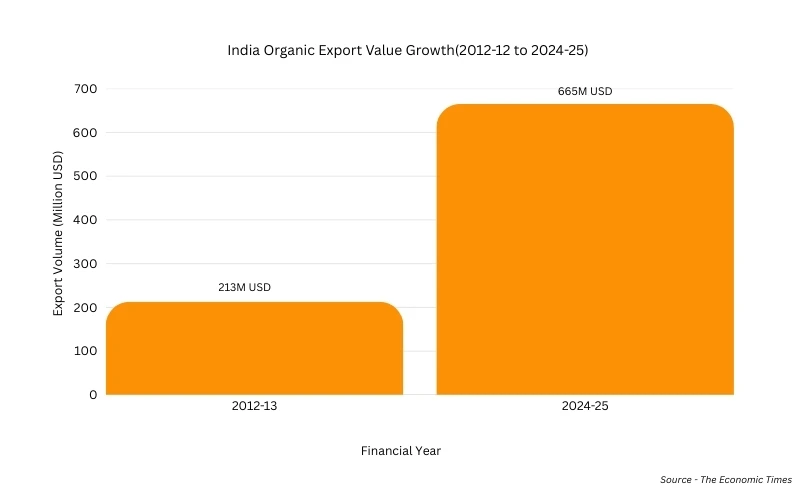
The growth trajectory is tangible. Organic food exports, like organic spices, organic oilseeds, organic pulses etc., moved from a small base (roughly US$213 million in 2012–13) to the mid-three-hundreds of millions and now about US$665 million in 2024–25. That’s not a consumer fad; it’s a structural expansion in demand, led by the US, EU, Canada, UK and Switzerland, markets where procurement teams prize traceability, predictability and long-term vendor relationships. These geographies are the logical anchor buyers for India’s next phase of organic expansion.
But scale means two things for B2B players:
(1) build reliable aggregator capacity so you can put container-loads on contracts, and
(2) invest in value-chain predictability — post-harvest, cold chain where needed, packhouse readiness and logistics SLAs that satisfy commercial buyers.
The good news: India’s certified + in-conversion organic production rose markedly (to about 46.99 lakh tonnes in 2024–25) and cultivated area is already in the order of ~4 million hectares — a sizable base to mobilise supply if it is aggregated and commercialised with discipline.
What the export basket tells us about market strategy
Cereals & millets and processed foods together make up the lion’s share of export value — each accounting for roughly a quarter of the export pie. That composition is useful: it means the immediate payback from scale investments will come from commoditised, bulk-oriented channels (institutional buyers, food ingredient houses, and private label processors), whereas premium pockets (single-origin millets, speciality flours, and branded processed organic snacks) create higher per-kg margins but require different GTM. Trade players should therefore run parallel tracks: a volume track to lock capacity in shipping lanes and an aspirational track to cultivate brand-led buyers (regional retail chains, organic grocery importers, nutraceutical formulators).
Northeast India: a strategic raw material pocket — treat it like an acquisition
The government’s push to spotlight the Northeast through a dedicated Organic Week in Shillong is not a cultural exercise — it is a targeted sourcing strategy. The region’s crop profile (Lakadong turmeric, specialty ginger, pineapples, certain tea profiles, orchids) maps well to premium niches overseas.
For exporters, the Northeast represents an acquisition play: secure long-term offtakes via FPO tie-ups, invest in on-farm aggregation centres, and underwrite graded processing and packaging in-region. The buyer–seller meets arranged there — bringing 27 buyers from 14 countries — are precisely the venue where commercial contracts and master supply agreements should be forged, not just marketing memoranda.
Commercial playbook: three things exporters must do now
- Convert volume into credible supply contracts. If you’re an exporter, stop chasing single-shipment buyers. Convert demand into 12–24 month rolling contracts with price adjustment clauses tied to transparent indices. That reduces inventory churn and lends predictability for financiers.
- Split risk across channels. Keep a balanced channel mix: institutional buyers in the US/EU for volume, specialty importers in the UK/Switzerland for premium pricing, and selective Asian/Canadian partners for diversified payment terms. Diversification decreases the exposure to policy shocks in one buyer geography.
- Invest selectively in value addition. Processed foods and spice/value-added streams command higher ticket prices. Use government grants and scheme support to upgrade packhouse and processing lines (Spices Board and other support mechanisms already subsidise equipment and certification assistance). This reduces downstream dependency on commoditised pricing.
Financing & logistics: the practical enablers
Banks and trade financiers must be persuaded to move from transactional financing toward pre-export and warehouse-receipt style instruments for organic consignments. Aggregators and exporters should structure receivable financing around long-term purchase agreements; this lowers cost of carry and enables competitive FOB pricing. On logistics, consolidation centres close to production hubs (including the Northeast) and dedicated LCL/LTL arrangements for premium pack sizes will improve buyer confidence and reduce lead times.
Where policy support must focus — a trader’s wishlist
Policymakers should prioritise predictable incentive architecture (longer tenors for capex support, matching grants for packhouse CAPEX, and export promotion targeted at mid-sized exporters). Equally important: scale up BSMs and reverse-buyer meets that produce executed MOUs rather than PR soundbites. The technical assistance that accompanies finance must be practical — packaging specs, shelf-life data, and industrial buyer quality matrices, not only standard paperwork.
Final take: commercialise with discipline, not optimism
India’s organic export story has moved beyond promise to plausibility. The production base, export momentum and policy intent exist; the commercial task is to align aggregation, contractual discipline, financing and logistics to convert that potential into predictable, profitable trade flows. Export houses and investor groups that treat organic exports as a repeatable supply business — with proper SLA management, channel segmentation and buyer relationship engineering — will be the winners in the decade ahead.