
Higher farm-gate prices, expanding cultivation and renewed overseas demand are reshaping the economics of Haryana's Basmati industry. But sustaining this momentum will require more than a favourable harvest.
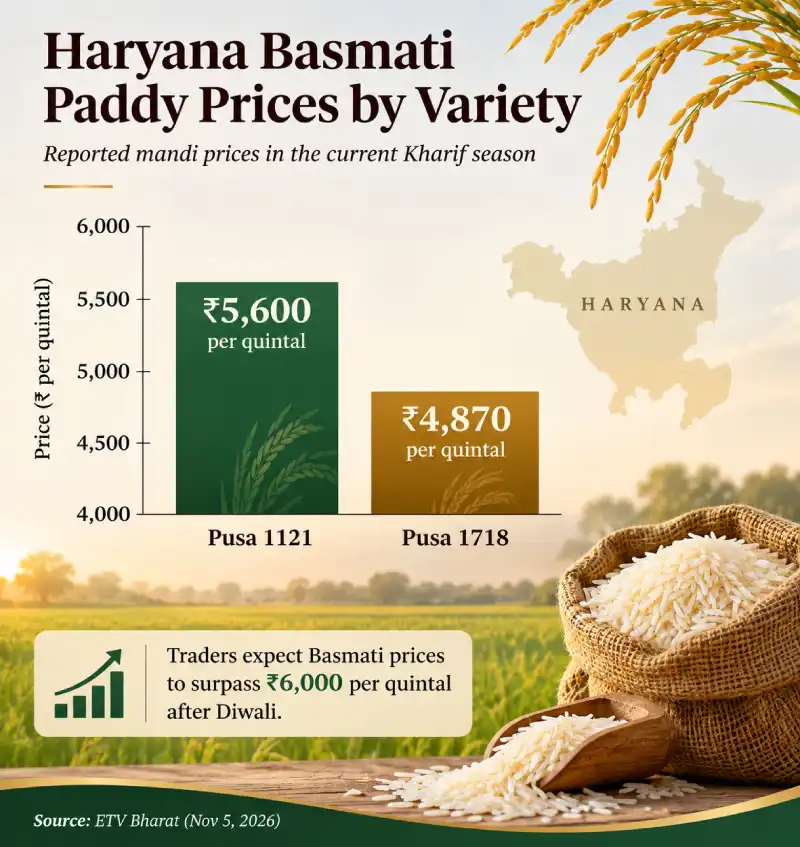
There is positive sentiment in Haryana’s Basmati industry this Kharif season. Pusa 1121 paddy has seen prices rise to ₹5,600 per quintal and Pusa 1718 has seen prices of around ₹4,870. This has been a positive change for farmers after a few seasons of lower prices. However, traders are expecting prices to increase further to above ₹6,000 per quintal post Diwali. This will depend on how much paddy is bought and how much demand there is from exports.
The Basmati industry in Haryana is heavily linked to the export industry in India. This means that prices in mandis will impact how much millers pay to buy the paddy, how much rice exporters stock and therefore the competitiveness of the Indian Basmati in the global market.
The Changing Economics of Basmati
As more land is being cultivated with Basmati (around 19 lakh acres / 7.7 lakh hectares), farmers are recognising the value of growing aromatic paddy. They are beginning to grow more Pusa 1121, 1718 and 1509 varieties.
This is a key factor as Basmati has a higher value in the market. The length of grain, aroma, stretchiness when cooked and variety will impact how much demand it has from international buyers. This means that simply having higher productivity levels will not increase farmers’ profits as they need to get a good price for their exportable varieties.
The ICAR have recognised that Pusa 1509 is an early maturing paddy which can reduce the number of irrigations needed by 3-4 compared to longer maturing varieties like Pusa 1121.
A crop survey conducted by APEDA for Kharif 2023 in Haryana shows that on average, Pusa 1121/1718 produce around 18.21 quintals per acre and Pusa 1509/1692 produce around 21 quintals. This is based on historical data so the yield, cost of inputs and prices in the mandi will all need to be considered. Whilst higher prices in the mandi will increase farmers’ profits, this needs to be balanced with how much profit they can make after the costs of production.

Export Demand Impacting Procurement Economics
India has had a positive year exporting Basmati internationally. APEDA report that India exported around 65.21 lakh metric tonnes of Basmati rice in FY2025-26, earning around ₹50,138 crore.
Interestingly, the previous year saw Basmati exports of around 60.65 lakh metric tonnes, earning around ₹50,312 crore. This shows that although there was an increase in volume of exports by around 7.5%, the total value of Basmati exported decreased.
Although the overall value has decreased, this is not always the case as the countries we export to, what we export and when we export can all impact the value. However, it does show that although exports have increased, this does not mean we are earning higher amounts.
When prices start to increase in the paddy market, millers and exporters will have to pay the higher prices in mandis. However, their export prices will depend on the competition in the market and any contracts they have. This can cause issues if prices aren’t increasing as much as the cost to buy the paddy.
For businesses looking to export Basmati rice, the timing of procurement, stock management and getting good export orders will impact their profitability.
The Cost of Procurement
Whilst higher prices will be beneficial for farmers, this can become complicated for exporters. There are many costs involved from buying the paddy to shipping the finished product.
The recovery percentage, breakage, sorting, grading, polishing, ageing and storage will all impact the final price. Rice exporters will also have to pay for packaging, transport, port costs, shipping, insurance and financing.
The amount of working capital needed will increase as more money will be spent on procurement. If shipments are delayed, the working capital will take longer to be received.
A report from CRISIL Ratings in March 2026 highlighted that shipping issues, longer delivery times and payment issues could increase the amount of working capital needed for exporters. Taking alternative shipping routes could increase working capital by 10-15%.
This shows that whilst higher prices may be a positive for farmers, millers and rice exporters will need to ensure their international contracts are still profitable.

Demand from Middle East
India has had a long relationship with the Middle East. We export to Saudi Arabia, Iran, Iraq, UAE and Yemen.
APEDA data from FY2025-26 shows that these 5 countries combined made up around 55.6% of India’s Basmati export value. This means we have access to established high volume markets. However, this means that the sentiment of procurement will depend on how these countries are doing.
As there can be geopolitical issues, shipping issues, shipping price fluctuations, currency fluctuations and payment issues, this can impact how much is bought from abroad. Delayed shipments can cause increased stock holding times and increased financing. Buyers may also delay purchasing depending on how much they have in stock and the landed costs.
For Indian rice suppliers and exporters, they will need to ensure they can turn this increased demand into profitable relationships.
Maintaining Value Throughout the Basmati Supply Chain
This season in Haryana is looking positive with increased prices at the farm gate, increased production and increased interest from exports. However, increased prices can impact how much farmers plant next season. If more land is cultivated in major Basmati producing areas, this could impact the price.
In the long term, Indian Basmati will depend on the quality of the variety, consistency of processing, productivity of the paddy and the ability to meet changing buyer requirements from abroad.
Farmers will need to get a good price for their paddy, millers and exporters will need to ensure they have profitable margins to invest in stock, processing and international contracts.
Ultimately, how strong Haryana’s Basmati industry will be will depend on how well India can turn their agricultural advantage into profitable exports.