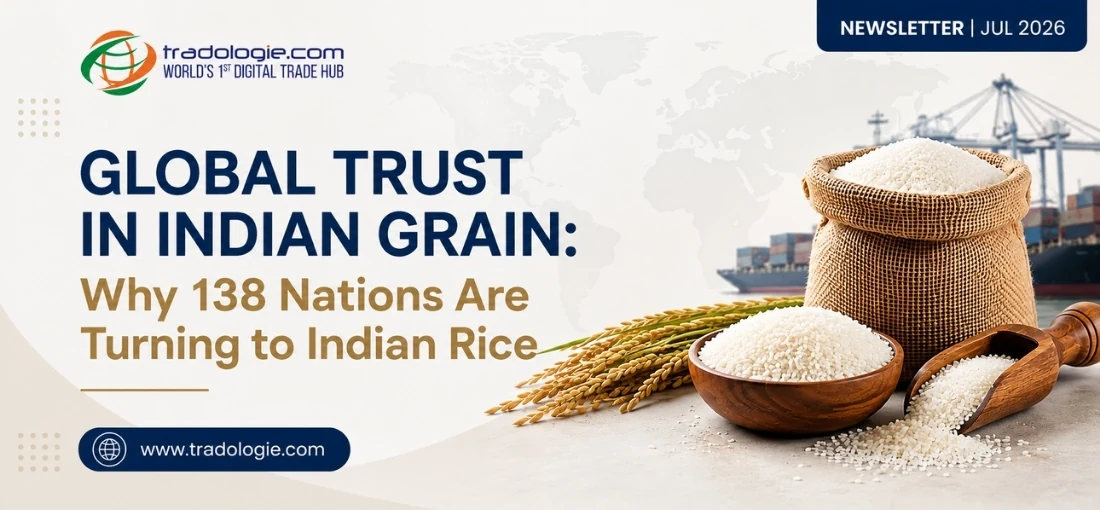
When the Indian Rice Exporters' Federation (IREF) released its registration numbers on August 30, it sent a clear wave of optimism across the international grain trade. Ahead of the Bharat International Rice Conference (BIRC) scheduled for October 23–25 at Bharat Mandapam in New Delhi, an impressive 3,317 commercial buyers from 138 nations have registered their interest in meeting Indian exporters.
This is not just a standard uptick in trade fair attendance. It represents a substantial pool of potential commercial demand across India's agricultural export corridors.
For millers, exporters, and international trade desks, the sheer geographical breadth of these numbers points to a transformative commercial opportunity. If properly harnessed, it marks a significant step toward expanding India's footprint beyond traditional buyer hubs into a far more diversified global trade network.

Mapping a Worldwide Demand Base
The spread of registered international interest shows where commercial inquiries are building. Bangladesh leads the table with 336 registered buyers, reflecting strong regional demand. Right alongside, African nations account for a major share of registered interest: Benin with 179 buyers, Nigeria with 177, Ethiopia with 127, and South Africa with 109. Add in delegations from Senegal, Côte d’Ivoire, Niger, Guinea, Ghana, Mali, Angola, and Kenya, and you see substantial interest from markets looking to evaluate reliable import pipelines.
The Gulf region features strongly with 145 buyers from the UAE and 125 from Saudi Arabia, alongside registered participants from Iraq and Yemen. Southeast Asia and neighboring markets have shown notable participation as well, with Nepal and the Philippines logging 137 buyers each, Indonesia recording 109, and Malaysia registering steady interest. Australian buyers have also booked their seats.
As IREF Vice President Dev Garg noted, the real focus is converting this broad international participation into fresh trade corridors, new buyers, and long-term commercial relationships. The previous edition of this initiative mapped out an addressable global rice-import market estimated at Rs 1.8 lakh crore.
To help turn that potential into actual trade flows, BIRC 2026 is deploying an app-based matchmaking system. The software aims to directly pair exporters and millers with overseas buyers based on specific rice varieties, moisture and grain specs, container volumes, and destination market requirements.
The summit will also lay out the broader 2027 market outlook—covering comprehensive crop surveys, price forecasting, ocean freight logistics, trade policy, sustainability frameworks, and modern milling and value-added products.
1. Expanding the Demand Curve for Non-Basmati Tonnage
The most immediate economic upside from this 138-nation footprint is the potential demand support it signals for India's non-Basmati segment.
Trade figures from the first half of 2026 already show strong commercial momentum. India’s total rice export volume grew by 5%, driven by a 9.6% jump in non-Basmati shipments to reach 8.9 million tonnes. Basmati shipments, meanwhile, stood at 3.36 million tonnes (down 5.5%).
That surge in non-Basmati volume was particularly supported by resilient African purchasing. If these hundreds of registered commercial buyers from West Africa, Manila, and Dhaka convert their interest into binding purchase orders, it has the potential to significantly steepen India’s non-Basmati demand curve, unlocking high-velocity sales channels for parboiled and white broken grains.

2. A Sturdy Price Floor and High Mill Utilisation
For non-Basmati millers operating across Andhra Pradesh, Chhattisgarh, Odisha, and West Bengal, the heavy presence of Benin, Nigeria, Côte d’Ivoire, and Senegal highlights an important commercial avenue.
These nations are high-volume consumers of price-sensitive parboiled rice. Recent market dynamics—underpinned by consistent African consumption, stable supply conditions, and clear monsoon trends—have helped maintain a firm price floor, with Indian 5% broken parboiled rice holding steady in the $362–$368 per tonne range.
Bringing large buyer delegations directly into structured B2B meetings could facilitate forward contracts, recurring shipments, and long-term commercial relationships. For Indian millers, that translates into opportunities for higher inventory turnover, improved milling capacity utilisation, and steadier export realisations without having to resort to aggressive, uncoordinated discounting to clear stock.
3. Strategic Risk Diversification Across Continents
Expanding into emerging African and broader international markets offers India a practical pathway to diversify its customer portfolio.
Trade data from APEDA shows that historically, roughly 77% of Indi's Basmati exports move into the Middle East, whereas only 9% of non-Basmati shipments head to that region. Iran alone accounted for 13.9% of Basmati export volume in FY2025-26.
African demand serves primarily as an alternative demand pool for non-Basmati rice, not as a direct substitute for premium aromatic Basmati. Even so, the sheer volume absorption of these markets gives India a valuable economic cushion. By building deeper buyer networks across 138 nations, India can maintain healthy port throughput and keep overall export earnings resilient even when individual high-value segments encounter headwinds.
4. Unlocking High-Value Growth Across the Gulf
For the Basmati sector, BIRC 2026 offers a focused venue to explore commercial opportunities across top-tier consumer markets.
Trade with Iran has faced ongoing pressure linked to payment and settlement difficulties, logistical bottlenecks, and wider geopolitical and sanctions-related restrictions—with Indian rice exports to the country standing at $383.11 million in H1 2026. In this context, registered delegations from Saudi Arabia, the UAE, Iraq, and Yemen represent important avenues for potential value expansion.
Basmati millers across Punjab, Haryana, and western Uttar Pradesh can use this targeted forum to pitch premium aged harvests, pesticide-screened 1121 and 1718 steam lots, and private-label retail packaging directly to commercial retail buyers, major importers, and institutional distributors across the GCC.
5. Capturing Long-Term Global Price Influence
India already stands as the primary pillar of global rice trade, offering substantial volume and competitive pricing alongside major origins such as Thailand, Vietnam, and Pakistan.
The strategic prize at BIRC 2026 is market diversification. Following the previous BIRC event, Indian rice shipments to 26 priority target markets exceeded their three-year historical averages in both volume and total value. While broader factors like global commodity price cycles, domestic supply, and trade policies always shape trade flows, that performance indicates that structured buyer engagement aligns well with wider export diversification.
If even a healthy fraction of these 3,317 registered buyers convert their interest into recurring contracts this October, India will have effectively broadened its commercial base across Asia, Africa, the Middle East, and beyond. Expanding and diversifying its customer relationships gives Indian exporters greater commercial resilience and reinforces the country's strong influence over global rice price formation.
Finally:
Finally exporting rise is all about leveraging the right market and keeping up with the market trends. India is an undisputed leader in the global rice export market and African countries have enormous potential for exporting non-Basmati rice varieties. The recent indication by Indian Rise Exporters Federation is a clear signal that opportunities are enormous. It is about leveraging it at the right moment.