Bulk source premium rice varieties at highly competitive market
prices through verified Indian suppliers
What Are Rice Traders?
Rice traders are specialised intermediaries in the agricultural value chain who facilitate the purchase, selling, and exchange of rice in bulk quantities. Rice traders can be defined as the “bridge” connecting the supply of rice from the supply side (ranging from farmers to the Millers) to the demand side (ranging from wholesalers to retailers to the government).
Unlike the people who produce the crop or the people who mill the rice, the traders are interested in the connectivity of the market. Traders are interested in the movement of the rice product either to the surplus region of the market, where the rice is largely available, or the region of deficiency, where the demand for rice is high.
Think of a rice trader as a logistics and deal-making expert.
In simple terms, Rice trading is the business of matching supply with demand. A trader does not usually grow the rice or eat the rice; they solve the problem of getting the rice from Point A (the farm) to Point B (the market).
They are primarily concerned with the "business" details:

Rice is the third most widely grown agricultural product in the world after sugarcane and maize. Private importers and governments regularly buy rice in bulk to supply food industries or maintain their food reserves for the population. It is the most crucial food staple globally, with African nations remaining the primary importers of non-basmati white rice, while the Gulf, the United Kingdom, and the United States are the leading importers of premium basmati rice.
Although historically it has been the largest producer of rice, India is likely going to equal, if not even surpass, China. In the pair of countries, they will be producing almost 145-150 mmt of rice. After restrictions on export were lifted late in 2024, India resumed its position as a leader.
On a global front, a total of around 165 million hectares of land has been allocated towards the cultivation of rice, where a significant part of that land belongs to India, which amounts to around 51.4 million hectares of land. A significant change in the 2025-26 season, as far as the history of crop cultivation is concerned, has been that India has surpassed its previous holder, i.e., China, to become a global crop yield leader, yielding around 152 MMT compared to 146 MMT of its previous counterpart, which was China.
Current global rice production stands at about 540 MMT on the Milled Basis—representing approximately 800+ MMT of Paddy Rice.
While in the trading arena, India remains the undisputed leader with nearly 40% of global rice export shares. Indian exports have risen significantly since the export ban was lifted, with shipments exceeding 20 MMT annually. Vietnam has moved into second place with the help of high-yielding varieties, followed closely by the country that remains in the third place, i.e., Thailand. Pakistan appears on the horizon as the new rising power in the basmati arena.
There is a clear asymmetry in the global rice market: imports are dispersed across a wide range of purchasing economies, while exports are dominated by a small group of five countries.
Top Rice Exporting Countries
The top five exporting nations collectively control approximately 80% of the global rice trade. Among these leaders, four are located in Asia [USDA, 2025].
Top Rice Importing Countries
Imports of rice are widely dispersed, in contrast to the export market. The top ten countries buy less than half of the total volume, and the top importing countries together make up only 30% of international trade.
Evolving Dynamics in Aromatic Rice
A significant shift has occurred in the high-value Jasmine rice sector regarding the balance between volume and value.
Whether you are navigating strict export compliance, managing volatile market prices, or securing safe payment terms, success in bulk agro-trade requires the right connections. Tradologie provides the complete digital infrastructure to bypass middlemen, showcase your certified quality, and match your goods directly with real global demand.
Start exporting with real demand
We, at Tradologie, facilitate global trade for a wide spectrum of rice varieties. By connecting genuine buyers with top-tier suppliers, the platform allows for direct negotiation on a specialised B2B agro-trade digital interface.
Our portfolio includes two primary categories:
Basmati Rice
This category comprises premium Indian varieties that are famous for their aroma and long grains.
Non-Basmati Rice
A broad category that meets both particular culinary requirements and international staples.
Buyers who use Tradologie have an opportunity to procure their raw materials from some of the most well-established organisations in the sector because they are directly obtained from millers/exporters.

As the global supply chain pivots toward digital ecosystems, Tradologie.com stands out as a specialised B2B Agro-trading platform. We replace traditional, cluttered trading procedures with a streamlined, direct-to-market approach.
The Power of a Verified Network
Tradologie connects a massive ecosystem of over 1 Million+ verified buyers and sellers registered across the globe. This scale ensures that, whether you are sourcing or supplying, you have access to a liquid and active market without the noise of unverified participants.
The Tradologie Difference: Real Trade, No Leads
What sets Tradologie apart from standard directories is its focus on transaction execution rather than lead generation.
The Indian rice traders play one of the most vital roles at the core of the global rice trade . India's position as the world's largest rice exporter appears to have strengthened further, with exports increasing substantially to the order of 21.5 million metric tonnes during the calendar year 2025, as exports were made freely available again.
Due to the distribution of sourcing across multiple areas of growth, rice traders in India now serve Africa, the Middle East, Southeast Asia, as well as other import-dependent countries at the same time. Due to the removal of export bans in early 2025, India's traders have been able to gain market share as supply has been stabilised globally [Rice News Today, 2026].
Global rice trade volume has been projected to set a new record of 62.8 million metric tonnes in the upcoming marketing year, 2026 [USDA, 2026]. India still leads in registering the largest share in the exchange volume through an apkproximate 40% contribution in the form of global export [Rice News Today, 2026].
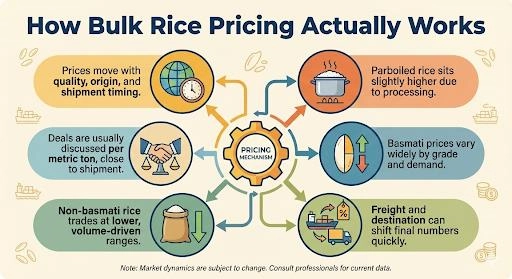
Rice prices in bulk fluctuate based on quality, origin, shipment terms, and real-time market dynamics. As of January 2026, prices have moderated compared to the highs of 2024 due to surplus supplies [FAO Rice Price Update, 2026].
Note: The above prices are based on reference numbers for Free On Board Indian ports as of early 2026. Actual costs will depend upon the percentage of broken pieces, sorting charges (Sortex), packing costs, and freight charges prevailing at the time of booking.
| Aspect | Details |
|---|---|
| Packaging - Bag Sizes | 1kg, 5kg, 10kg, 25kg, 50kg |
| Packaging - Bag Types | PP, Plastic, Jute, Gunny, Non-Woven |
| Preferred Export Packaging | 25kg and 50kg bags |
| Shelf Life | 12-24 months under dry storage |
| Common Incoterms | FOB, CIF |
| Export Documentation | Certificate of Origin (CO), Phytosanitary Certificate, Inspection Report |
Most bulk deals begin with a simple requirement: rice type, grade, quantity, and destination. Once that's established, traders negotiate price and shipment terms directly with exporters or millers before proceeding with container-level orders.
Practically put, it's typically one full container. Most exporters prefer containerised shipments because of cost and logistical efficiency, even though smaller quantities are possible.
Indeed, that frequently occurs. As long as packaging and documentation are in line, traders frequently combine basmati and non-basmati rice based on market demand.
The price is not fixed. Rates are influenced by a number of factors, including variety, quality requirements, origin, goods, and timing. Instead of locking in prices weeks in advance, most traders finalise them closer to shipment.
The largest volume market is Africa, particularly for rice that isn't basmati. While demand for basmati rice fluctuates depending on harvest conditions in Southeast Asia, it remains strong in the Middle East and Europe.
Both exist. Some traders work spot-to-spot, while others prefer repeat supply arrangements once quality and reliability are proven.
Rice trading is the international exchange of rice involving sourcing from producing regions and supplying bulk volumes to markets worldwide based on specifications, logistics, and compliance.
Tradologie offers a fully digital procurement journey for verified buyers. Once registered and approved through our KYC process, you can raise bulk rice inquiries by selecting rice type, its specifications, and total volume. Verified exporters will respond to your inquiry with their competitive quotes, and negotiations between a buyer and seller happen online on our SaaS based platform.
From premium Basmati rice variants like Pusa and Sugandha to Non-Basmati types like Parboiled, Jasmine, and Vietnamese rice, Tradologie supports a wide range of rice categories for global trade. You can also filter options based on grain length, moisture, whiteness, and other parameters.
Any rice exporter with valid documents such as IEC code, APEDA license, FSSAI certificate, GST, PAN, and a current bank account can register. Post-verification and subscription, exporters gain access to genuine global buyer inquiries for bulk orders.
Importers benefit from competitive pricing, multiple supplier options, and customisable quality specifications. Our SaaS based digital process ensures faster negotiation cycles, end-to-end transparency, and it protects against fraudulent trade practices.
Yes. Tradologie lists premium rice brands like Daawat, Lal Qila, Kohinoor, Shree Lal Mahal, and more, available for bulk purchase through verified exporters. These are often sourced directly from reputed mills and manufacturers.
Major importers include African nations (non-basmati rice), and Gulf & European countries (basmati rice). Tradologie serves buyers across all these regions by offering access to verified Indian rice exporters and facilitating direct trade based on region-specific preferences.
India, Thailand, Vietnam, Pakistan, and the U.S. dominate global rice exports. Tradologie features both Indian and global exporters, offering a transparent platform to trade with verified international buyers.
Most bulk deals start with a simple requirement — rice type, grade, quantity, and destination. Once that’s clear, traders negotiate price and shipment terms directly with exporters or millers and move ahead with container-level orders.
In practical terms, it’s usually one full container. Smaller quantities are possible, but most exporters prefer containerised shipments for pricing and logistics efficiency.
Yes, that happens often. Traders regularly mix basmati and non-basmati rice depending on market demand, as long as packaging and documentation are aligned.
There’s no fixed price. Rates depend on variety, quality specs, origin, freight, and timing. Most traders finalise prices closer to shipment rather than locking them weeks in advance.
Africa remains the biggest volume market, especially for non-basmati rice. Basmati demand stays strong in the Middle East and Europe, while Southeast Asia moves in and out depending on harvest conditions.
Both exist. Some traders work spot-to-spot, while others prefer repeat supply arrangements once quality and reliability are proven.