Key Highlights
- The key difference between white rice and broken rice lies in grain integrity, processing, pricing and commercial applications.
- White rice primarily serves household, retail and catering markets, while broken rice is used in food processing, brewing, starch manufacturing and other industrial applications.
- Thailand, Pakistan and Myanmar were the leading broken rice exporters by value in 2024. India exported 762,241 MT worth US$300.18 million.
- Senegal was India's largest broken rice export destination in 2024, receiving approximately 393,380 MT.
- India exported 16.51 million MT of semi-milled or wholly milled rice worth US$11.05 billion in 2024, highlighting its significant position in the global white rice trade.
Introduction:
White rice and broken rice are both popular products within the international rice market. Where white rice is largely consumed within households, broken rice is bought by a variety of food, beer, starch and industrial buyers. Due to the differences in specification, price and application, these two products are sourced and traded differently.
Understanding the difference between white rice and broken rice allows exporters to find appropriate buyers and appropriately target products within desired markets. Both products allow for business opportunities however there are differences in the demand, specification and price of each product. Understanding white rice vs broken rice is therefore important for identifying the right product for different market requirements.

1. Differences Between White and Broken Rice
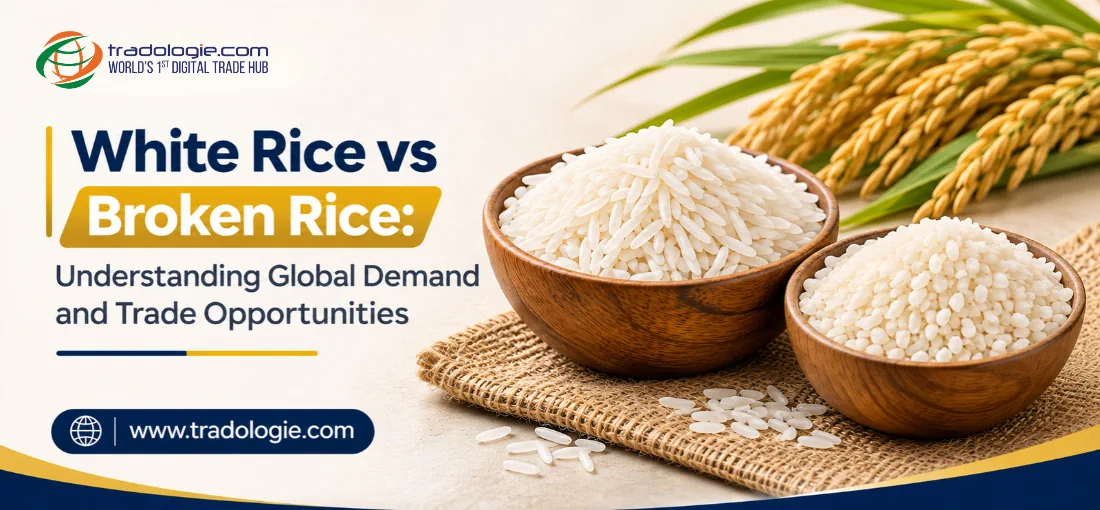
White rice is rice that has been milled and polished. It can be long grain, medium grain and short grain, depending on type and level of polish.
Broken rice is rice which has broken in the milling/processing stage. During the grading process, broken rice will be separated from intact rice. The rice can come in different sizes, although in some cases, small broken rice, large broken rice and mixes may be specified.
Key Differences:
| Parameter | White Rice | Broken Rice |
|---|---|---|
| Specification | Intact | Broken |
| Processing | Milled and polished | Sorted from intact during milling. |
| Application | Household and catering | Processing and industrial applications. |
| Market | Retail, Wholesale, Institutional | Price sensitive and industrial. |
| Price | Varies depending on type, grade and origin. | Varies depending on % broken rice and quality. |
| Quality Checks | Length, % broken rice, moisture and mill quality. | Size of broken rice, % broken rice, moisture and purity. |
Therefore, broken rice and white rice differ in specification which means that they are appropriate for different buyers.
2. How is broken rice formed?
Broken rice is formed during milling. The quantity of broken rice will depend upon the rice type, moisture levels, drying conditions, storage conditions, type of milling equipment and handling.
Once milled, rice is sorted with grading equipment. Intact and broken rice are separated. Broken rice is collected, cleaned and sorted depending upon buyer specifications.
The % of broken rice is also an important specification in intact rice. If a buyer requires rice with 5% broken rice, this will be very different to rice with 25% broken rice.
To appropriately specify broken rice in contracts, exporters should include % broken rice, rice size, moisture content and level of foreign matter.

3. Applications for Broken Rice
Broken rice is demanded for a variety of applications. The rice size and price make it appropriate for many products.
- Processing: Broken rice can be used in producing rice flour, rice noodles, snacks, breakfast products and other processed foods.
- Beer/fermentation: In some markets broken rice can be used in beer/fermentation due to its starch content.
- Starch manufacturing: Food and industrial manufacturers can use rice to extract starch.
- Feed: Broken rice can be included in animal feed if appropriate. Buyers must adhere to the correct feed safety standards and relevant import regulations in order to use broken rice. This will depend on the country.
Although broken rice is demanded for far more applications than just household consumption, there can be significant variation in quality requirements depending on what buyer it is for. A food manufacturer may have different requirements than a brewery or feed buyer.
4. Global Demand and Key Buyers of Broken Rice
Demand for broken rice globally depends on processing requirements, availability of rice in a region, price differences and industrial demand.
According to 2024 data from WITS/UN Comtrade, broken rice (HS code 100640) was exported to many countries. Key exporters included Thailand, Pakistan, Myanmar, India and Brazil.
| Country | Export Value ($Million) | Export Volume (MT) |
|---|---|---|
| Thailand | 683.91 | 1,313,720 |
| Pakistan | 534.18 | 1,172,750 |
| Myanmar | 452.25 | 1,117,290 |
| India | 300.18 | 762,241 |
| Brazil | 196.32 | 451,917 |
As can be seen, there is a significant market for broken rice. In 2024, the top exporters by export value were Thailand, Pakistan and Myanmar.
Key importers of broken rice included Senegal, China, Indonesia, Cote D'Ivoire and the Philippines. Demand requirements for these countries will depend on domestic demand, processing requirements and other applications.
When considering the global demand for broken rice, it is important to identify what application it will be used in. A food processing company may require clean, uniformly sized broken rice, whereas an industrial buyer may have different size and quality requirements.
5. India as a Broken Rice Exporter
India exports both intact and broken rice. With a large milling industry, varying growing regions and export capabilities, India is a key exporter of rice.
In 2024, India exported 762,241 MT of broken rice with a value of $300.18 million.
Key destinations included:
| Destination | Export Value ($Million) | Quantity (MT) |
|---|---|---|
| Senegal | 155.29 | 393,380 |
| Indonesia | 76.91 | 199,898 |
| Cote D'Ivoire | 26.18 | 66,057 |
| Gambia | 18.89 | 48,500 |
| Vietnam | 6.96 | 15,989 |
The biggest destination for broken rice in 2024 was Senegal. This highlights that West African countries are key buyers of broken rice from India.
In 2025, India exported around 807,675 MT of broken rice (HS 100640). This had an export value of $270.19 million, with Senegal once again being the main importing country. Around 463,772 MT of rice was sent to Senegal. This shows that broken rice is still a significant business opportunity for exporters in India. However, values and demand from different countries can vary year on year.
6. White Rice Export Opportunities
White rice has a much broader market than broken rice, with buyers coming from retail, wholesale and institutional sectors. Demand can be driven by population growth, consumer preference, shortages in domestic production, food security requirements and preference for specific rice types.
India is a key international exporter of white rice. In 2024, it exported $11.05 Billion worth of semi-milled or wholly milled rice (polished or glazed) (HS100630), totalling 16.51 Million MT.
Key destinations included Saudi Arabia, Iraq, Benin, Iran and the United Arab Emirates.
Other key exporters in the white rice market include Thailand, Pakistan, Vietnam and the USA. Different varieties, characteristics, pricing and established relationships with buyers mean that competition exists between these countries.
Depending on the market, different white rice products are required to meet specifications. Buyers may require specific grain type, length, % broken rice, moisture content, degree of milling and packaging.
If a buyer is requesting long grain non Basmati rice, this may be very different to a buyer requesting high quality Basmati rice. It is important to understand the requirements of the buyer before providing a quotation.
7. Specifications and Export Requirements
Before exporting either rice products, clear specifications are required. These specifications play a paramount role in the global trade industry and the documents related to contracts and shipping.
White Rice
- Type of rice and origin.
- Grain length and average dimensions.
- % broken rice and foreign bodies.
- Moisture content and degree of milling.
- Discoloured, damaged and yellow rice.
- Packaging, net weight and shelf life.
Broken Rice
- % broken rice.
- Uniformity and size.
- Presence of intact / large rice.
- Moisture content, impurity and damaged grains.
- Appropriate for application.
Exporters must ensure that they comply with customs, food safety, pesticide limits, labelling requirements and any phytosanitary requirements within the destination country. Within India, businesses should confirm current export policy requirements, customs classifications and documentation requirements from DGFT before confirming shipping. The international HS codes for white rice and broken rice are:
- HS Code 100630 - Semi-milled or wholly milled rice (whether or not polished or glazed).
- HS Code 100640 - Broken rice.
This means that white rice and broken rice can easily be identified within international trade. However, the contents of HS Code 100630 are more general than white rice, meaning care should be taken in referring to it as semi-milled and/or wholly milled rice.
Summary
White rice and broken rice play different roles in the global rice market. White rice is largely associated with household consumption, retail and catering, whereas broken rice can be used in food processing and other industrial applications.
If exporters understand buyer requirements, and can target the appropriate market and maintain good quality, then business opportunities can be found. Understanding the difference between white rice and broken rice allows exporters to better target their product and establish trade relationships based on real demand in the market. The white rice vs broken rice comparison also highlights how product specifications, applications and buyer requirements shape export opportunities.
Disclaimer
The information presented in this article is intended for general informational purposes. Export values, quantities, market demand and international trade conditions may change over time. Trade figures cited relate to 2024 and 2025, as specified in the article. HS classifications and export policy requirements should be verified against the latest applicable customs tariff and DGFT notifications. Exporters and importers should also confirm product specifications, food-safety standards, pesticide residue limits, phytosanitary requirements and destination-country regulations before entering into commercial transactions.