
Key Highlights
- The best Basmati rice for restaurants depends on grain elongation, aroma, texture, cooking consistency and cost per portion.
- Pusa Basmati 1121, 1509, 1718, Pusa 1401 and traditional Basmati 370 are important options for commercial kitchens.
- Pusa Basmati 1121 is particularly suitable for premium biryani, while 1509 and Pusa 1401 offer versatility for pulao and multi-cuisine menus.
- Hotels, restaurants and catering businesses should evaluate cooked rice yield, percentage of broken grains, ageing, moisture and batch consistency before bulk procurement.
- The best Basmati rice for commercial use is not necessarily the most expensive variety, but the one that delivers consistent cooking results at a commercially viable cost per portion
Introduction:
Choosing the best Basmati rice for restaurants depends predominantly on grain characteristics. Including taste, texture, volume expansion and consistency, the type of rice used will influence the quality of the final product. Therefore, within restaurants, knowledge of the different Basmati rice types available is instrumental in selecting the finest quality product. Selecting the right Basmati rice for restaurants also requires consideration of the menu, cooking method and service requirements.
Within restaurants, chefs and bulk purchasers should choose rice that ensures cooking consistency whilst maintaining cost efficiency. Within these contexts, rice may be chosen for exceptional grain elongation, or to balance aroma, texture and price, depending on the menu items. The ideal rice for restaurants should correspond with the menu, cooking method and service requirements.

1. Best Basmati Rice Types for Restaurants
Basmati rice is a long grain aromatic rice traditionally cultivated in the foothills of the Himalayas within the Indian sub-continent. It possesses a distinctive aroma and is naturally elongated and slender if sourced from genuine basmati rice suppliers.
Genuine Basmati rice will have long, slender grains, with an elongation of double the original grain size when cooked. It will also have a delicate, fluffy texture and possess a characteristic aroma and flavour.
Within restaurants, choosing Basmati rice with these characteristics in mind is essential. If substantial volumes of rice are going to be cooked and used across a wide range of dishes, the rice should exhibit good grain integrity, texture and consistent quality between batches.
For purchasing Basmati rice for restaurants , factors to consider include:
- Grain length - long grains may provide superior presentation of rice in dishes such as biryani.
- Volume elongation - determines the visual appeal of rice.
- Aroma - distinctive Basmati aroma.
- Texture - grains should remain separate and retain their structural integrity.
- Consistency - uniform results between batches.
- Cost per portion - must account for yield to determine cost.
2. Best Basmati Rice Types
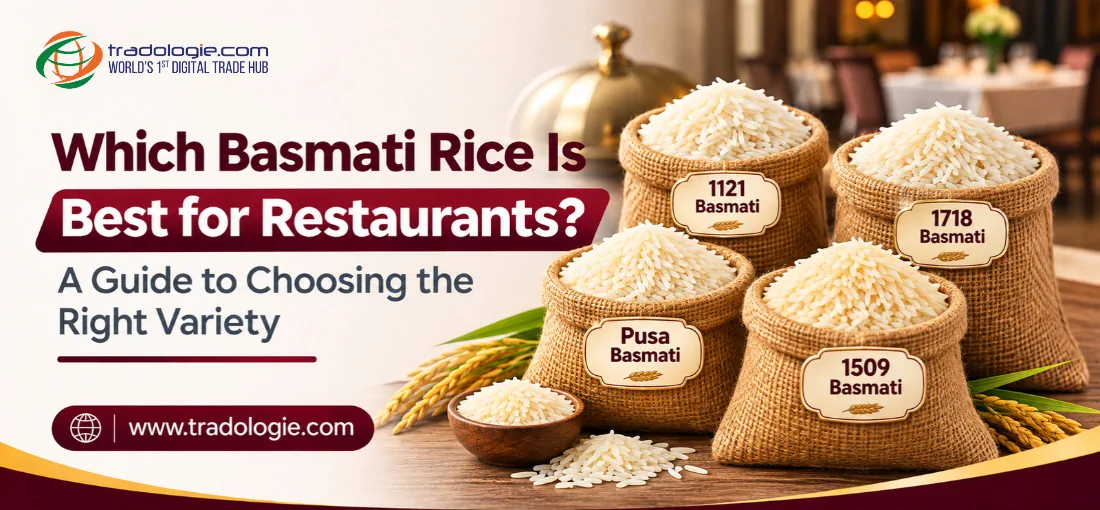
There are numerous varieties of Basmati rice cultivated in India. In bulk procurement and food service contexts, Pusa Basmati 1121, Pusa Basmati 1509, Pusa Basmati 1718 , and Pusa Basmati 6 (1401) are prominent varieties. The variety should be selected to align with the specific requirements of the restaurant menu, rather than based purely on the variety. Also make sure to select the reliable basmati rice suppliers who cater with genuine supplies.
Pusa Basmati 1121
Pusa Basmati 1121 is characterised by an exceptionally long grain and high elongation. Under evaluation conditions, raw grains measure approximately 7.7mm, however once cooked, they measure up to approximately 22mm in length.
It is therefore a preferred choice in restaurants serving Biryanis, due to its ability to deliver elongated grains in the final product. The aroma, volume expansion, and grain structure also make it suitable for premium food service. For establishments looking to serve elongated grains in generous portions, 1121 would be a suitable choice to consider. However, buyers should trial older and new stock to determine which would be most suitable for bulk procurement.
Pusa Basmati 1509
Pusa Basmati 1509 is an early-maturing Basmati, developed by ICAR-IARI. It offers commendable grain quality and cooking characteristics, and the grains have been found to be approximately 18.2mm in length when cooked, in trials at the technology transfer unit.
This may be a suitable choice for restaurants wanting to use long grain Basmati, but do not require the expensive, premium-grade 1121. As with all Basmati grains, suitability depends on milling standards, age, aroma and cooking characteristics. In a commercial context, 1509 could be considered for Biryani, Pulao and general restaurant use, where superior grain presentation and cost efficiency are required.
Pusa Basmati 1718
Pusa Basmati 1718 is an improved variety of Pusa Basmati 1121, resistant to bacterial blight. It retains several of the defining attributes of Basmati rice, with exceptionally long thin grains and a pronounced aroma.
The average grain length of raw grain is approximately 8.10mm, and once cooked it measures approximately 17mm. However, these values should not be considered definitive measurements across all commercial stocks.
If extra long aromatic grains are required, 1718 is a suitable option for restaurants. However, buyers should trial samples to ascertain the appropriate grain length, texture and aroma.
Pusa Basmati 6 (1401)
Pusa Basmati 6 (or 1401) is another established variety of Basmati rice developed by ICAR-IARI. It possesses a pronounced aroma and uniform grain structure once cooked.
This rice may be a suitable choice for traditional rice dishes in restaurants (such as biryani and pulao). It may be considered in situations where an appropriate balance of grain appearance, aroma and texture is required. As with all varieties, quality will depend on milling standards, age, storage and cooking.
Traditional Basmati 370
Basmati 370 is a traditional variety with a pronounced aroma and long thin grain. It retains several traditional Basmati characteristics, making it appealing to restaurants focused on pronounced aroma and the authenticity of regional cuisines.
However, compared to modern extensively cultivated varieties, it may not be readily available in substantial volumes. If it is considered by restaurants, its regular supply availability and overall procurement expenditure should be assessed.

3. Best Basmati Rice for Different Menu Items
Depending on what menu items you are preparing, the quantity of rice being used, and the pricing model of your restaurant, a different variety of rice may be more appropriate. In a premium Biryani restaurant, rice with exceptional grain elongation may be preferred. However, in a multi-cuisine restaurant, a rice with a balanced combination of characteristics may be more appropriate.
| Menu item | Recommended varieties | Key considerations |
|---|---|---|
| High quality Biryani | Pusa Basmati 1121, Pusa Basmati 1718 | Elongation, aroma and separation |
| Pulao | Pusa Basmati 1121, Pusa Basmati 1509, Pusa 1401 | Texture and consistency |
| Buffet style (hotels) | Pusa Basmati 1121, Pusa Basmati 1509 | Yield and appearance |
| Traditional rice dishes | Basmati 370, Pusa 1401 | Aroma and flavour |
| Multi cuisine menu | Pusa Basmati 1509, Pusa 1401 | Versatile and cost effective |
These recommendations are intended to facilitate the evaluation of each variety. To identify the most suitable rice for regular procurement, trials should be conducted.
4. Selecting the Best Rice in Restaurants
Selecting the best rice for use in a restaurant involves establishing a balance between superior rice quality and cost. If a rice is very inexpensive, it may not be the most economical option to serve if it delivers an unsatisfactory yield or inconsistent quality, or has a high percentage of broken grains.
Before bulk purchasing, factors to consider include:
- Breakage - excessive broken grains may compromise the visual presentation of high-quality biryanis.
- Moisture content - confirm that the rice conforms to the required quality specifications.
- Age and crop - ensure that it has been aged for the specified duration, and is from the correct crop.
- Grain uniformity - ensure grains are uniform in length, colour and milling standards.
- Yield - determine how much cooked rice can be prepared from a specified quantity of uncooked rice.
- Consistency - ensure that the supplier can provide products of identical specifications across repeated orders.
To compare suppliers effectively, it is particularly beneficial to use a sample of rice and cook it according to your own recipe, using your own equipment and methods.
5. Best Commercial Basmati Rice
In hotels, chain restaurants and catering, rice is regularly procured. Therefore, the best Basmati rice for commercial use may not be the one with the longest grain length, or highest price, but the rice that consistently fulfils the operational requirements of the kitchen, and at an acceptable price per portion. To simply compare rice, consider the price per kg, the percentage of rice that can be utilised, yield and wastage. If substantial quantities are being purchased, it is important to consider supplier dependability, packaging specifications, delivery timelines and batch consistency.
Bulk purchasers may find it beneficial to negotiate the required rice specifications with the supplier. This includes variety, ageing, grain length, % broken grains, moisture content and packaging. Doing this minimises potential quality discrepancies and streamlines repeat ordering.
For commercial kitchens, the ideal rice for restaurants is one that delivers consistent cooking results, fulfils menu requirements and offers a commercially viable cost per portion.
Conclusion
When selecting Basmati rice for use in restaurants, a balanced combination of grain quality, aroma, cooking characteristics and cost is important. Pusa Basmati 1121 is renowned for its exceptional grain elongation. However, 1509, 1718 and Pusa 1401 all offer distinct combinations of grain characteristics and cooking qualities. Basmati 370 could also be considered if aroma and traditional characteristics are important.
Overall, the best Basmati rice for restaurants will depend on the menu, cooking method, expected service and supplier consistency. To make a well-informed procurement decision, buyers may wish to trial samples and calculate yield.
Disclaimer
The information presented in this article is intended for general informational purposes. Grain measurements, cooking performance, availability, quality and procurement costs may vary depending on the crop, ageing, milling standards, storage conditions and supplier. The variety recommendations are indicative and should not be treated as universal specifications for every restaurant. Buyers should conduct cooking trials using their own recipes and kitchen equipment before finalising bulk orders. Product specifications, supplier credentials and applicable food-safety requirements should also be verified before procurement.