Key Highlights
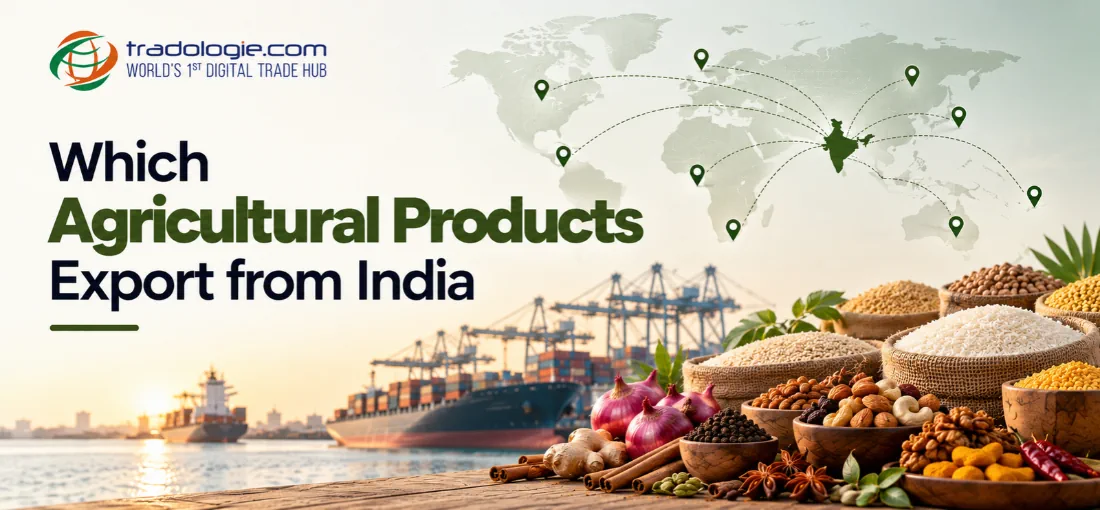
- India exports a wide range of agricultural products, including rice, pulses, spices, fruits, vegetables, oilseeds and processed foods.
- Non-Basmati rice exports reached approximately US$5.86 billion in FY 2025-26, while Basmati rice exports stood at US$5.67 billion.
- Export opportunities also include maize, millets, groundnuts, cashews, fresh grapes, mangoes, spices and fruit pulp.
- Exporters generally need an Importer Exporter Code (IEC), along with applicable registrations and product-specific certifications.
- Quality standards, export policies, packaging and import requirements vary by commodity and destination country.
- Tradologie helps agricultural exporters connect with potential international buyers through B2B trade opportunities.
Introduction:
India's agricultural exports range from rice and pulses shipped in bulk to fresh grapes, mangoes, groundnuts and processed food products. For anyone researching agricultural products to export from India , the choice is not limited to crops grown in large quantities. Products that undergo cleaning, grading, processing or packaging can also serve overseas buyers, depending on their requirements.
APEDA's export data gives a useful picture of where Indian agricultural trade stands. In FY 2025-26, non-Basmati rice exports were valued at approximately US 5.86 billion,while Basmati rice exports reached about US 5.67 billion. The same data records exports of pulses, fresh fruits, vegetables, maize, millets and several processed agricultural products.
These figures show the scale of the market, but they do not mean every product is equally suitable for a new exporter. Rice requires one kind of sourcing and quality control; fresh grapes need careful handling and timely delivery. The right place to start is with products you can source consistently, buyers you can realistically reach and the requirements of the country you intend to supply.

Which Agricultural Products Can You Export from India?
India exports agricultural commodities in raw, graded and processed forms. The following categories offer a useful starting point for exploring which crops can be exported from India.
| Product category | Examples |
|---|---|
| Cereals and grains | Basmati rice, non-Basmati rice, maize, millets and other cereals |
| Pulses | Chickpeas, pigeon peas, green gram, black gram and lentils |
| Spices | Red chillies, cumin, turmeric, coriander, cardamom and black pepper |
| Fresh fruits | Grapes, mangoes, bananas, pomegranates and other seasonal fruits |
| Fresh vegetables | Onions, potatoes, garlic, okra and other vegetables |
| Oilseeds and nuts | Groundnuts, sesame seeds and cashew products |
| Processed agricultural products | Fruit pulp, juices, frozen vegetables, pickles and cereal preparations |
| Other agricultural commodities | Guar gum, oil meals, coffee, tea and sugar, subject to applicable rules |
This list covers several types of trade, not just crops sold directly after harvest. A business may export raw sesame seeds to a food manufacturer, cleaned cumin to a spice importer or processed mango pulp to a food company. Each product has its own quality, packaging and compliance requirements.
One important distinction: APEDA's product-wise data covers products under its monitoring remit, while India's wider agricultural export basket also includes categories tracked by other commodity boards and agencies. The figures below are identified accordingly.
1. Rice, Maize, Millets and Other Cereals
Rice is one of India's most established agricultural export products. Both Basmati and non-Basmati rice have substantial overseas markets, although the varieties, buyer requirements and commercial positioning differ.
APEDA's FY 2025-26 data records the following export values for selected cereal products.
| Product | Export value, FY 2025–26 |
|---|---|
| Non-Basmati rice | US$5.86 billion |
| Basmati rice | US$5.67 billion |
| Maize | US$374.78 million |
| Millets | US$61.57 million |
| Wheat | US$10.29 million |
Source: APEDA Agri-Exchange, three-year export statement. Figures are rounded. Wheat exports must be assessed against the applicable current export policy.
Rice buyers may specify grain length, broken percentage, moisture, milling quality and variety. For maize, the intended use matters: food, feed and industrial buyers may ask for different specifications. Millets also need careful grading, cleanliness and moisture control.
Wheat requires an additional policy check before procurement. Do not assume that the rules for one cereal automatically apply to another.
For exporters considering cereals, the practical questions are straightforward: Can you source the required grade? Can you supply the quantity consistently? And will the selling price cover procurement, handling, freight and other costs?
2. Pulses and Legumes
Pulses are used in everyday cooking across many markets, and importers may purchase them for wholesale distribution, food processing or retail packing. Indian products include chickpeas, pigeon peas, green gram, black gram and other varieties.
APEDA's FY 2025-26 statement records pulse exports worth approximately US$969.58 million.
Before approaching a buyer, establish which variety and grade they require. A commercial order may specify:
- Grain size, colour and uniformity.
- Moisture content and foreign matter.
- Broken or damaged grains.
- Insect infestation and storage condition.
- Permitted residue levels and other applicable food-safety requirements.
There is a difference between selling raw produce and supplying export-ready pulses. Cleaning, grading and packing may add costs, but buyers often need those steps completed before the goods arrive.
Export policy also needs to be checked for the specific pulse. Do not assume that every pulse has the same rules or that an earlier policy position remains in force.
3. Spices and Condiments
India's spice trade includes red chillies, cumin, turmeric, coriander, cardamom, black pepper, ginger and spice blends. Overseas customers range from commodity importers and wholesalers to seasoning manufacturers and food processors.
Spices are part of India's wider agricultural export basket, but their product-specific export data and regulatory guidance are available through the Spices Board rather than being fully represented by APEDA's product tables.
The form in which a spice is sold makes a difference. Whole cumin, for example, may be purchased on the basis of purity, colour, aroma and moisture. A buyer purchasing ground turmeric or a spice blend may also be concerned about particle size, microbial quality and batch-to-batch consistency.
Common products to explore include:
- Red chillies and chilli powder.
- Cumin and coriander seeds.
- Turmeric fingers and turmeric powder.
- Green and large cardamom.
- Black pepper and dry ginger.
- Curry powders and blended seasonings.
Pesticide residues, aflatoxins and microbial contamination can affect acceptance in destination markets. Some markets also impose requirements for specific contaminants or treatments. Confirm the buyer's specification and destination rules before purchasing stock.
For registration and product-specific guidance, exporters should consult the Spices Board of India.
4. Fresh Fruits: Grapes, Mangoes and Other Produce
India exports a range of fresh fruits, including grapes, mangoes, bananas and pomegranates. But fresh produce needs a different approach from dry commodities. The condition of the fruit when it arrives matters as much as the price at which it was purchased.
APEDA's FY 2025-26 data records exports of other fresh fruits worth approximately US722.69million,fresh grapes worth US367.98 million and fresh mangoes worth US$54 million. These are separate product categories in APEDA's statement.
| Product | Important export considerations |
|---|---|
| Grapes | Berry size, bunch condition, residue compliance, packaging and cold-chain management |
| Mangoes | Variety, maturity, appearance, shelf life and destination-specific treatment requirements |
| Bananas | Maturity, handling, ripening arrangements and transit time |
| Pomegranates | Fruit size, visible damage, grading and storage |
| Other seasonal fruits | Harvest timing, buyer demand, shelf life and suitable transport |
Fresh fruit shipments need coordination between the farm, packhouse, transport provider and importer. Delays can affect quality, particularly when produce must travel long distances before reaching the market.
Destination requirements should be checked before the goods are sourced. Some markets require specific plant-health certificates, treatments or approved protocols for particular fruits. Permission to export one type of fruit does not automatically establish access for another.
5. Vegetables: Onions, Potatoes, Garlic and More
Onions, potatoes, garlic, okra and other vegetables offer opportunities for exporters supplying wholesale markets, distributors, food-service businesses and importers.
APEDA's FY 2025-26 data records fresh onion exports worth approximately US$397.26 million. Its broader fresh-fruit-and-vegetable category also includes other fresh vegetables.
Vegetable exports are often affected by seasonality and changes in domestic and international prices. An exporter sourcing onions, for example, needs to account for size grading, curing, storage, packaging and the time needed to reach the destination. Export policy can also affect the commercial calculation.
Before accepting an order, check:
- Size, grade and uniformity.
- Physical damage, rot and visible defects.
- Storage and ventilation requirements.
- Packaging and loading arrangements.
- Transit time and expected shelf life.
- Destination-specific plant-health and food-safety requirements.
A lower purchase price does not necessarily mean a better export opportunity. If the produce deteriorates during storage or transit, the saving can quickly disappear.
APEDA's Fresh Fruits and Vegetables section is a useful starting point for official information.
6. Groundnuts, Sesame Seeds and Other Oilseeds
Groundnuts and sesame seeds are worth considering for businesses interested in dry agricultural commodities. Buyers may include food manufacturers, ingredient suppliers, oil processors and commodity traders.
APEDA recorded groundnut exports worth approximately US$795 million in FY 2024-25. Its annual report lists groundnuts among the major products in its export basket.
Groundnuts may require careful aflatoxin control and testing, while sesame buyers can specify purity, colour, moisture and other quality parameters. Requirements vary according to the destination and intended use.
Before quoting, clarify whether the buyer wants raw, cleaned, graded or otherwise processed material. These are not equivalent products from a pricing perspective. Sorting, testing and preparation all affect the final export cost.
7. Processed Agricultural Products
Agricultural exports are not limited to products shipped in their raw form. India also exports processed fruits and vegetables, juices, cereal preparations, preserved products and other food preparations.
APEDA's FY 2025-26 statement records exports worth approximately US932.25millionforprocessedvegetables,US662.83 million for processed fruits, juices and nuts, and US$1.01 billion for cereal preparations.
Products in this category include:
- Mango pulp and other fruit pulps.
- Fruit juices and preparations.
- Frozen vegetables.
- Pickles and preserved vegetables.
- Dried fruits and vegetables.
- Cereal preparations and other processed foods
Processing can extend shelf life and open up opportunities with manufacturers and distributors. It also brings additional requirements for ingredient declarations, labelling, packaging, food safety and destination-specific compliance.
For some exporters, supplying processed products may be more practical than shipping fresh produce. The decision depends on access to processing facilities, the buyer's needs and whether the additional costs leave a viable margin.

8. Other Agricultural Commodities: Guar Gum, Cashew, Coffee and Sugar
Several other products deserve attention when researching top agricultural products to export from India.
Guar gum is used in food and industrial applications. Buyers may specify viscosity, mesh size, moisture and purity, so understanding the product's end use is important.
Cashew products include kernels and other forms. APEDA's FY 2025-26 data records cashew kernel exports worth approximately US$265.08 million.
Coffee and sugar are also part of India's wider agricultural export trade. Their markets and regulatory frameworks differ from those of APEDA-monitored products, so exporters should consult the relevant commodity authorities and check current export conditions.
Oil meals and other agricultural ingredients may also be worth exploring. These markets can be specification-driven, with buyers focusing on parameters linked to processing, storage or industrial use.
Which Agricultural Products Are India's Major Exports?
APEDA's product-wise data provides a useful way to compare export categories. The table below uses FY 2025-26 figures from APEDA's three-year export statement.
| APEDA product category | Export value, FY 2025-26 |
|---|---|
| Non-Basmati rice | US$5.86 billion |
| Basmati rice | US$5.67 billion |
| Cereal preparations | US$1.01 billion |
| Pulses | US$969.58 million |
| Processed vegetables | US$932.25 million |
| Other fresh fruits | US$722.69 million |
| Processed fruits, juices and nuts | US$662.83 million |
| Groundnuts | US$ data varies by category and reporting table; refer to APEDA's current statement |
Rice stands out in these figures, but a high export value alone does not establish that a product is the best choice for a new exporter. Competition, supplier access, working capital, destination requirements and shipment costs all influence the actual opportunity.
How to Choose the Right Agricultural Product for Export
Rather than trying to trade every product on the list, start with two or three that match your sourcing network and the buyers you can realistically reach.
Check whether you can source consistently. An importer may need regular shipments, not a one-off consignment. Make sure you can maintain the required quantity and grade.
Study the destination market. Look at import demand, competing origins, seasonal patterns and buyer specifications. Large import volumes can also mean strong competition.
Understand the quality requirements. Depending on the product, buyers may test moisture, purity, grain size, residue levels, microbial parameters or shelf life.
Calculate the full cost. Include procurement, grading, packaging, testing, inland transport, port handling, freight and finance costs before deciding on a selling price.
Check export policy and registrations. The rules for one agricultural commodity may differ from those for another. Use the correct HS code and verify current requirements before committing to stock.
How to Start Exporting Agricultural Products from India
Once you have selected a product, the process becomes more specific. Exporting pulses is different from shipping fresh grapes, but several commercial steps apply to both.
- Research the product and destination. Use trade data to understand demand, competition and import requirements. APEDA's Agri-Exchange portal provides product-wise export information.
- Find reliable suppliers. Compare specifications, available quantities, samples and pricing. Check quality before committing to a large purchase.
- Complete applicable registrations. An IEC is generally required. Check APEDA registration or RCMC requirements where applicable, along with relevant food-safety and business formalities.
- Find and verify buyers. Approach importers, processors, wholesalers and distributors through trade networks, exhibitions, direct outreach and B2B platforms such as Tradologie.
- Agree on the contract and price. Specify grade, quantity, quality tolerances, delivery terms, payment arrangements and required documents.
- Arrange testing and documentation. Depending on the product and destination, requirements may include laboratory reports, a certificate of origin, phytosanitary certification or fumigation records.
- Coordinate shipment and payment. Plan packaging, loading, customs clearance and transport. Fresh produce may require more careful temperature and transit management.
Not every certificate is mandatory for every shipment. Confirm the requirements for the particular commodity and destination with the relevant authority, buyer and customs broker.
Finding Buyers for Agricultural Products
Knowing what India exports is only the first part of the exercise. The next is finding an importer whose requirements match the product you can supply.
A spice importer may need cumin with a defined purity level. A rice buyer may specify variety, grain length and broken percentage. A fruit importer may care most about maturity, treatment, packaging and arrival condition. The more closely your offer matches these requirements, the more useful your initial conversation will be.
Tradologie is one route for exploring international B2B buyer connections. Exporters can also approach importers directly, attend agricultural trade exhibitions and use commodity associations and trade directories.
Before accepting an order, confirm the buyer's specifications, required quantity, delivery schedule and payment terms. Verify the buyer's business credentials as well. An inquiry is a starting point, not proof that the transaction is commercially secure.
Conclusion
India offers exporters a wide range of agricultural products, from rice, pulses and spices to fruits, vegetables, oilseeds and processed foods. APEDA's data shows the scale of several of these markets, particularly rice, while also recording exports of pulses, fresh produce and processed agricultural products.
If you are deciding which crops can be exported from India , start with products you can source reliably and sell to a clearly identified market. Check the applicable export policy, understand the buyer's specifications and calculate the complete shipment cost before committing to stock.
The strongest starting point is not necessarily the product with the largest export figure. It is the one where supply, quality, buyer demand and logistics come together at a price that works.
Disclaimer
Agricultural export policies, registration requirements, food-safety standards and destination-country regulations may change. Exporters should verify the latest requirements with the relevant Indian authorities, commodity boards, customs professionals and overseas buyers before entering into a transaction. Export values mentioned in this content are based on the referenced reporting period and may differ across data sources and reporting categories.