
Key Highlights
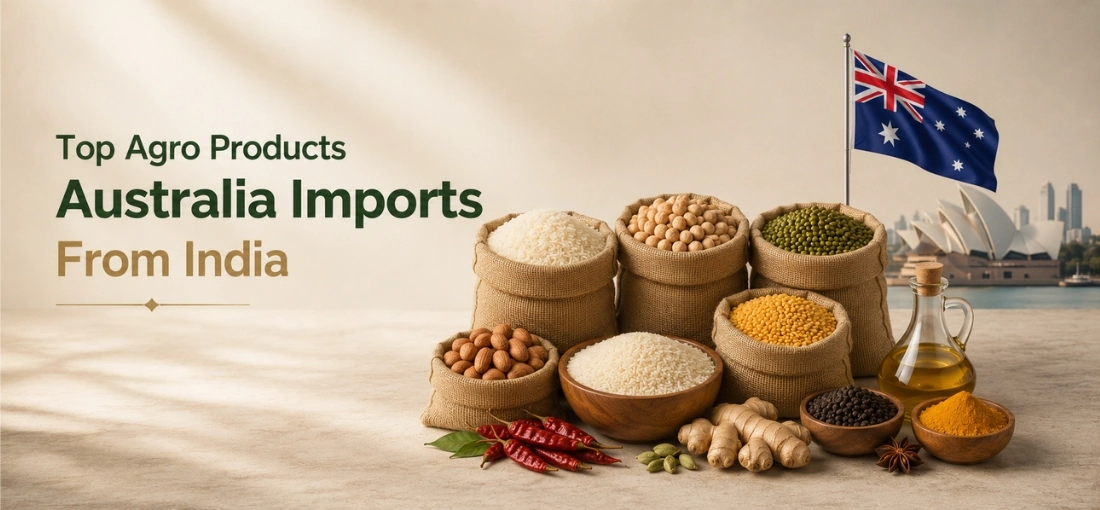
- Australia imported 235.62 thousand MT of agricultural products from India in FY 2024-25.
- India's agricultural exports to Australia were valued at USD 504.01 million .
- Miscellaneous food preparations are India's largest agricultural export to Australia.
- Basmati rice, spices, marine products, and other agricultural commodities are among the top export categories.
- Australia's multicultural population and growing demand for specialty foods create strong opportunities for Indian exporters.
- Strict biosecurity and food safety compliance are essential for successful exports.
Introduction:
Have you ever stopped to think about where a massive agricultural powerhouse like Australia gets its specialty foods? It sounds a bit backwards at first. Australia is famous for its own massive farming sector, exporting millions of tons of beef, grain, and dairy globally every single year. Yet, if you look closely at their retail shelves and commercial kitchens, they are actually buying a massive volume of Indian agricultural and food products.

But why does Australia still import agricultural commodities from India? It really comes down to Australia's growing multicultural population and evolving consumer preferences. The growing South Asian diaspora, alongside a mainstream liking with authentic Indian, Middle Eastern, and Asian cuisines, has turned specialty items into everyday essentials. When you add their food processing industry's need for specific raw materials and a nationwide surge in demand for convenient, packaged foods, India has emerged as an important supplier of several agricultural and food products to Australia. If you are an Indian exporter looking to diversify, and export food products to Australia , this small island country presents lucrative opportunities.
Keep reading this informative piece of blog as it will tell you the top agricultural commodities Australia imports from India .
Let's Look at the Actual Trade Numbers (FY 2024-25)
So, where exactly does Australia stand when it comes to India agricultural exports to Australia ? If you check the official trade charts for the FY 2024-25 fiscal cycle, Australia ranks as India's 28th largest agricultural export destination. But how much physical volume are we talking about here? During the year, Indian suppliers successfully moved a total volume of 235.62 thousand metric tonnes of agricultural exports across this trade lane.
Now, you might ask, what is the actual net worth of all that cargo landing at Australia imports from India docks? In terms of value, that volume brought in a substantial USD 504.01 million, which converts to roughly ₹4,261.53 crore. If you want to look at the grand scheme of things, Australia accounts for exactly 0.95% of India's total global agricultural exports value.
Here is a quick snapshot of how those core metrics stack up:
| Metric | Value |
|---|---|
| Australia's Global Rank | 28th |
| Export Value (USD) | USD 504.01 Million |
| Export Value (INR) | ₹4,261.53 Crore |
| Export Volume (Metric Tonnes) | 235.62 Thousand MT |
| Share in India's Total Agri Exports (%) | 0.95% |
But what do these figures actually tell us about the market? Surprisingly, even though Australia contributes less than 1% of India exports to Australia, it remains a valuable and relatively stable export destination for India Australia agricultural trade. Why? Because the Australia food imports demand is diversified across multiple agricultural product categories rather than relying on a single commodity. Instead, the value is incredibly well-spread across value-added processed food products, premium rice, spices, and seafood, making it a highly resilient corridor for consistent agricultural exports to Australia.
Top 5 Agricultural Commodities Australia Imports From India
Before we dive into the specific industry dynamics of each segment, let's look at exactly how the top five commodities stack up against each other in terms of value and market share:
| Product Category | Export Value (USD Millions) | Share of Total Agri-Exports (%) |
|---|---|---|
| Miscellaneous Preparations | 79.29 | 15.73% |
| Basmati Rice | 72.47 | 14.38% |
| Spices | 53.81 | 10.68% |
| Marine Products | 38.19 | 7.58% |
| Other Commodities | 37.43 | 7.43% |
Miscellaneous Preparations (USD 79.29 Million | 15.73% Share)
Then you have the absolute number one category on the leaderboard: Miscellaneous Preparations. It pulls in a massive USD 79.29 million, securing a 15.73% chunk of the entire export basket. But what exactly is hiding inside this corporate-sounding category? It is almost entirely value-added food products—think instant meal mixes, processed cooking pastes, pre-packaged corporate snacks, and ready-to-eat items. The big driver here is Australia's urban lifestyle, where busy working professionals are constantly hunting for high-quality convenience foods. This creates significant export opportunities for manufacturers who can deliver retail-ready products that comply with strict Western shelf-life expectations.
Basmati Rice (USD 72.47 Million | 14.38% Share)
Right behind processed items, we find Basmati Rice sitting comfortably in the number two slot, bringing in USD 72.47 million. But what makes ,Basmati Rice exports to Australia so consistently profitable? The great thing about this market is that Australian consumers and commercial chefs do not treat Indian Basmati Rice like a basic, cheap grain. Surprisingly, they view premium rice as a high-tier specialty ingredient. This luxury perception is heavily fueled by the country's multicultural restaurants, corporate catering networks, and ethnic grocery stores. Because of that, long-grain, aged varieties command premium prices in the market across major supermarkets like Coles and Woolworths.
Spices (USD 53.81 Million | 10.68% Share)
Then we have the spice sector taking the third spot, netting a cool USD 53.81 million. The fascinating thing about spice exports to Australia is that the demand spreads way past traditional South Asian households. Mainstream Australian palate preferences have completely transformed over the last decade. Today, massive commercial food manufacturers, industrial bakeries, and multicultural restaurant chains are constantly buying bulk Indian spices to fuel their production lines. Whether it is whole seeds or high-value ground powders, Indian spices continue to enjoy a strong reputation for quality and flavour among Australian procurement managers due to India's dominant global reputation for intensity.
Marine Products (USD 38.19 Million | 7.58% Share)
Next up on the list is Marine Products , which generated USD 38.19 million for Indian seafood exports. But what exactly is driving this steady flow of Indian seafood into the southern hemisphere? It comes down to the daily needs of Australia's massive food service, hospitality, and pub sectors . Commercial kitchens require a highly consistent, premium supply of frozen seafood—specifically items like Vannamei shrimp and prawns—that can be prepared quickly. Indian exporters continue to supply Australia's foodservice and retail sectors because their aquaculture facilities can deliver highly competitive wholesale pricing while meeting the rigid quality expectations of Australian buyers.
Other Commodities (USD 37.43 Million | 7.43% Share)
Finally, rounding out the top five is the "agricultural commodities" basket, bringing in USD 37.43 million. But what does this tell us about Australia's general buying habits? It highlights just how diverse the overall demand for Indian agro products really is. We are talking about smaller, niche shipments of specialty starches, unique oilseed derivatives, plant extracts, and miscellaneous agricultural items. For an exporter, this category is proof that the Australian market isn't just looking for the usual suspects—if you have a unique, well-processed agricultural product, there is likely a corporate buyer in Sydney or Melbourne looking for it.

Why Australia Imports Food Products from India
Have you ever wondered why a major country like Australia imports a wide range of agricultural products from India ? If you look closely at how the Australian food market operates, it becomes obvious that their domestic production simply isn't designed to grow everything. They excel at large-scale cattle ranching and massive wheat fields, but their local climate and high labor costs make cultivating labor-intensive specialty foods completely unviable.
But what is the real anchoring point for Indian food products over there? It is the demographic reality. Australia has seen a massive influx of South Asian professionals and students over the last twenty years. That permanent population base creates a massive, non-negotiable demand for authentic staples because local production does not meet demand for every specialty food product . When you combine this built-in consumer base with the fact that Australia imports food to meet the needs of its expanding processed food sector, export food to Australia becomes a highly viable path. We have the agricultural variety, the massive processing capacity, and the established trade relationships to supply their Indian agricultural products supply chains consistently week after week.
Key Considerations Before You Export Agricultural Products to Australia
If you are planning to jump into this trade lane, you cannot just focus on the sales margins. You absolutely must understand the local border rules. Australia enforces what are among the world's strictest biosecurity regulations and food safety standards on the planet. The Department of Agriculture, Fisheries and Forestry (DAFF) screens incoming shipments with extreme scrutiny. What does this mean for your daily operations? It means if your cargo shows even a trace of pest contamination, improper moisture levels, or unapproved chemical residues, it will be immediately fumigated, destroyed, or sent back at your expense.
To ensure your shipment actually makes it past the docks, you need to treat your export documentation and quality assurance like a science.
| Requirement | Why It Matters |
|---|---|
| Food Safety Compliance | Meets Australia import requirements and prevents automatic border rejections. |
| Product Labelling | Ensures legal market entry by detailing ingredients and allergens correctly. |
| Documentation | Secures smooth customs clearance through flawless export documentation. |
| Packaging Quality | Protects products from moisture and damage during long ocean transit. |
| Traceability | Builds long-term buyer confidence by proving exact farm-to-fork origin. |
| Logistics Planning | Reduces transit risks and avoids expensive port demurrage fees. |
If you skip out on high-grade packaging suitable for long-distance shipping, or fail to use reliable logistics partners who know how to navigate Australia import requirements , you are setting yourself up for a nightmare at the port. Consistency and compliance are the only real ways to export agricultural products to Australia successfully over the long haul.
Conclusion
When you look at the entire picture, Australia represents a highly profitable, stable market for Indian exporters who are serious about quality. During FY 2024-25, the USD 504.01 million trade value reflects steady demand for Indian agricultural products. Whether your business focuses on high-margin Miscellaneous Preparations, premium Basmati Rice, or industrial spice exports to Australia, the opportunities are vast.
The secret to winning long-term contracts in this market isn't about competing on the absolute lowest price—it is about proving that your shipments can consistently meet Australia’s strict quality and regulatory standards. If you can deliver that level of reliability, you can build a highly lucrative, multi-year export business feeding one of the wealthiest consumer markets in the world
Disclaimer
The information provided in this article is for educational and informational purposes only. Export statistics, customs procedures, biosecurity regulations, and Australia's import policies may change over time. Exporters should verify the latest DGCIS data, Department of Agriculture, Fisheries and Forestry (DAFF) requirements, and destination-country compliance requirements before exporting agricultural products.




.webp "Top Global Food and Beverage Trade Shows 2026: Dates, Countries, and Complete Event Guide")

.webp "Banana Export From India: Varieties, Top Markets And Trade Guide")