Key Highlights
- The UAE is a major rice import and re-export hub for the Middle East.
- India is the UAE's largest rice supplier by import value.
- Al Ghurair Foods, Olam Agri Gulf, and KRBL DMCC are among the top importers.
- Transaction-based B2B platforms help exporters reach verified buyers directly.
- UAE import rules require strict quality, MRL, and documentation compliance.
- Proper documentation and direct buyer relationships improve export success.
Introduction:
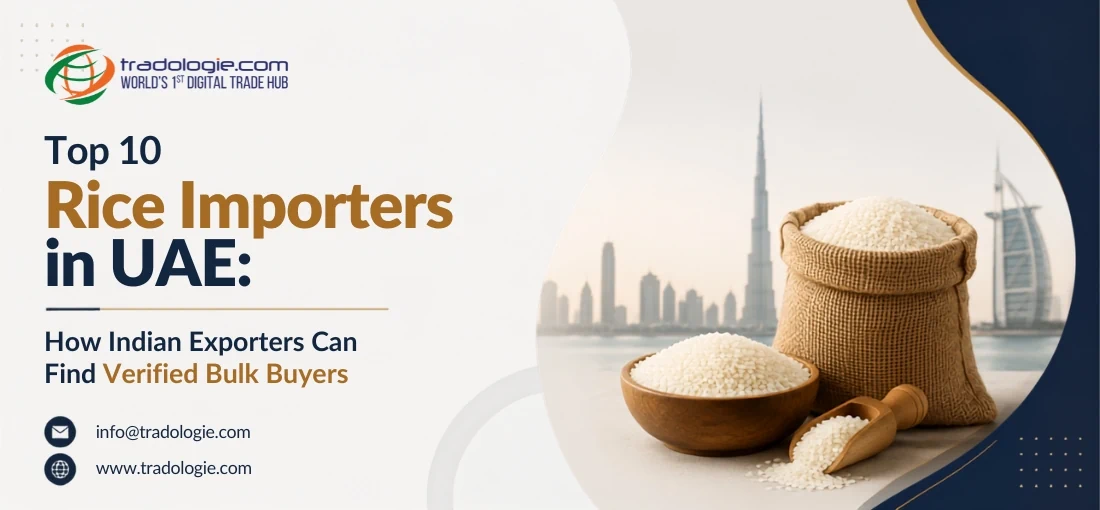
If you run a rice milling unit or an export business out of India, targeting the United Arab Emirates is pretty much a no-brainer. The UAE isn't just buying grain to feed its own residents; it acts as the primary re-export hub for the entire Middle East, East Africa, and parts of Central Asia. The top rice importers in UAE form the large chunk of rice imports for the entire gulf countries.
However, breaking into the market isn't as simple as firing off cold emails or calling up numbers you bought online. The real challenge lies in cutting through the noise to find leading rice buyers in UAE who are pre-screened, financially sound, and actually actively buying bulk container loads.
In this guide, we'll look at the exact numbers driving the UAE rice trade, walk through the top 10 rice importers in UAE you should know, weigh up the different ways exporters find buyers, and show you how to secure clean, profitable supply contracts.

UAE Rice Import Market at a Glance
Before pitching to procurement heads in Dubai or Abu Dhabi, you need a clear picture of the market dynamics. Because local crop production is virtually non-existent due to water scarcity, the UAE relies entirely on sea imports to meet both daily consumption and re-export needs.
The raw numbers highlight just how important this trade lane is:
| Market Metric | Trade Value / Volume | Source / Context |
|---|---|---|
| Total Import Value (2024) | US$678 Million | Ranks 16th largest globally (OEC) |
| Overall Product Import Rank | 74th Most Imported Good | Covers all product categories entering the UAE (OEC) |
| India's Export Share (2024) | US$488 Million | India remains the UAE's #1 rice supplier by a wide margin (OEC) |
| Competing Export Origins (2024) | Pakistan (US$174M), Thailand (US$6.5M), US (US$2.56M), Italy (US$1.38M) | Pakistan holds the second-largest market share (OEC) |
| Export Growth (2023 vs 2024) | Pakistan (+US$61.5M), India (+US$24.6M) | Pakistan recorded the fastest recent export growth (OEC) |
| Indian Basmati Exports (FY 2025-26) | US$464.17 Million | High demand for 1121, Traditional, and Sella grades (APEDA) |
| Indian Non-Basmati Exports (FY 2025-26) | US$237.36 Million | Heavy volume in IR 64, Sona Masoori, and broken grades (APEDA) |
As the APEDA figures show, Indian suppliers have a massive presence in both segment categories. Premium long-grain Basmati moves heavily into upscale retail chains, hotels, and restaurants, while Non-Basmati staples like IR 64 Parboiled and Sona Masoori supply institutional caterers, labor camps, and commercial food processors.
Top 10 Rice Importers in the UAE
It's a well-known fact that food trade in most countries is controlled by a few big trading companies. That's exactly how it functions in the UAE as well. No doubt there are a huge number of unorganised merchant importers that are spread across the country. But the leading rice importers in UAE dominate a large chunk of the trade game. These companies handle big operations from in-house manufacturing all the way to private label packaging to cater to the nationwide retail supply as well as the big re-export market in the Gulf countries.
Here are ten of the main rice trading companies in UAE you ought to have on your radar:
1. Al Ghurair Foods (Dubai)
Ask anyone in the Gulf commodity scene and they'll tell you Al Ghurair is a giant. They bring in metric tons of raw Basmati and non-basmati straight from origin mills into their Dubai plants. Once the grain lands, they handle the whole pipeline—cleaning, milling, packing under their own consumer labels, and moving stock out to supermarkets, regional wholesalers, and hotel chains across the UAE and broader GCC.
2. Olam Agri Gulf (Dubai)
Setting up their regional desk in DMCC, Olam Agri runs what is essentially a massive supply funnel for the Middle East and Africa. They regularly contract bulk rice buyers in UAE shipments out of India, Pakistan, Vietnam, and Thailand. Rather than just sitting on local store shelves, a huge chunk of what they import gets redirected out to merchant buyers, food factories, and re-exporters working across neighbouring borders.
3. KRBL DMCC (Dubai)
KRBL is the force behind India Gate Basmati, and their Dubai arm handles the entire Middle East distribution leg. They don't mess around with lower-tier mixes here; they focus on high-grade, aged Basmati. You’ll find their shipments heading straight into major hypermarket chains, wholesale grain markets, and high-end hotel and catering accounts throughout the region.
4. Lulu Group International
If you've spent five minutes in the UAE, you've seen a Lulu Hypermarket. They are a massive retail presence, and they import huge volumes on their own tab. Instead of buying through local middlemen, Lulu sources directly from Indian and Pakistani millers to pack their private-label rice bags and keep their store shelves stocked at low prices.
5. Al Maya Group
Al Maya is another heavyweight in the UAE's retail and FMCG space. They run a network of supermarkets, but their wholesale division is just as busy. They import everything from budget non-basmati varieties for mass catering up to premium aged Basmati, supplying both their own aisles and independent grocers across the country.
6. Jaleel Holdings
Jaleel Holdings has been supplying the UAE's food trade for decades, and they are a go-to house for wholesale distribution. They bring in Basmati, Non-Basmati, and popular South Indian varieties like Matta and Ponni. Their trucks supply everything from small neighborhood cafeteria kitchens to large retail chains across all seven emirates.
7. Al Adil Trading
Al Adil built its entire business around serving the South Asian diaspora living in the Emirates. If an Indian expat is looking for genuine Sona Masoori, regional non-basmati, or specific Basmati brands, they usually end up at Al Adil. Because of this focus, they maintain a very steady import line coming directly from Indian processing hubs.
8. Al Dahra Food
Al Dahra operates on a different scale because they are deeply tied to the UAE’s national food security initiatives. They own and manage heavy grain storage silos and processing plants in Abu Dhabi and across the country. They buy bulk grain shipments to keep government reserves full, feed local processing mills, and handle large commercial supply deals in the region.
9. WALQ Food Industries LLC
WALQ Food Industries might not be a household consumer brand name to regular shoppers, but if you look at port customs data, they move serious grain volume. They import bulk raw rice in FCL loads, run it through their processing facilities, and pack it into private labels and wholesale sacks for regional traders.
10. Al Tayeb Distribution LLC
Al Tayeb is another major distributor that consistently shows up with high shipment numbers at UAE ports. They buy Basmati and Non-Basmati grades from multiple origins, feeding stock into local supermarket chains, wholesale trade markets, and commercial catering groups across the emirates.

Comparing the Top 10 Rice Importers in UAE
To give you a quick side-by-side view, here is how these major buyers compare in terms of their core business focus and sourcing preferences:
| Rice Importer | Main Operational Hub | Primary Sourcing Focus | Target Channels |
|---|---|---|---|
| Al Ghurair Foods | Dubai | Basmati & Non-Basmati | Processing, Retail, Foodservice, GCC Re-export |
| Olam Agri Gulf | Dubai (DMCC) | Bulk Rice (India, PK, VN, TH) | Wholesalers, Re-export, Food Manufacturers |
| KRBL DMCC | Dubai (DMCC) | Premium Basmati (India Gate) | Retail, Wholesale, HORECA |
| Lulu Group International | Abu Dhabi / Dubai | Direct Basmati & Non-Basmati | Hypermarkets, Private-Label Retail |
| Al Maya Group | Dubai | FMCG, Basmati, Non-Basmati | Supermarket Chains, Institutional Buyers |
| Jaleel Holdings | Dubai | Basmati, Non-Basmati, Specialty | Wholesale, Retailers, Hospitality |
| Al Adil Trading | Dubai | Premium Basmati, Sona Masoori | Ethnic Retail, South Asian Diaspora |
| Al Dahra Food | Abu Dhabi | Strategic Grain Import & Processing | Food Security, Domestic Supply, GCC Re-export |
| WALQ Food Industries | Dubai / Sharjah | Bulk Grain for Packaging | Branded Retail Packs, Wholesale Distribution |
| Al Tayeb Distribution | Dubai | Multi-Origin Basmati & Non-Basmati | Supermarkets, Wholesalers, Caterers |
Traditional Ways Exporters Search for UAE Buyers (And Their Limits)
Knowing who the top 10 rice importers in UAE are is a good start, but getting in touch with their actual procurement heads is a different story altogether. Most Indian exporters end up using a few traditional methods. While these can work once in a while, they come with big drawbacks that often waste a lot of time and money.
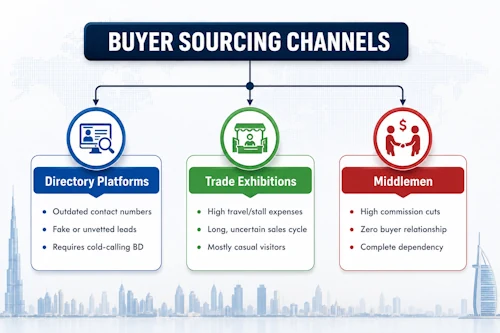
1. B2B Directory Platforms
Online contact directories are usually where new exporters start. You pay a fee and download a spreadsheet full of company names, numbers, and emails.
The main problem here is that the data gets old very quickly. Half the phone numbers don't work anymore, purchasing managers have changed jobs, or emails bounce. Even if you get a real contact, you still need a sales team to cold-call, chase gatekeepers, and deal with language barriers.
2. International Trade Shows
Renting a booth at events like Gulfood in Dubai lets you display your grain samples and speak to people face-to-face.
While personal meetings are great, trade shows take a lot of upfront cash. Between stall costs, flights, hotel stays, and marketing materials, you can easily spend lakhs with zero guarantee of closing a real contract. You often return with a stack of business cards, but turning those casual chats into container shipments requires months of chasing, and conversion rates stay pretty low.
3. Relying on Local Middlemen and Brokers
Commission brokers still control a lot of trade volume because they already have local connections with buyers in the Gulf.
Using a broker might get you a quick order, but it costs you in the long run. They charge heavy per-ton commission fees that slice right into your margins. On top of that, brokers guard their contacts closely. You never build a direct working relationship with the actual buyer, leaving you completely dependent on the middleman. If another mill offers them a cheaper rate next season, your business can vanish overnight.
Why Transaction-Oriented Platforms Work Best
Since directory lists are unreliable, trade shows are expensive, and brokers eat up profits, the export industry is shifting toward transaction-oriented platforms.
Unlike directory sites that just give you an email address, a transaction platform works as an end-to-end digital trade setup. It connects you directly with verified buyers who have active, container-scale buy requirements.
Here is how a transaction model simplifies finding real buyers:
- Pre-Verified Buyers: Importers undergo background checks to confirm their trade licenses, import history, and financial standing.
- Live Procurement Demands: Instead of cold outreach, you see active buy orders specifying exact needs—like 5 containers of 1121 Basmati Steam in 10 kg non-woven bags bound for Jebel Ali Port.
- Direct Negotiations: You negotiate prices, specs, and delivery dates straight with the buyer, cutting out middleman commissions.
- Secure Payment Setup: Deals use standard banking channels, such as Letters of Credit (LC) or Telegraphic Transfer (TT), protecting your money before the cargo leaves port.
Sourcing Method Comparison
Here is how the different buyer outreach methods stack up for an Indian exporter:
| Feature / Metric | Directory Platforms | Trade Shows | Middlemen / Brokers | Transaction-Oriented Platforms |
|---|---|---|---|---|
| Upfront Cost | Low to Medium | Very High | Low (Commission-based) | Low / Performance-based |
| Time & Effort | High (Cold calling) | High (Travel & follow-ups) | Low | Low (Direct digital workflow) |
| Buyer Authenticity | Low (Unvetted lists) | Variable | High | Very High (Pre-verified buyers) |
| Profit Margins | Moderate | Moderate | Low (Eaten by commissions) | High (Direct deal-making) |
| Client Relationship | Direct (Hard to reach) | Direct | Indirect (Broker owns relationship) | Direct & Long-Term |
Essential Requirements for Exporting Rice to the UAE
Connecting with an importer is only half the job. To get your cargo through UAE customs without hitting costly port delays, your processing and documentation must meet local standards.
Quality and Technical Specs
- Moisture Limits: Moisture needs to stay below 12% to 13% depending on the variety. High moisture in a sealed ocean container creates condensation during transit, leading to mold and ruined grain.
- Pesticide Residues: Shipments must comply with UAE Ministry of Climate Change and Environment (MOCCAE) rules on Maximum Residue Limits (MRLs).
- Purity Standards: Shipments must be completely free of live or dead insects, rodent damage, foreign seeds, or heavy chalkiness.
Essential Export Documentation
Before your container clears customs at Jebel Ali or Port Rashid, you must supply clean, accurate documentation. Any glitch in the documentation will result in the rejection of your shipment and cause a big financial loss.
- Commercial Invoice & Packing List
- Bill of Lading (B/L): The final proof of dispatch or the document that is used by the buyer to get the goods from the port.
- Certificate of Origin (issued by recognized Indian trade bodies)
- Phytosanitary Certificate (issued by Indian plant quarantine officers)
- Fumigation Certificate
- Pre-Shipment Quality Inspection Certificate (from independent agencies like SGS or Intertek)
Final Thoughts for Exporters
The UAE rice market offers huge, year-round volume for Indian exporters, but succeeding there requires a smart, modern approach.
Stop wasting time on outdated lead lists or giving away your profit margins to brokers. By using transaction-oriented trade platforms and keeping your processing aligned with UAE import regulations, you can build a direct, secure, and profitable export business in the Gulf.
Disclaimer
The information provided in this article is for educational and informational purposes only. UAE import regulations, customs procedures, buyer preferences, and documentation requirements may change over time. Exporters should verify the latest MOCCAE regulations, APEDA guidelines, and destination-country import requirements before shipping rice to the UAE.