
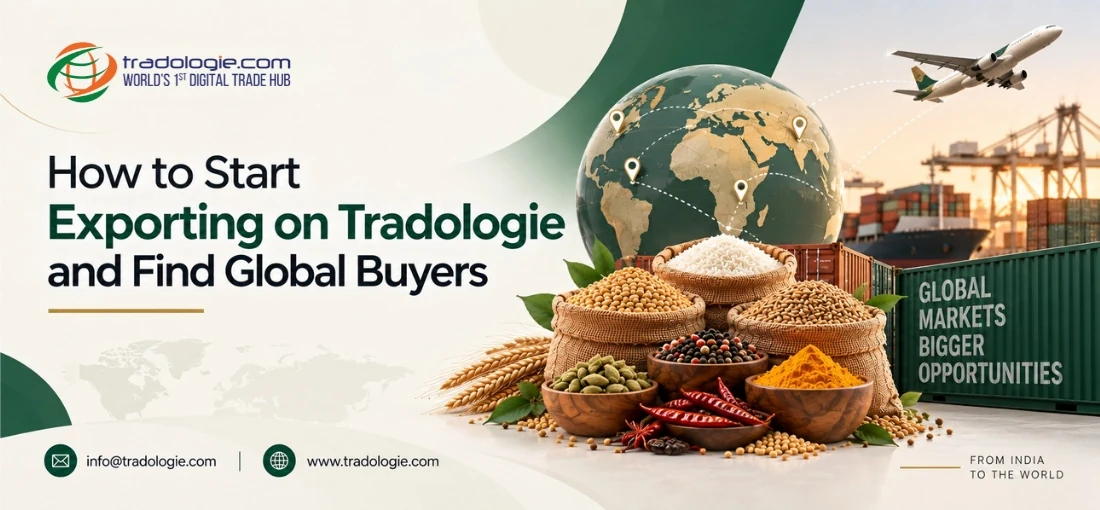
Key Highlights
- Tradologie is a leading platform if you want to become an agricultural exporter.
- It focuses on verified buyer requirements and live negotiations.
- Exporters still need the required registrations and licences.
- IEC, FSSAI and APEDA registration may apply depending on the business.
- Seller onboarding includes KYC and business-document verification.
- Relevant buyer requirements are matched to registered commodities.
- Exporters can quote and negotiate directly with buyers.
- Payment, quality, delivery and documentation terms still matter.
- Tradologie facilitates the transaction while exporters fulfil their contracts.
Introduction:
When looking online for how to start export business , it is often presented as a paperwork exercise. This is true no matter if you are exporting an agricultural commodity or any other product.
Get an Importer Exporter Code, obtain the necessary licences, register with the relevant export promotion body, find a product and start approaching buyers. All of that is part of the process, but anyone who has actually tried to start an export business knows that there is another, much bigger challenge sitting in the middle of it: finding buyers who are genuinely ready to purchase.
That is where the export journey can become difficult.
You may have products like Rice, sugar, wheat, pulses, spices, dry fruits , etc. You may have the capacity. You may even have the registrations and certifications required to ship internationally. But if your sales process depends entirely on cold emails, phone calls, international travel, trade fairs or waiting for random enquiries, turning that capability into regular export orders can take considerable time.
This is where digital trade platforms have started changing the way exporters approach international markets. Keep reading this informative piece of blog as it will tell you how to become an exporter and expand your agro export business with Tradologie.

How Is Tradologie Different If You Want To Start An Export Business?
Tradologie positions itself differently from a conventional B2B listing portal. Rather than simply displaying products and passing enquiries to suppliers, its current exporter model is built around verified buyer requirements, live price negotiations and transaction facilitation. The platform says exporters can access more than 1 million verified global buyers and participate in live negotiations around relevant requirements.
But there is an important point to understand before getting started.
Tradologie does not replace the fundamentals of exporting. It sits on top of them.
You still need to be a legitimate business, you still need the relevant registrations, and you still need to be capable of supplying what you offer.
First, make sure your export registrations are in place
Before thinking about how to start export business activities through any platform, get the fundamentals right.
For an Indian exporter, the Importer Exporter Code (IEC) issued by DGFT is one of the basic requirements for undertaking export activities, subject to applicable exemptions. If you are dealing in food products, you need the appropriate FSSAI licence, while exporters dealing in APEDA-scheduled agricultural and processed-food products need to look at the relevant APEDA registration/RCMC.
Depending on the product, there can also be other product-specific registrations, certificates and compliance requirements.
Tradologie's own seller-registration information lists GST registration for Indian sellers, business registration, FSSAI for food products, APEDA registration for agro exports, IEC and current-account/AD-Code-related banking requirements among the basic requirements for getting started.
This is important because a buyer may be ready to purchase, but that does not mean you can ship an improperly documented product.
Your export capability needs to exist before you start negotiating the order.
The onboarding process is more than creating an account
Once your business is ready, the next stage is onboarding.
This is where Tradologie's process differs from simply opening an account on a product-listing website. The platform describes a verification process in which sellers submit business and trade-related documentation before being approved. Its current seller information refers to KYC, business licences, GST, PAN, Aadhar Card, Current Account and other relevant business documents as part of the verification process.
That verification serves an important purpose. International trade works better when both sides know that they are dealing with an identifiable business rather than an anonymous online profile. Once the documentation and KYC process is completed, the seller's profile can move towards activation.

You need a subscription to participate as a verified seller
This is another part of the model that new exporters should understand clearly.
Registration and verification are not the same thing as full participation in the seller marketplace. Tradologie currently operates on a paid subscription model for sellers and exporters. Its published seller information states that, after registration and document submission, sellers activate their yearly subscription to access the full platform functionality.
The current price for Indian seller/exporter subscription is ₹1,55,760 ( inclusive of GST for 12 months.)
The important thing is to understand what that subscription is buying. It is not simply a fee for putting your company name into an online directory. The platform describes the subscription as providing access to verified global buyers, live negotiation opportunities, a dedicated microsite and trade-support features.
That makes the model closer to a digital business-development and trade-facilitation platform than a conventional listing service.
Once verified, the nature of the buyer enquiry changes
This is probably the most significant difference for an exporter.
On many online export platforms, a seller may receive an enquiry and then spend days or weeks trying to establish whether the person behind it is actually interested in buying. Sometimes the inquiry is genuine. Sometimes the buyer is comparing prices. Sometimes there is no immediate purchasing requirement at all.
The Tradologie model is built around verified buyer requirements.
Once you become an active verified seller, the platform says its system matches buyer requirements with the commodities and products registered by you. Relevant requirements are then made available for you to pursue. There is an important practical point here:
You do not receive every requirement on the platform.
The requirements you see are connected to the products and commodities you have stated that you can supply.
If you have registered yourself as a rice exporter, for example, the relevant rice requirements are what matter to you. If you have also registered capabilities for pulses or spices, requirements for those categories can become relevant as well.
This keeps the process considerably more focused than simply receiving a large pile of unrelated leads.
The buyer requirement itself is meant to give you the commercial picture
Another useful part of the process is the structure of the requirement. A serious bulk trade transaction needs much more information than simply “I want rice” or “I need 500 tonnes of wheat.”
The requirement needs to establish what is actually being purchased and under what conditions. Tradologie describes its actionable buyer requirements as containing commercial details around aspects such as quantity, specifications, quality, payment terms, inspection and port requirements.
That gives the exporter a much better basis for deciding whether a requirement is worth pursuing. You can look at the requirement and ask a fairly straightforward question:
Can I actually fulfil this order on these terms?
If the answer is yes, that is when you move into negotiation.
This is where the live negotiation becomes important
The next step is not to send an email and wait.
Tradologie's model allows sellers to participate in live negotiations with verified buyers. The exporter can quote a competitive price and negotiate around the requirement in real time. The platform lets the sellers see competing pricing during negotiations, helping them understand where their offer sits in relation to other suppliers.
That changes the commercial dynamic considerably. An exporter is no longer making a quotation in isolation.
You know that other suppliers may also be competing for the same requirement, which means the discussion becomes much closer to an actual marketplace negotiation.
Price, of course, matters. But it is not the only consideration. Your ability to meet the specification, supply the required quantity, comply with quality conditions and provide a credible business profile can all influence the buyer's decision.
What happens when the buyer likes your offer?
If your pricing and overall offer meet the buyer's requirements, the transaction moves to the next stage.
According to Tradologie's stated process, the buyer can issue an order or Letter of Intent (LOI) after evaluating the supplier's offer, portfolio and negotiation.
At this point, the process moves beyond simply finding a buyer.
The commercial transaction now has to be formalised.
The relevant sale and purchase agreements, trade contracts, payment arrangements and other transaction documents are finalised according to the agreed terms. Where a Letter of Credit is used, the banking mechanism is established as part of the transaction. Where advance-payment arrangements are agreed, the payment schedule and supporting documents are formalised accordingly.
Payment terms need to be understood before you commit
Exporters should pay particular attention to this stage.
For example, where an LC-backed transaction is agreed, the Letter of Credit provides a bank-backed payment mechanism subject to its terms and conditions. Tradologie specifically highlights LC-backed transactions as one of its payment-security mechanisms.
Advance-payment arrangements can work differently.
If the agreed transaction provides for a 30% advance, for instance, the exporter needs to understand precisely when that advance is released, what documents trigger it and what happens to the balance payment. The commercial contract should establish these conditions clearly. This is why exporters should never look at a buyer requirement purely from the perspective of the selling price.
The payment mechanism is part of the deal. So are the quality inspection conditions, delivery terms, port, shipment schedule and documentation.
Tradologie's role is facilitation, not replacing the exporter
There is sometimes a misunderstanding around platforms like this.
A digital trade platform does not remove the exporter from the transaction.
You are still responsible for having the product, maintaining quality, arranging supply, meeting your contractual commitments and completing the export process.
What Tradologie provides is the commercial infrastructure around the transaction — verified buyer requirements, negotiation tools, buyer-supplier connectivity, trade support and transaction facilitation. Its own FAQ makes clear that finalising an order depends on the seller's pricing, negotiation, portfolio and ability to meet the buyer's requirements.
That distinction is important because no serious exporter should expect a platform to do the entire business for them. The platform can bring the buyer and the opportunity to the table. The exporter still has to make the offer worth accepting.
Language should not become a barrier to the deal
International trade also brings a less obvious problem: communication.
A buyer may be commercially serious but operate in a language that the Indian exporter does not speak comfortably. That can make negotiations slower and sometimes lead to misunderstandings around specifications, payment terms or delivery conditions.
Tradologie provides linguistic support through its international business and translation teams, with support across more than 20 international languages.
For an exporter dealing with buyers across markets such as the Middle East, Africa, Europe or Southeast Asia, that can be useful.
The objective is simple: the commercial discussion should be about the deal itself, not about whether both parties can communicate comfortably in the same language.
Why this is different from chasing leads
This is perhaps the clearest way to understand the Tradologie model.
A conventional lead-generation platform can give you a contact.
Then the exporter has to call.
Then send an email.
Then follow up.
Then call again.
Then perhaps arrange a meeting.
And after all that, you may discover that the person was never ready to purchase.
Tradologie's stated model works in the opposite direction. The platform says it provides actionable requirements from verified, ready-to-purchase buyers , after which exporters can quote and negotiate directly through the platform.
That is why it positions itself as a transaction-oriented platform rather than a conventional listing or lead-generation portal.
For someone trying to export agri products , that difference can be significant.
You are not simply putting your commodity online and hoping somebody finds it. You are responding to a requirement that already exists.
The same logic applies when exporters want to export food products. The product still has to meet the buyer's requirements and all applicable regulations, but the commercial starting point is an identified purchasing requirement rather than an entirely cold prospect.
So, how do you start exporting through Tradologie?
The journey is fairly straightforward once you understand the sequence.
First, make sure your business and export registrations are in place — including your IEC, FSSAI licence for food products, APEDA registration where applicable and any other product-specific certifications.
Then register your business on Tradologie and submit the required KYC and business documents for verification. Once your profile is approved, activate the applicable seller subscription to participate in the platform's seller functions.
After activation, your dashboard becomes the working point for relevant buyer requirements. You can review requirements connected to the commodities you have registered, decide which ones you can realistically fulfil and participate in the live negotiation by quoting your most competitive offer.
The buyer can compare the competing offers, review your microsite and assess your business profile. If your offer works for the buyer, the process moves towards an LOI or order, followed by the formalisation of the trade, payment and delivery terms.
From there, Tradologie's trade-support team facilitates the transaction while you remain responsible for fulfilling your side of the contract.
That is the important distinction to remember.
Tradologie is not a shortcut around exporting. It is a different route to finding and negotiating with international buyers.
And for businesses wondering how to become an exporter without building a large overseas sales operation from scratch, that distinction can make the starting point considerably more practical.
The registrations still matter.
The product still matters.
The price still matters.
The quality still matters.
How Do You Get Buyers On Tradologie?
But once all of those pieces are in place, the next question is always the same: where will the buyer come from?
That is ultimately what makes platforms such as Tradologie relevant to today's exporters.
Whether you are exploring export-import platforms , researching online food trading portals , or simply trying to understand how to start export business activities without relying entirely on foreign travel and cold outreach, the commercial objective remains unchanged: get in front of a genuine buyer, understand what that buyer wants, make a competitive offer and deliver what you promised.
Because in international trade, finding a buyer is only the beginning.
The real export business starts when that buyer is ready to place the order.
Want to export or import agricultural commodities in bulk globally? Register as a buyer or seller on Tradologie today.

.webp "Types of Sugar Explained: Decoding the Global Logistics of Raw, Refined, and Specialty Supply")