
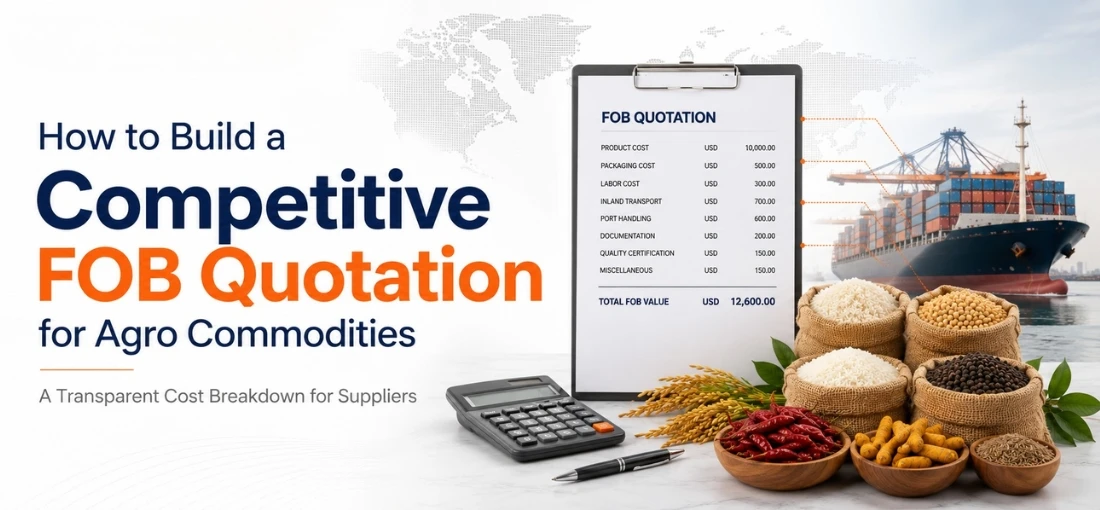
Key Highlights
- A competitive FOB quote requires accurate cost calculation from sourcing to vessel loading.
- FOB pricing includes mandi costs, inland freight, processing, customs, and loading expenses.
- Missing even small charges can significantly impact export profitability.
- Processing, packaging, and quality compliance costs must be factored into quotations.
- Transit moisture loss can affect final shipment weight and margins.
- Time-bound quotations help protect exporters from commodity price volatility.
Introduction:
Landing an international contract depends heavily on how you present your final numbers. When an overseas buying desk requests a Free on Board (FOB) price, they aren't just looking for a vague, bundled figure. They want to see a clean, mathematically sound price that proves you understand every single domestic variable between the regional market yard and the ship’s hook. If you miscalculate even one small local fee, you will either price yourself completely out of the market or win a contract that actively loses you money.
Building a truly competitive FOB Quotation for Agro Commodities means moving away from guesswork and setting up a transparent, line-by-line pricing framework. Whether your trade desk is preparing to Export Rice, Wheat, Sugar, Pulses or manage complex oilseed volumes, you need a standard operational blueprint to handle your cost aggregation without eroding your built-in profit margins.

The Anatomy of an FOB Quote: Sourcing to Vessel
To understand How to Calculate FOB Price parameters accurately, you have to look at the journey of the crop as a series of distinct physical movements. Under standard Incoterms, your financial risk and cost obligation as a supplier only end once the physical goods safely pass the ship’s rail at your designated loading port.
Every single handoff along this path introduces specific secondary charges—ranging from local market taxes to terminal handling fees. If you forget to factor in seasonal variations, like monsoon tarping costs or peak-season port delays, your paper profits will disappear before the cargo even leaves the coast.
Step-by-Step Breakdown: The Core Cost Elements
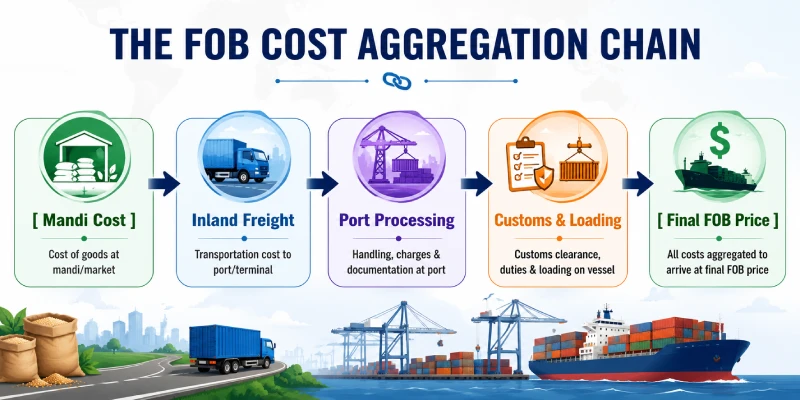
To map out a flawless Export Quotation Format, your pricing structure must systematically account for five independent cost blocks. Let’s break down how these expenses stack up on the ground:
1. The Raw Material Base (Mandi Cost)
This is your baseline procurement cost at the wholesale market yard. When calculating this element, you must look past the raw auction price and include local commission agent fees, state market fees (mandi tax), and basic labor charges for initial weighing and filling into rough jute or PP bags.
2. Inland Logistics and Inter-State Transit
Moving agricultural cargo from landlocked production belts down to major coastal ports like Mundra, Vizag, or Nhava Sheva represents a major chunk of your total spend. Your FOB Pricing for Exporters must factor in truck or rail-rake freight, transit insurance policies, border toll taxes, and potential fuel surcharges.

3. Processing, Sorting, and Export-Grade Packaging
Raw field crops are rarely ready for direct international delivery. To protect your trade capital, the inventory must pass through automated cleaning lines to remove dust, stones, and broken grains. This stage also includes specialized sorting (like Sortex grading for rice or pulses) and packaging into final multi-wall export bags.
4. Port Ground Handling and Customs Gate-In
The moment your trucks arrive at the port vicinity, you enter a new regulatory pricing zone. You must account for customs broker fees, terminal handling charges (THC), container stuffing labor, and port ground rent while your cargo waits for its designated vessel gate-in window.
5. Biosecurity Clearances and Loading Fees
The final gatekeeper before the cargo is lifted onto the vessel holds official clearances. This includes mandatory pre-loading fumigation, independent surveyor sampling fees (such as SGS inspections), and securing your official Phytosanitary Certificate from Plant Quarantine authorities.
Operationalizing the Math: The FOB Cost Breakdown Matrix
To see how these individual elements interact inside a real-world spreadsheet, let’s look at how a competitive quote is built from scratch. The template below outlines a typical baseline FOB Cost Breakdown for moving a standard high-density agricultural cargo through a primary Indian port gateway.
Line-Item Export Quotation Format (Basis: Estimated USD per MT)
| Cost Component Category | Itemized Operational Expense Line | Estimated Cost Range (USD/MT) | Core Cost Driver & Variable |
|---|---|---|---|
| Origin Procurement | Raw Mandi Auction Base Price | $215 – $235 | Local crop size, minimum support prices, and regional market inflows. |
| Origin Procurement | Mandi Tax & Commission Agent Fees | $4 – $7 | Fixed percentage-based state levies and local brokerage rules. |
| Processing & Pack | Mechanical Cleaning & Sortex Grading | $6 – $10 | Rejection percentages, electricity tariffs, and processing yield loss. |
| Processing & Pack | Export Packaging (50kg PP Bags + Stenciling) | $3 – $5 | Global polymer resin prices and specialized branding print runs. |
| Inland Logistics | Trucking / Rail Freight to Marine Terminal | $16 – $26 | Total distance from internal state silos down to the coast. |
| Port & Customs | Customs Brokerage & Shipping Line THC | $5 – $8 | Fixed terminal handling tariffs and customs house agent fees. |
| Port & Customs | Surveyors, Sampling & Lab Testing | $2 – $4 | Complexity of target market pesticide MRL testing protocols. |
| Biosecurity | Phosphine Fumigation & Phytosanitary Certificate | $1 – $3 | Mandatory quarantine treatments and biosecurity paperwork. |
| Trade Buffer | Interest on Working Capital & Internal Margin | $12 – $18 | Bank credit terms, transaction velocity, and baseline company profit goals. |
| Final FOB Quote | Free on Board Port Exit Price | $264 – $316 | The final competitive price presented to the international buyer. |
FOB Price Calculation Disclaimer: The figures detailed in this costing log represent general trade averages across major commercial corridors. The actual price shifts continuously based on local weather shifts, sudden maritime fuel spikes, equipment availability, and domestic industrial consumption mandates.
Strategic Nuances: Protecting Your Quotation from Volatility
When executing an active FOB Price Calculation, seasoned trading desks build specific safety valves directly into their proforma terms to avoid absorbing unexpected local inflation.
Address the Time-Validity Barrier
Agri-commodities are highly volatile assets. If you give an international buyer an open-ended quote, you are taking an immense financial risk. A local crop shortfall or a sudden change in state export duties can drive up your domestic procurement costs overnight. Always stamp your proforma documents with a strict time-validity clause—limiting your offered price to a specific 48-to-72-hour window.
Factor in the Transit Moisture Dynamic
When your field teams pack grain at the regional mill, they must account for weight loss during transit. Agricultural items naturally lose moisture while traveling via rail or sitting in hot port warehouses. If you buy 1,000 tons of crop at 14% moisture, you might only have 985 tons of physical weight by the time the cargo clears customs. To remain a preferred partner among firms that Export Rice, Wheat, Sugar, Pulses, you must calculate this natural shrinkage into your baseline volume costs to avoid weight shortage disputes at the destination port.
The Tactical Verdict
Building a highly competitive FOB Quotation for Agro Commodities isn't about cutting corners on your processing lines or squeezing your transport networks on payment terms. It comes down to achieving complete visibility over your internal cost structure.
By setting up an automated, line-by-line pricing ledger that updates in real-time alongside local mandi swings, you strip all the guesswork out of your trade desk's international pitches. You protect your company's working capital from unexpected terminal surprises, project absolute operational authority to global corporate buyers, and ensure that every single bill of lading your firm executes lands as a clean, highly predictable, and deeply profitable transaction.
Disclaimer
The FOB cost ranges and examples mentioned in this article are illustrative and intended for informational purposes only. Actual costs may vary based on commodity type, procurement location, freight rates, processing requirements, port charges, exchange rates, government regulations, and market conditions. Exporters should conduct independent cost assessments before submitting commercial quotations.