Key Highlights
- Port-side costs often create bigger profit leakages than ocean freight itself.
- Demurrage and detention charges can quickly erode margins on export shipments.
- Laboratory testing and compliance certifications are unavoidable export expenses.
- Poor packaging design can increase freight costs through wasted container space.
- Currency conversion spreads often reduce exporter earnings without notice.
- Inadequate marine insurance can expose businesses to major financial liabilities.
- Delayed RoDTEP and GST claims can lock up working capital for extended periods.
- Export profitability depends as much on operational efficiency as on product pricing
Introduction:
The financial blueprint of an agricultural trade desk often looks flawless on a spreadsheet. You calculate the raw procurement price per metric ton at the farm gate or milling cluster, factor in basic ocean freight, add a standard margin, and assume the net returns are secure
But talk to any experienced merchant running a container operation out of Mundra, Chennai, or JNPT, and they will tell you a different story. The global trade floor sees frequent margin slipups where excellent product sourcing gets systematically eroded by minor operational leakages.

While overall domestic logistics costs in India are estimated to hover around 8% to 14% of goods value, the administrative and technical friction specific to agricultural exports can quietly compound. In a sector where net margins often sit in the single digits, ignoring these minor port-side and compliance friction points is the quickest way to turn a profitable contract into a financial liability. Understanding the absolute reality of your true food export cost for exporting commodities like rice, sugar, wheat, pulses, spices , etc., requires looking past the baseline ocean freight quote and auditing the hidden line items that standard freight forwarders rarely highlight upfront.
The Freight Forwarder Loophole: Port Side and Technical Costs
The most frequent financial damage happens within a ten-mile radius of the exit terminal. Exporters often budget for ocean freight based on a simple port-to-port quote, completely forgetting that a container spends days moving through local ground infrastructure before it ever touches a vessel.
1. The Real Cost of Custom House Agents (CHA)
Many new trade desks treat the CHA fee as a flat, nominal service charge. It isn't. While the baseline documentation filing fee might look modest on paper—often ranging between ₹3,500 and ₹8,000+ per container depending on the commodity—the true hidden costs in food exports are tucked inside auxiliary line items:
- Cartage and Stuffing Variables: If your bulk sugar or wheat import shipment arrives at a central warehouse and needs mechanical stuffing into an ocean liner, then, in such a case, the unexpected labour shortages or equipment delays at the port CFS (Container Freight Station) quickly alter your handling rates.
- Agency Handling Surcharges: CHAs frequently pass down vague operational coordination charges or peak-season handling fees during high-volume harvest months, which can quietly add up if not capped by an ironclad service-level agreement (SLA) beforehand.
2. Detention, Demurrage, and Port Ground Rent
This is where significant capital vanishes. Demurrage is the penalty the shipping line charges you for using their container past the allowed free days inside the terminal yard; detention is the fee for holding onto that container outside the gate past your time slot.
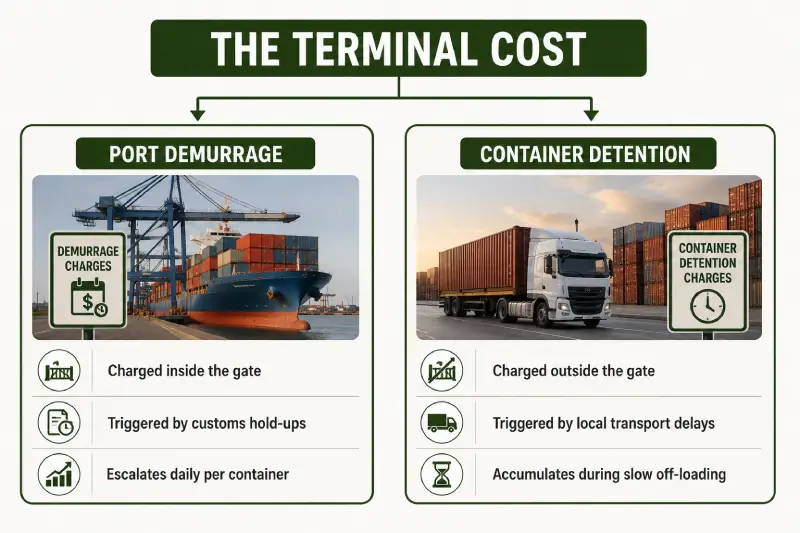
Standard carrier free-time windows are often incredibly brief, sometimes offering just 3 to 7 days. If a shipment of premium basmati rice gets flagged for a random agricultural quality check or custom clearance audit, your container sits on the terminal floor. Once you cross that free-day threshold, you face steep, escalating daily penalties that can easily scale into hundreds of dollars per container per day, instantly wiping out your projected profits.
Technical Barriers: Testing, Certifications, and Spatial Waste
Navigating international biosecurity standards requires significant technical investment. These compliance steps are an essential part of your total food export cost, particularly when dealing with strict entry gates in Europe, North America, or East Asia.
No matter if you want to export rice, spices, sugar, wheat or any other commodity in bulk. This cost breakdown will be useful for you in all the scenarios.
1. The Real Expense of HPLC and Micro-Assays
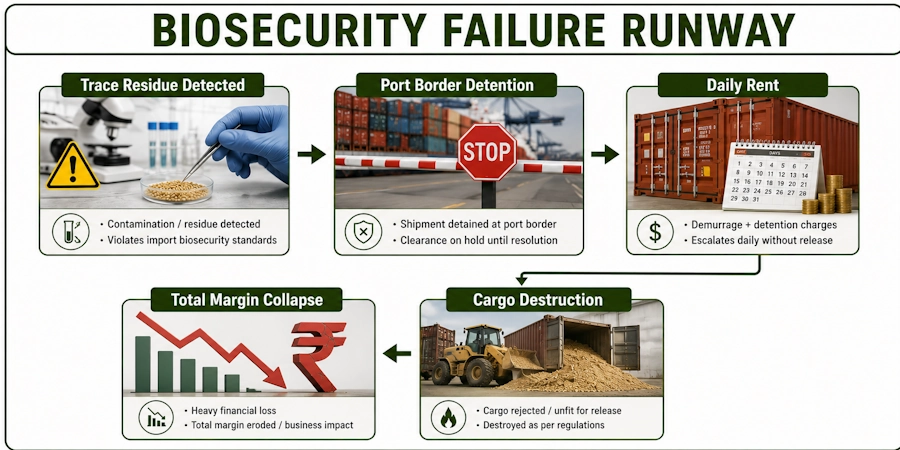
You cannot simply assume your cargo is clean because it looks perfect at your warehouse. Foreign custom authorities enforce absolute zero-tolerance limits for heavy metals, aflatoxins, and pesticide residues like Ethylene Oxide (ETO).
Running high-performance liquid chromatography (HPLC) assays or microbiological screenings via independent, APEDA-approved laboratories is a non-negotiable expense. If a batch of fine spices fails a destination port check due to trace chemical residues, you face two choices: pay for expensive return freight or watch your entire inventory get incinerated at the border.
2. Volumetric Waste and Container Sweat
When shipping processed food items or consumer-packaged goods, ocean freight is frequently calculated based on volume—total cubic meters (CBM)—rather than pure weight. If your internal packaging design leaves empty air pockets inside your master cartons, you are essentially paying premium maritime freight rates to ship empty space across the ocean.
Furthermore, unexpected moisture spikes inside standard steel containers during long voyages across the equator can cause packaging condensation, or "container sweat." This moisture weakens cardboard boxes, leading to collapsed pallets and costly broken bulk claims from your buyer upon arrival.
Financial Risk: Invisible Surcharges, Insurance, and Currency Gaps
Managing international monetary movements introduces several invisible financial hazards that can quietly degrade your bottom line if left unmonitored.
1. The Failure of Minimal Marine Insurance
Many merchants save a small amount by purchasing standard, low-tier marine cargo insurance that only covers "Total Loss Only." This is a critical mistake. If the ocean vessel encounters rough weather and the captain declares a "General Average"—a maritime law where all cargo interests must proportionally share the losses or sacrifices made to save the ship (like jettisoning cargo or paying for salvage vectors)—your minimal policy will leave you completely exposed to massive liabilities.
2. Bank Realization and Exchange Rate Margins
When your foreign buyer remits payment in USD, EUR, or AED, your local bank doesn't convert that capital to INR at the exact interbank spot rate. They add an internal spread or exchange margin. On a large commodity transaction, a variance of just 0.5% due to unnegotiated bank card rates can quietly skim a significant sum right off your top-line revenue.

Outdated Habits: Where Indian Exporters Voluntarily Lose Capital
Clinging to legacy operational methods directly stops merchants from learning how to save money in agriculture exports. Several specific habits continue to drain trade capital every day:
- Accepting Standard Ocean Freight Quotes: Relying strictly on the very first spot freight rate provided by a single forwarder, rather than utilizing digital freight booking platforms to compare multi-liner options simultaneously.
- Ignoring Local Tax Reimbursement Timelines: Failing to systematically track and claim internal GST input tax credits (ITC) or RoDTEP (Remission of Duties and Taxes on Exported Products) benefits, leaving valid liquidity locked up in government portals for months.
- Overlooking Re-Fumigation Realities: Assuming a single fumigation run at your internal processing facility is enough, ignoring the fact that high humidity at port container stations or specific ISPM 15 wooden packaging rules often requires a second application before loading to pass biosecurity checks.
The Operational Fix: Strategic Re-Engineering for Maximum Returns
To stop these financial leakages and build a blueprint for how to get maximum profit in exports , your enterprise needs to transition from speculative trading to integrated supply chain management.
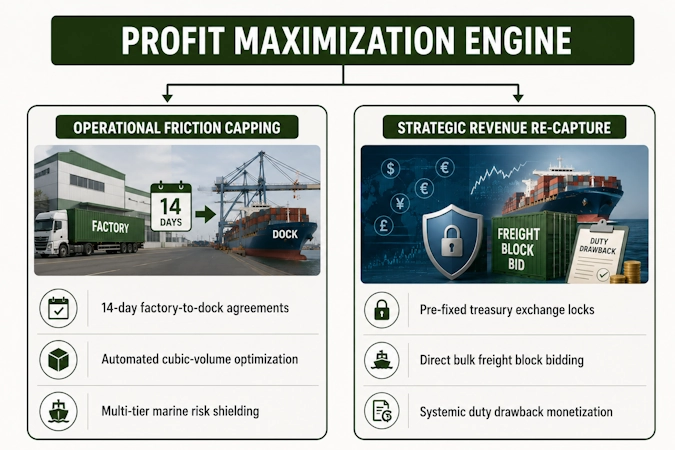
First, eliminate port-side detention traps by making extended free-time windows a non-negotiable term in your ocean liner contracts. Never accept a standard three-day gate allotment. Insist on a minimum 14-day factory-to-dock free-time agreement directly with the shipping line. This cushion ensures that a sudden customs inspection or local transport strike won't trigger immediate, daily financial penalties.
Second, focus on your container space. Get a packaging engineer to look at your master cases so you aren't paying to ship empty air across the ocean. Every cubic inch in a 20-foot or 40-foot box needs to be working for you. Wrap the pallets tight in heavy-duty shrink wrap and hang clay desiccants on the container walls. It is a simple way to protect your rice , sugar, or processed cargo from container sweat and stop transit damage claims before they happen.
Finally, lock in your financial variables long before the vessel leaves the berth. Establish a pre-fixed treasury rate with your corporate bank to freeze your exchange margins, protecting your transaction from sudden currency fluctuations. Pair this with a comprehensive, "All-Risk" marine insurance policy that explicitly includes General Average coverage. By systematically reclaiming your eligible RoDTEP benefits and running a tightly controlled, predictable logistics loop, you transition your trade desk into a highly efficient, high-margin international supplier.
Conclusion:
Protecting your margins in the agricultural export game isn't about pulling off a massive logistical miracle. It really comes down to boring, daily discipline. Once you start tightening your CHA contracts, maximizing your container space, and locking in your bank rates, those unexpected leaks stop happening. Moving away from risky spot trading and running a tight, predictable supply chain is exactly how you turn a volatile trade desk into a highly profitable, sustainable international business.