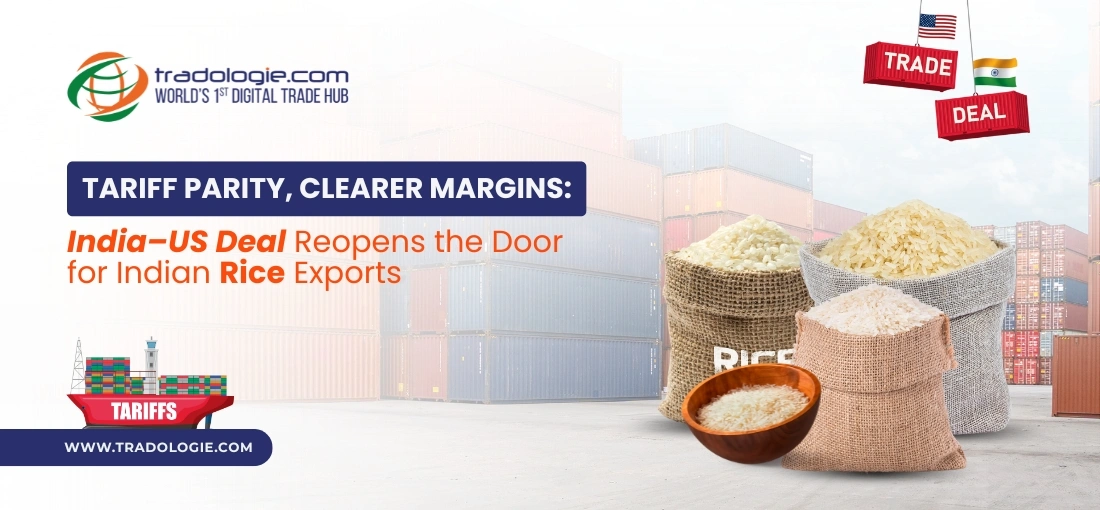
Tariff Parity, Clearer Margins: India–US Deal Reopens the Door for Indian Rice Exports
In commodity trade, competitiveness is rarely decided by slogans or sentiment. It is decided by arithmetic. A few percentage points in duty, a small shift in landed cost, a slight change in freight economics and entire supply chains realign. That is precisely why the recent India–US tariff reset matters. It does not merely reduce friction. It restores balance.
.webp)
For Indian rice exporters, the reduction of US tariffs from 50 percent to 18 percent is not symbolic relief. It is structural correction. And in bulk agricultural trade, structural corrections tend to translate quickly into volumes.
From Cost Burden to Cost Parity
For months, Indian suppliers were operating under a visible cost disadvantage. A combined 50 percent tariff effectively inflated the landed price of Indian rice before negotiations even began. Importers might appreciate quality and reliability, but procurement decisions ultimately follow numbers.
At those duty levels, margins narrowed and flexibility disappeared.
• Landed prices rose sharply compared to Thailand and Pakistan
• Importers absorbed higher risk on contract pricing
• Indian offers required deeper discounts to remain viable
• Long-term contracts became harder to lock in
Reducing the tariff to 18 percent changes that equation almost immediately. It places India broadly in line with competing origins where duties hover around 19 percent.
Parity, in global trade, is often enough.
Demand Never Really Left
What makes this episode interesting is that exports to the United States did not collapse even under higher duties. According to the Indian Rice Exporters Federation (IREF), shipments continued to rise despite the tariff spike from 10 percent to 50 percent.
That persistence says something important about demand.
It suggests Indian rice — both basmati and non-basmati — is not a discretionary purchase for US buyers. It is embedded in retail and foodservice channels.
• Strong diaspora and ethnic consumption demand
• Established relationships with US importers and distributors
• Consistent grain quality and milling characteristics
• Competitive base pricing even before tariff relief
In other words, the product was already wanted. Tariff relief simply removes the artificial penalty.
Landed Price Is Where Deals Are Won
Exporters often talk about production costs, farm yields, or freight rates. Buyers, however, look at one figure: landed price. That is the number that determines shelf pricing and wholesale margins.
When duties distort landed cost, trade flows adjust accordingly.
With the tariff cut to 18 percent:
• Indian offers regain immediate price competitiveness
• Procurement teams can diversify sourcing back toward India
• Importers reduce hedging pressure on contracts
• Volume commitments become easier to forecast
This is not theoretical. In bulk food trade, even a 2–3 percent pricing edge can shift hundreds of thousands of tonnes. A 30-plus percent correction is far more decisive.
Parity with Thailand and Pakistan Matters More Than Preference
Rice procurement is rarely casual. Buyers do not “prefer” origins in principle; they calculate.
Thailand and Pakistan have historically maintained a stable presence in the US market largely because their tariff exposure sat around 19 percent. That created predictability. India’s temporary 50 percent duty simply made it mathematically harder to compete.
Now, with duties aligned, sourcing decisions revert to fundamentals.
• Quality consistency
• Supply reliability
• Shipment scale
• Price execution
On those parameters, India has long performed well. The tariff gap was the anomaly. Removing it restores normal market logic.
Scale Works in India’s Favor
India is not a niche supplier. It is the world’s largest rice exporter. That scale provides advantages that become more visible once policy barriers recede.
Large inventories, established milling infrastructure, and broad supplier networks allow Indian exporters to respond quickly to bulk tenders.
• Ability to service high-volume contracts
• Wider variety mix across basmati and non-basmati
• Faster shipment turnaround
• Competitive freight consolidation
For US importers seeking reliability rather than experimentation, this matters. Predictable supply chains tend to win repeat business.
Policy Signals and Industry Confidence
IREF’s reaction to the deal reflects something else: sentiment.
Trade is practical, but it is also psychological. When policy uncertainty rises, buyers hesitate. When clarity returns, they commit.
The removal of the additional punitive levy linked to geopolitical considerations signals that the trade corridor is stabilizing.
• Reduced policy risk perception
• Stronger forward bookings
• Improved pricing negotiations
• Greater confidence in multi-season contracts
That stability alone can increase volumes, independent of price movements.
What This Means for Exporters
For Indian exporters, the opportunity is straightforward but not automatic. Tariff parity opens the door. Execution decides how much of that opportunity is captured.
Competitive markets reward discipline.
• Maintain consistent quality specs
• Protect shipment schedules
• Lock in long-term buyers early
• Focus on landed cost efficiency, not just FOB price
The advantage now lies in operational strength rather than policy protection.
A Market Reset, Not a Windfall
It would be wrong to treat this deal as a windfall. It is better understood as normalization. The market is simply returning to conditions where price, quality, and reliability — not penalties — determine outcomes.
And in that environment, Indian rice has historically held its ground.
Tariffs may have clouded the view for a while, but fundamentals remained intact. Now the numbers are aligned again.
In commodity trade, that alignment is often all it takes.
The opportunity, this time, is less about expansion through hype and more about growth through arithmetic — steadier margins, clearer pricing, and a level field on which Indian exporters can compete as they always have: on merit.