Buy Proso Millet in Bulk From the Trusted Global Suppliers
What is Proso Millet?
- Healthy, gluten-free, and suddenly everywhere? That’s Proso Millet. The taste is mild, it cooks quickly, and right now it fits neatly into the whole “clean eating” and nutrition trend. No surprise it has started getting attention in both retail and bulk food markets for those who want to buy proso millet in bulk.
- But this grain is not just a health fad. In the B2B world, it makes sense for very practical reasons. The demand is steady, the pricing does not swing wildly, and supply is available through most of the year. For processors and feed companies, that kind of predictability is half the battle won.
- Where does it go? Almost everywhere. Breakfast cereals, snack blends, gluten-free bakery, bird feed, livestock feed—you name it. As health and organic segments expand, this grain keeps finding new entry points. The growth is not dramatic, but it is consistent.
- And that’s why it moves in bulk. Large buyers are not experimenting. They need reliable volumes, stable quality, and uninterrupted supply. Proso Millet ticks those boxes, which is why it keeps showing up in long-term procurement contracts.
Product Specifications
| Parameter |
Standard / Limit |
| Moisture Content |
Max 12.0% – 13.0% (Lower preferred for long shelf life and export stability) |
| Protein Content |
Min 10.0% – 12.5% (Variety, origin, and grade dependent) |
| Purity |
Min 98.0% – 99.5% (As per export and food-grade requirements) |
| Foreign Matter |
Max 0.5% – 1.0% (Includes dust, stones, husk, and extraneous materials) |
| Broken / Damaged Kernels |
Max 2.0% – 5.0% (Based on contract and application) |
| Admixture |
Max 1.0% – 2.0% (Other grains or varieties) |
| Weevilled / Insect Damaged Grains |
Max 1.0% – 3.0% (Critical for export compliance and storage) |
| Pesticide Residues (MRL) |
Strictly compliant with Codex, EU, US FDA, and importing country norms |
| Heavy Metals |
Within Codex and international permissible limits |
| Color |
White, Light Yellow, Golden, or Red depending on variety |
| Size & Uniformity |
Uniform grains, contract-specific |
| Microbiology (if applicable) |
As per FSSAI, Codex, and importing country food safety standards |
| Aflatoxin (B1, B2, G1, G2) |
Strictly compliant (Typically 5–20 ppb depending on region and buyer requirements) |
| Mycotoxins |
Within regulatory limits for human consumption |
| Gluten |
Naturally gluten-free (Optional certification available) |
| Organic (if applicable) |
NPOP, USDA Organic, EU Organic certified |
| Packaging |
25kg, 50kg PP bags, jumbo bags, or customized as per buyer |
| Shelf Life |
12–24 months under recommended storage conditions |
| Storage |
Cool, dry, hygienic, pest-free environment |
| Inspection |
SGS, Bureau Veritas, Intertek, or buyer-appointed agency |
| Sampling |
As per ISO 24333 grain sampling standards |
| Compliance |
Phytosanitary certificate, COA, Certificate of Origin, and export documentation mandatory |
| Traceability |
Lot-wise and batch-wise traceability maintained |
Types, Grades & Variants of Proso Millet
Let’s keep this simple. Proso Millet is not traded in just one form. Buyers usually choose the format depending on what they want to do with it. Some need it for direct consumption, some for processing, and some for feed. So the grain moves in different stages.
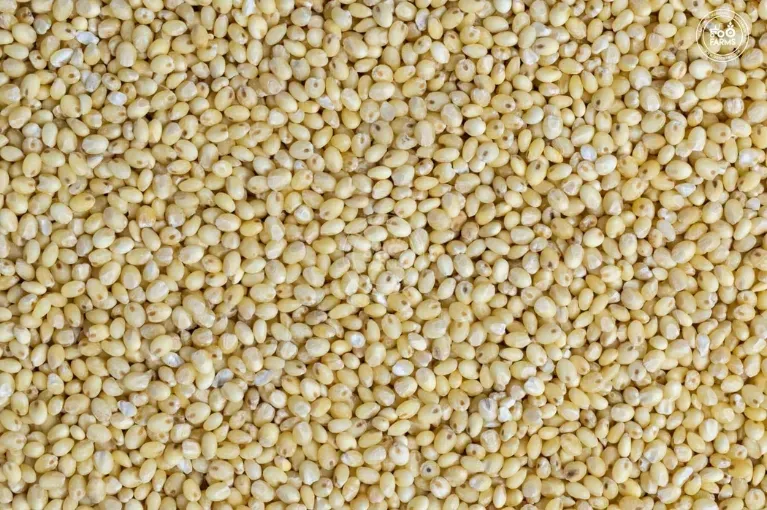
- Whole Grain – This is the raw, unprocessed version. Many bulk buyers start here because it gives them flexibility. They can clean, process, or customise it based on their own requirements.
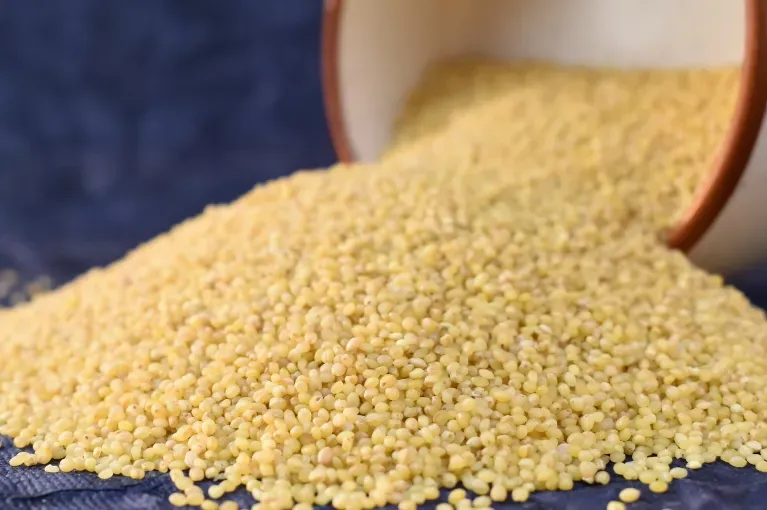
- Hulled Proso Millet – In this format, the outer husk is removed. It becomes easier to cook and is preferred for food applications. Many processors and food brands go for this because it saves time in production.
- Polished Proso Millet – This is a more refined version. The grain looks cleaner and more uniform, which works well for retail and premium markets. Visual appeal matters here, especially in packaged products.
- Broken Proso Millet – Nothing really goes to waste in this trade. Broken grain is widely used in bird feed and livestock nutrition. It is cost-effective and still retains nutritional value.
- Proso Millet Flour – This is where value addition starts. The grain is milled into flour and used in gluten-free bakery, snacks, and ready-to-cook mixes. Demand for this format is growing as food brands experiment with millet-based products.
Colour / Variety Types
Now let’s talk about varieties. Buyers do not just look at price. Colour and variety also matter because they affect taste, processing, and final product quality.
- White Proso Millet – This is the most common and widely traded. It works across both food and feed industries, which is why it dominates bulk trade.
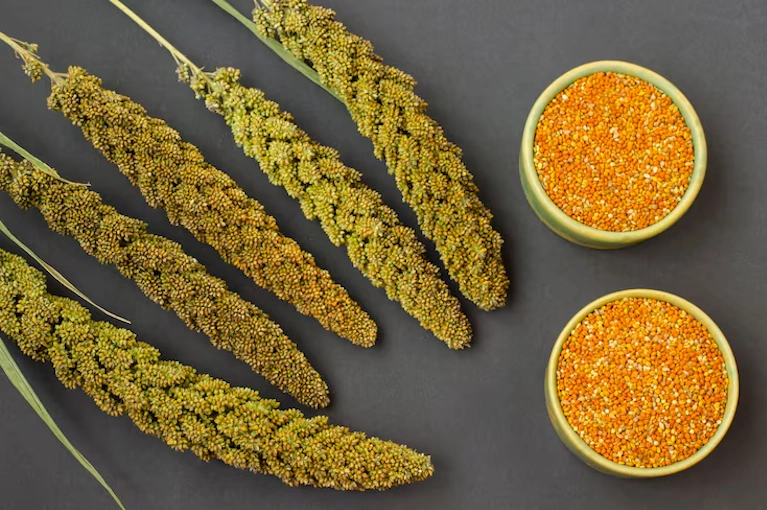
- Red Proso Millet – Slightly niche, but still in demand in certain markets. Some buyers prefer it for specific recipes and traditional food applications.
- Yellow (Golden) Proso Millet – This variety is popular in premium and export segments. The colour stands out, and it fits well in value-added and branded products.
- At the end of the day, the choice depends on the buyer’s end-use. Processing, retail, or feed—each segment has its own preference. And in bulk trade, these small differences often make a big commercial impact.
Applications & End-Use Mapping
- Where does bulk proso millet actually end up? Pretty much across the board. Whole and sortexed grain goes into breakfast cereals, porridge, multigrain blends, and the whole range of “healthy” ready-to-eat snacks that are trending right now. Hulled and polished millet is mostly for direct consumption. Broken grain usually finds its way into bird feed and livestock nutrition. And when it is processed into flour, it shows up in gluten-free bakery, instant mixes, and convenience foods. In short, nothing really goes to waste.
- The biggest consumer is still the food processing industry, especially the health and wellness segment. That’s where most of the innovation is happening. At the same time, the animal and poultry feed sector quietly absorbs large volumes because of the grain’s nutrition value and cost balance. HORECA and packaged food players are also stepping in, using millet in menu innovation and retail-ready formats. The demand base is wider than it looks.
- Different buyers, different priorities. Industrial buyers care about consistency, moisture levels, and bulk packaging. Retail and private-label brands are far more particular about appearance, certification, and traceability. Processors sit somewhere in between. They want steady supply, uniform grain size, and fewer surprises during production. Everyone wants reliability, but the definition changes depending on the business model.
- Export demand is clearly moving in one direction. Gluten-free, vegan, and clean-label categories are expanding across Europe, North America, and the Middle East. Importers in these markets are not just buying grain. They are buying compliance and peace of mind. Low moisture, high purity, and residue-compliant millet has become the standard for large-scale processing and private-label food manufacturing.
Supply & Demand Countries (Geo + Trade)
- Let’s talk sourcing first. Bulk Proso Millet does not come from everywhere. A few countries more or less run the show—India, Ukraine, Russia, China, and the United States. Each one brings something different to the table. India usually wins on price and flexibility.
Eastern Europe, especially Ukraine and Russia, is known for large volumes and steady export programs. China is a different game altogether. It produces big, trades regionally, and moves fast when demand shifts. For buyers, this mix is useful. It gives room to negotiate and, more importantly, a backup plan when one origin slows down.
- Now flip the picture. Where does all this millet go? Europe, the Middle East, North America, and parts of Southeast Asia are pulling most of the demand. Well, the reason is simple. These markets are betting big on gluten-free and health-focused foods.
Add to that the feed industry, and the demand base becomes even wider. The sustainability angle is also gaining ground. Millets are being pushed as climate-friendly grains, and that story is catching on. Slowly, but surely, consumption is picking up.
- India’s position in this space is changing. Earlier, it was mostly a domestic market. Now it is trying to play the global game. Government support, better processing, and focus on value-added exports are all moving in that direction. Competitive pricing helps, of course. But organic supply and multiple quality options give India an edge. Bulk buyers like having that flexibility. It reduces risk and keeps procurement smoother.
- And then there are the middlemen—though no one really calls them that. The UAE, Turkey, and the Netherlands act as trade hubs. They import in bulk, break shipments, repack, and move the grain across regions. Think of them as distribution highways. They make the supply chain more flexible and help buyers reach smaller markets without starting from scratch. In many ways, these hubs quietly keep the trade flowing.
Key Demand Drivers
- So where is the real demand coming from? Not from one industry. It’s coming from everywhere. Food processors are clearly the biggest buyers, but feed players and health food brands are right behind. The reason is simple. Bulk Proso Millet fits into too many use-cases to ignore—cereals, snacks, gluten-free mixes, feed. One grain, multiple doors. And once a product enters both food and feed chains, demand rarely dries up overnight.
- Consumer behaviour is also changing, and that’s half the story. Plant-based diets, clean labels, ancient grains. You might call them trends if you want, but the fact is brands are taking them seriously. Food companies are not waiting around. They are adding millets to stay ahead of the curve.
- Innovation is where the game is shifting. Millet is no longer just a traditional grain. It is showing up in ready meals, snack bars, bakery mixes, and convenience foods. The value chain is stretching. Proso millet exporters who see this early are already moving into higher-margin segments. Others are still stuck selling raw grain and competing only on price. That gap will only widen.
- And then there is the sustainability angle. This is not just marketing talk anymore. Proso Millet needs less water, handles climate stress better, and fits well into food security conversations. That matters, especially in Europe and North America. Proso millet buyers want products that look good on paper and in sustainability reports. Once that mindset takes hold, sourcing patterns start to change. Slowly, but for the long term.
Production & Supply Dynamics
- Truth is, Proso Millet does not come from too many places. A few countries dominate—China, India, Russia, Ukraine, and the U.S. China and India alone produce a big chunk of the global crop. Why? Because the basics work. The weather suits the grain, land is available, and governments are pushing millet farming these days. When all that comes together, supply tends to stay stable. At least most of the time.
- But that does not mean things are smooth. Not at all. Yes, this crop handles dry conditions better than many others. Still, weather can mess things up. One bad monsoon, unexpected heat, or uneven rainfall and suddenly output drops. Then there is the geopolitical side. Eastern Europe has been anything but predictable. Add freight issues or export curbs, and the market tightens before anyone sees it coming.
- For bulk buyers, this is where the real risk lies. Too much dependence on a few origins. That is never comfortable. Quality shifts, seasonal supply, weak infrastructure in some regions—it all adds friction. So most serious buyers do the obvious thing. They spread their sourcing. Not because they want to. Because they have to. In this business, one shock can wipe out margins.
- The good part is that new origins are slowly stepping in. Central Asia, parts of Africa, even Southeast Asia are testing the waters. Volumes are still small, but they matter. More suppliers mean more breathing room. Over time, this changes how buyers negotiate and how the market behaves. It is slow, but the direction is clear.
Global Trade Flows & Regional Trends
- See, the global Proso Millet trade is actually quite straightforward. It’s not scattered. A few countries more or less control the supply. China, India, Ukraine, Russia, and the U.S. That’s where most of the grain comes from. Buyers already know this. They keep shifting between these origins depending on price, quality, and who can ship faster. India, though, is slowly changing its game. Earlier it was all about cheap supply. Now Proso Millet exporters are trying to move into better margins. Value-added products, better cleaning, better compliance. Still early days, but the direction is clear.
- Now look at the demand side. Europe, the Middle East, North America. These are the main proso millet buyers. But they are not just buying grain. They want reliability. Clean shipments. Proper paperwork. Traceability. If something goes wrong, they walk away. Simple. Gluten-free and health trends are helping, but consistency is what really keeps the business going. Price is important, yes. But only till a point.
- Then you have the next set of markets. Southeast Asia, parts of Africa, and some fast-growing cities. They are not big yet. But they are watching. Governments are talking about millets. Consumers are hearing the health story. Buyers are doing trial shipments. Testing quality. Testing suppliers. This is how new markets usually start. Slow in the beginning. Then suddenly, demand jumps.
- And honestly, you cannot ignore the trade hubs. UAE, Turkey, Netherlands. These guys don’t produce much, but they keep the wheels turning. They buy bulk, split shipments, repack, and move cargo wherever demand shows up. For many importers, this is the safest route. Less risk. Less drama. In tough times, these hubs often save the day when direct trade gets stuck.
Export & Import Trend Analysis
- If you look at export volumes, the growth is there. But it’s not explosive. More like a slow, steady climb over the last ten years. The push mostly came from health food and bird feed demand, especially in Europe and North America. Still, this is agriculture. Every season tells a different story. One year the crop is good and shipments move easily. Next year, the weather plays games and suddenly supply tightens. That up-and-down pattern is just part of the business.
- The bigger shift is in value. Prices have been moving faster than volumes. Why? Because buyers are changing. They don’t just want grain anymore. They want clean-label, organic, well-processed material. They are willing to pay for it. And whenever supply from a major producing region slows down — maybe because of weather, maybe because of logistics — the market reacts quickly. Even if volumes stay flat, prices still move.
- If you track the peaks, they usually show up when health trends get louder or governments start promoting millets. Suddenly everyone wants a piece of the market. Then reality kicks in. A weak harvest, geopolitical tension, freight costs going up — and the momentum cools off. This cycle has repeated more than once. Nothing unusual there.
- So what’s the takeaway? The long-term direction looks steady, but short-term swings are here to stay. Proso millet buyers know this now. They are planning differently. More focus on quality. More paperwork. More traceability. And most importantly, they don’t depend on one country anymore. The goal is simple — reduce risk and keep the supply running, no matter what.
Price & Bulk Cost Indicators
- Let’s talk numbers. In bulk trade, Proso Millet usually moves somewhere between USD 350 and 650 per metric ton. That’s the broad range. Of course, the final price depends on a lot of things—grade, origin, cleaning, processing. Basic cleaned material sits at the lower end. Once you move into sortexed, organic, or residue-compliant grain, the price climbs. Buyers know what they’re paying for. Better quality, longer shelf life, fewer headaches at the destination.
- Over the last few years, prices have been inching up. Nothing crazy, but the direction is clear. Health-food demand has been picking up. Freight has been unpredictable. And whenever supply slows down in major producing regions, the market reacts. Still, compared to many specialty grains, Proso Millet has stayed relatively stable. That’s one reason buyers like it. It doesn’t give too many shocks.
- Origin also makes a difference. Eastern Europe often comes in cheaper because of scale and logistics advantages. Indian millet is popular for value and organic supply. The U.S. usually trades at a premium. The quality is consistent, and compliance standards are strong. So different proso millet buyers choose different origins depending on their priorities—price, quality, or reliability.
Disclaimer: Prices in this market can change quickly. Grade, volume, certification, packaging, and freight all play a role. What looks competitive today may not stay that way tomorrow. That’s just how commodity trade works.
HSN / HS Code & Tax Classification
- Then comes the detailed work. Buyers will tell you exactly what they want. Grain size, broken percentage, cleaning level. Some just want to be cleaned. Some want sortexed. Some want to be polished. Food buyers are stricter. They care about looks and uniformity. Feed buyers are more relaxed. For them, nutrition and cost come first. So the same millet, but different expectations.
- Testing has become normal now. Earlier, not everyone asked. Now most serious buyers do. Residues, heavy metals, microbiology. They want reports for everything. Organic and non-GMO also come up often, especially in Europe and the U.S. Without these, many shipments don’t even move. This is just how the business has changed.
- And paperwork… that’s standard. Certificate of origin, phytosanitary, fumigation, inspection. Everyone knows this part. But honestly, documents alone don’t build trust. Buyers want consistency. They want the same quality every time. They want shipments on time. They want suppliers who don’t disappear after one deal. In bulk trade, relationships matter more than one good price.
Logistics, Packaging & Incoterms
- Packaging is pretty straightforward. Most shipments go in 25 or 50 kg PP bags. That’s the standard. Some buyers still ask for jute, but that’s less common now. If the volume is big, jumbo bags make more sense. Food buyers are more particular. They ask for inner liners, sometimes vacuum packing. They don’t want moisture or contamination. Feed buyers? Much simpler. Keep the cost low and move the cargo. That’s it.
- Storage is basic, but if you mess this up, everything goes wrong. The grain has to stay dry. No moisture. Good ventilation. No pests. If this is managed, the shelf life is around 8 to 12 months. Enough time for exports and holding stock. But if warehouses are not proper, losses happen fast. So experienced exporters don’t take shortcuts here.
- Incoterms are not complicated either. Most deals happen on FOB. Buyers like control over freight. CIF works when they want a full solution and don’t want to get involved in shipping. EXW is mostly for nearby deals or when the buyer has their own logistics setup. In the end, it comes down to trust and how comfortable both sides are.
Certifications & Compliance
- First thing. No paperwork, no shipment. Simple. Most buyers will ask for phytosanitary, fumigation, and basic food safety documents. That’s the minimum. Without this, the cargo doesn’t move. And if something goes wrong at the port, the whole deal can get stuck. Nobody wants that headache.
- Then come residue limits and contamination checks. This part has become stricter over the years. Earlier, some markets were flexible. Not anymore. Buyers don’t want risk. If the product fails testing, they just reject it. So exporters now take this more seriously.
- After that, it depends on the buyer. Some want extra comfort. Organic, non-GMO, HACCP, ISO. Not everyone asks, but the serious ones do. Especially in Europe and the U.S. If you have these, you can enter better markets. You can also charge more. It’s that simple.
- Different regions, different expectations. Europe is very strict on residues and traceability. The Middle East focuses more on halal and safety. North America wants full transparency, reports, documentation. So exporters keep adjusting. One standard doesn’t work everywhere.
- At the end of the day, this is about trust. Buyers want to know the supplier is reliable. Not just once, but every shipment. If compliance is smooth, business runs smoothly. If not, the relationship ends quickly.
Future Outlook & Opportunities
- Honestly, the future is not that hard to read. Gluten-free, plant-based, functional foods — this is where things are moving. Consumers are changing. Food companies are just following them. That’s why grains like Proso Millet are getting more attention. Europe and North America are already pushing demand. Asia, especially cities, is slowly getting there. It won’t happen overnight. But the direction is clear.
- Just exporting raw grain won’t cut it for long. Many exporters have already realised this. They are moving into flour, flakes, mixes, ready-to-cook. That’s where the real money is. Private label is also picking up. Big brands don’t always want to build factories. They want someone who can produce for them. So whoever can process and customise will stay ahead.
- Sustainability… this is no longer just a buzzword. Buyers are actually asking questions now. Water usage, climate impact, traceability. Proso Millet fits that story. It needs less water. It survives tough weather. That gives it an edge. But exporters have to show proof. Saying it is not enough anymore.
- Technology is slowly changing the game too. Digital sourcing, online platforms, better supply chains. Deals are becoming faster. Buyers want visibility. They want fewer surprises. So investment in cleaning, sorting, packaging — all this is becoming basic. Those who upgrade will grow. Those who don’t will keep fighting on price. And that gets harder every year.
Transparency & Disclaimer
(Market data, production estimates, and trade insights for Proso Millet are based on industry sources and may vary by region, season, and reporting methods. Prices, supply, and availability are indicative and can change due to crop conditions, weather, logistics, currency, and global demand. Final contract terms may differ depending on grade, volume, origin, certification, and compliance. Product specifications, packaging, and quality parameters may also evolve based on buyer needs and destination regulations. Both importers and exporters should verify technical, commercial, and regulatory details before finalizing any transaction.)





.webp)