Lentils: Definition, Production, and Global Trade
"Lentils are the seeds of the legume plant Lens culinaris and are harvested and sold each year as whole seeds, as well as split seeds with the husk removed."
They serve as the foundation of many lives for citizens of developing countries, providing a rich source of plant-based protein and fiber. Lentils become a base for many value-added forms during the process of harvest, including lentil flour, lentil isolates, and split lentil dals, used by many food product manufacturers, mills, and pulse companies globally.
What Are Lentils?
From the technical standpoint, the lentils are a pulse crop from the dried seeds of the leguminous cultigen. The seeds are vaguely lens-shaped with two per pod; the seeds are contained within the pod. Also, the variation of the lentils is described with the term “masoor” or the descriptive variety such as the colors – Red, Green, or Brown.
The process is straightforward and largely mechanical:
- Cleaning: Getting rid of dust, soil clods, and plant debris.
- De-husking (Decortication): Eliminating the seed coat (hull) to produce "football" lentils.
- Splitting: Separating the two cotyledons to produce split lentils (dals).
Lentils Meaning
Simply put, lentils are "energy-dense" pulses. Unlike fresh peas, which are eaten as vegetables, lentil beans are harvested from the field as dried lentils when they are fully mature and hard.
Key Distinctions:
- Colour: Yellow, red (decorticated), up to green, brown, black (whole)
- Cooking: They cook faster than chickpeas or kidney beans, but some varieties for soup can be mushy in a short time.
- Fragrance: They retain an earthy, mild, nutty aroma.
Whole Lentils vs. Split Lentils
| Feature |
Whole Lentils |
Split Lentils |
| Processing |
Cleaned and graded, skin intact. |
De-husked and mechanically split. |
| Nutrients |
Higher fiber (retained in the husk) |
Higher protein density by volume; lower fiber. |
| Texture |
Firm, holds shape well when cooked. |
Soft, creamy, and blends easily. |
| Shelf Life |
Longer protection against pests. |
Slightly shorter, more prone to oxidation. |
Usage / Application
Lentils are used across various sectors:
- Culinary & Food Processing Lentils are a very versatile ingredient and have applications beyond being a soup base. Lentil flour is a very valuable ingredient used to create products for the gluten-free sector because of its binding capabilities and nutrient profile, which are ideal for high-quality pasta, crackers, and chips. Lentils are also used to produce very valuable convenience food products such as ready-to-eat curries, extruded snacks, and batter mixes because consumers are looking for high-protein and vegan-friendly products.
- Industrial & Chemical The processed use of lentils is made possible by its distinctive protein isolates. In the alternative meat sector, it is a critical "base" in formulation and is mainly used for the production of plant-based burgers and nuggets. Currently, with the rise in emphasis on sustainability, lentil starch (a by-product of protein extraction) has become a critical material for adhesives and binders in the textile and paper industries.
Types / Grades / Varieties
- Green / Brown Lentils (Whole) Green and brown lentils are flat and disk-like in shape, with sizes ranging from small (Esther) to large (Laird). Because of the seed coat, when cooked, these lentils will remain firm, whole, and separate in texture. In the B2B sector, premium varieties such as French Green (Puy style) or Large Green Lairds are leading choices. These are preferred for key international export markets in Europe and the Americas for applications requiring integrity at the grain level, such as warm salads, side dishes, and canning.
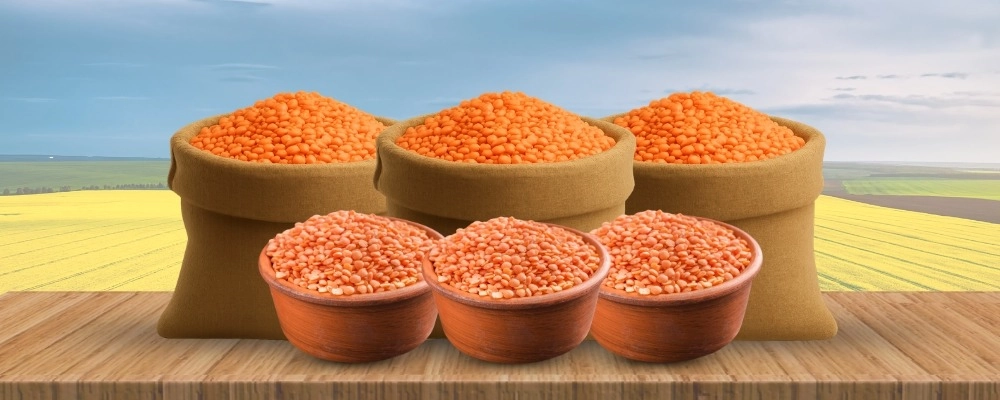
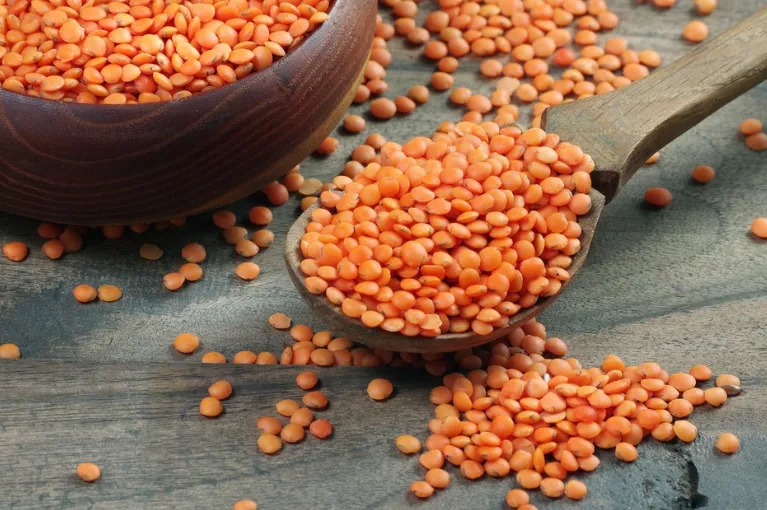
- Red / Yellow Lentils (Split) Bulk red lentils and yellow varieties, such as the popular Red Chief or Crimson, include a decorticated, split central piece. As such, they are merely split brown or green lentils that have been skinned. The cooked grains contribute a soft, creamy texture, making them prone to falling apart or bursting apart. As such, they are best utilized as a thickening agent of various dishes, from Indian dals, soups, and purees. The lentils are staples in the Middle Eastern and South Asian cuisine.
- Specialty Lentils It can be defined by specific pigmentation and size. Beluga lentils (Black) are small and round. The combination of anthocyanins that is found only in these lentils is responsible for the color and powerful flavor. Loseke and Pott are the “caviar” of the lentil family for salading. Other varieties, such as Spanish Pardina, are desired for their nutty characteristics. Procurement managers in purely industrial settings may search for organic lentils for sale to health-food outlets.
Quality Grades (Foreign Matter & Damage)
In global trade, lentil quality is strictly classified by the percentage of "foreign matter" and damaged seeds allowed in a batch.
- No. 1 Canada/USA Grade is considered a premium product, consisting of clean, uniform seeds with minimal discoloration, suitable for canning and retail packaging.
- No. 2 Grade is a mid-tier "Standard Grade" often used for bulk milling or splitting where visual uniformity is less critical.
- Feed Grade consists of wrinkled or stained seeds; while not used for standard human meals, it is a high-demand commodity for animal nutrition and pet food manufacturing.
Production & Manufacturing
Rainfed fields, often in cool temperate climates, are used to grow lentils.
- Production Farming using lentils is a low-input crop that mainly occurs in semi-arid regions like the Canadian Prairies, the Northern areas of the US, or Australia. This crop requires a cool growing season with minimal moisture, on which it thrives. The primary regions of lentil farming consist of areas with loamy soil that has the ability to act as a nitrogen fixer, reducing the cost of fertilizer.
- Environmental Factors The size and quality of the lentil harvest depend on how moisture is managed and when the crop is gathered. Lentils are a long-growth crop; they can withstand drought, but farmers must avoid heavy rain at harvest time. Excessive moisture causes staining and fungus-related diseases that take down the market price of this legume. Another major challenge is weeds: lentils do not compete well, so good weed control is a must. That means that proper planning of crop rotation is non-negotiable to protect yields.
- Quality Factors & Milling Efficiency The entire process of going from field to market depends on how well the mill works in extracting the "split yield" from whole seed. If the seed gets too dry, it cracks and breaks apart unevenly; if too wet, the husk becomes difficult to take off. The aim, therefore, is to hit that 13–14% sweet spot with our grain, keeping it fresh and bright.
Export Overview
Bulk lentils are a high-volume commodity in international trade, with consistent demand from nations looking to import lentils.
- Top Exporters: Nations that export lentils are led by Canada, subsequently followed by Australia, Turkey, and the USA.
- Major Importers: India, Turkey, Bangladesh, and the United Arab Emirates.
- Compliance: Exports require Phytosanitary Certificates and must meet strict "pesticide residue" limits (MRLs) and fumigation specifications to prevent infestation during sea transit.
Indian & Global Market Overview
The lentil market globally is fueled by the rise in veganism and protein security strategies. The key player in the consumption market is India, which momentously controls import tariffs to regulate lentils wholesale prices and the domestic lentils price per kg in India. The latest trends in this market reflect a growing requirement for sustainable plant-based protein ingredients in the West.
Final Summary
Lentils are characterised as that which, in their natural form, maintain a high protein-to-weight ratio. They are available in different colours, split forms, and quality grades. It is a value-added, health-related food product and an industrial raw material for protein extraction. Being at the top of the global pulse trade list, there is a huge demand for both whole and split products. Thus, lentils are a significant global agricultural commodity.
Businesses seeking quality lentils, either for sourcing or export opportunities, it is fundamental to know their variety specifications, moisture limits, and market dynamics for successful trade operations.
Tradologie is a platform that connects buyers and sellers worldwide, along with industry insights and procurement solutions for agro-commodities.