
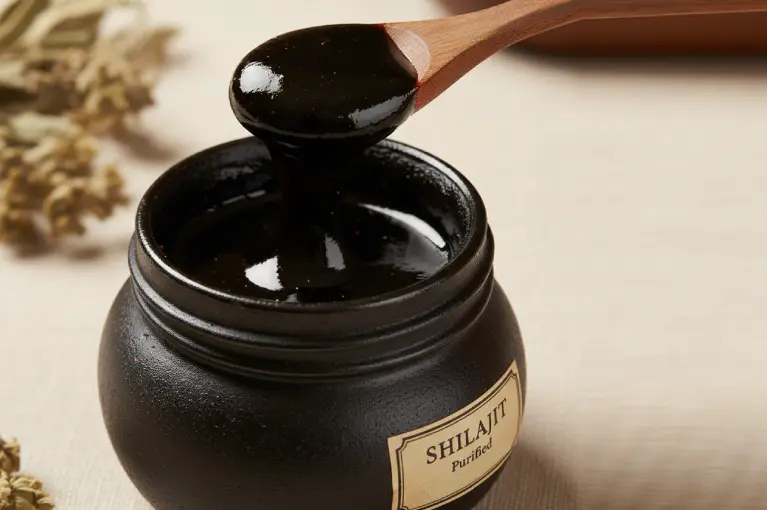
Kashmiri Shilajit
Minimum Order Quantity : 10 KG
Available Size
Consider a product that requires centuries to make, and only at the very end of its production cycle do human hands touch it. Kashmir Shilajit is, in essence, a biological time capsule—a very potent resin that is extracted from the anaerobic decomposition of medicinal plants that are sandwiched between rock strata for centuries. It is produced in the Himalayas, where nature literally breaks down organic matter through intense tectonic pressure.
In the global trading market, customs manifests may label it as "Mineral Pitch" or "Asphaltum", but sophisticated buyers know it by its chemical architecture. It is not merely a rock; it is a natural repository of concentrated Fulvic Acid and over 84 ionic trace minerals.
This "ionic" distinction is critical for the food and pharma industry. Unlike synthetic mineral supplements, which are often derived from sedimentary rock and difficult for the body to absorb, the minerals in Shilajit(also spelled Salajit / Salajeet) have already been predigested by plants. They exist in a bioavailable, water-soluble form that human cells recognise instantly. For product developers, this makes Kashmiri Shilajit more than just a supplement—it is a "bio-enhancer" and a cornerstone ingredient for the next generation of functional foods and clean-label performance blends.
When comparing Altai material with Pure Kashmiri Shilajit, differences emerge in fulvic concentration, processing tradition, and sensory profile.
| Parameter | Specification Standard |
| Product Name | Purified Kashmiri Shilajit (Asphaltum Punjabianum) |
| Form | Resin (Semi-liquid), Solid (Stone), or Powder |
| Solubility | 100% Water Soluble (leaving no residue) |
| Fulvic Acid Content | > 60% (Premium Grade), 40-50% (Standard Grade) |
| Humic Acid | 5% - 15% |
| pH Value | 6.2 – 7.5 (Neutral to slightly alkaline) |
| Moisture Content | < 15% (for Resin), < 5% (for Powder) |
| Heavy Metals | Lead < 3 ppm, Arsenic < 1 ppm, Mercury < 0.1 ppm (Must pass USP/EU standards) |
| Microbial Limit | Total Plate Count < 1000 cfu/g |
| Testing Methods | HPLC (for Fulvic Acid), ICP-MS (for Heavy Metals) |
These specifications directly influence Original Shilajit price per kg and smaller retail units, such as Original Shilajit price 10-gram packs in consumer markets.
It is not an easy task to navigate the market for Shilajit(also spelled Salajit / Salajeet), as it is replete with inconsistencies and fakes. For a B2B buyer, the most important differences lie in the physical state of the material and, most importantly, the method of purification used.
Where to Import From: The Source
India remains the undisputed global hub for authentic Kashmiri Shilajit. While other “Mumijo”-like materials are found in Russia or the Andes, the Kashmiri variety is different and has always been the most sought-after in the market.
Demand is primarily in regions with well-established nutraceutical markets and strict regulatory requirements.
The global Shilajit market is rapidly graduating from an informal, grey-market trade into a highly structured botanical industry. This shift is driven by a crackdown on raw exports and a surging preference for lab-certified resin.
Currently, the market valuation stands at approximately USD 191.1 million (Source: Grand View Research), with other analyst projections placing it as high as USD 206.6 million for 2025 (Source: Straits Research). This validates Shilajit’s transition from a niche Ayurvedic remedy to a globally traded commodity.
Forecast & Growth The growth trajectory is aggressive. Fuelled by the "Men's Health" boom and natural testosterone market, the industry is projected to expand at a CAGR of 9.13% through 2030 (Source: Mordor Intelligence). By the end of the decade, the total market value is expected to breach USD 320.1 million (Source: Grand View Research).
The Value Gap: Resin Dominance There is a distinct split in value distribution. While raw rock is traded in high volume, the money is in the purified form. The liquid and resin segment now accounts for over 60% of the total market share (Source: Straits Research), confirming that modern buyers are willing to pay a premium for ready-to-consume, standardised extracts over raw material.
Market Scope Disclaimer: Data represents formal trade; informal cross-border trade of raw rock remains unquantified.
The Men’s Health Renaissance
The single biggest commercial engine for Shilajit is the global surge in natural testosterone support. People are becoming more wary of artificial hormone therapies and are opting for natural “T-Boosters” instead. Shilajit fits perfectly into this narrative. It is marketed not just as a libido enhancer, but as a foundational vitality supplement for the ageing millennial male who wants to maintain muscle mass and energy levels without a prescription.
The "Clean Label" Revolt
Consumers today are focusing on the flip-side of consuming lab-created minerals and moving on with more natural options. Instead of lab-produced magnesium oxide, they are searching for plant-based nutrition. With its ionic form of trace minerals like zinc, iron, and magnesium, shilajit is an excellent choice for this purpose. Shilajit is a fantastic option for people searching for wildcrafted, organic supplements because plant-based minerals are easier for the body to absorb than lab-created minerals.
The Bio-Hacking & Nootropic Wave
The productivity drive in Silicon Valley is no longer staying within its borders. Regular people are looking for anything that might just help hone the mind. Enter Shilajit, which has been catapulted into the world of smart drugs due to its high Fulvic Acid content. It is now being added to nootropic supplements that promise to remove brain fog, improve memory, and optimise mitochondria—think fuel for the knowledge worker.
Wildcrafted, Not Cultivated
There are no plantations of Shilajit. Every drop of the resin must be extracted by hand from the treacherous cliffs by the local people, who have passed down their knowledge of where the deposits lie. Because it is a wild product, you can’t simply increase production to keep up with a sudden spike in demand.
The Summer Window
The harvest rhythm is that of the sun. You can harvest only for a short summer season, when the Himalayan ice melts and the rocks are warm enough for the resin to seep out. But if winter hangs around or if summer remains cool, the yield of the harvest falls immediately.
Finite Veins & Price Pressure
Genuine Kashmiri veins are not infinite resources. Over-harvesting in accessible areas has forced collectors to trek higher and further, increasing the labour cost per kilo. This natural scarcity creates a permanent "price floor" for authentic material. If you see cheap Kashmiri Shilajit, it is likely adulterated, because the economics of genuine extraction simply do not allow for low-cost volume.
The Kashmir Shilajit chain of supply follows a distinct East-to-West direction, almost like a funnel. It rarely travels straight from the high-altitude areas of Ladakh and Kashmir, where it originates. Rather, the product is shipped by land to the Northern Indian industrial processing hubs of Delhi, Haryana, and Punjab, where the real work—purification, safety testing, and export standardisation—begins.
Then, the trade diverges. Bulk consignments are flown to GMP-approved co-packing facilities in the USA and Europe, where the resin is packaged and branded. A prominent shift in this trade is the “Origin Branding” phenomenon. Western companies are no longer satisfied with the simple “Himalayan Shilajit” label on their packaging. They specifically advertise products with “Kashmiri Origin”, specifying the exact geography to command a higher price and distinguish them from the more affordable Siberian varieties.
The Indian Shilajit export pattern underwent a dramatic change after 2020, with a sudden spurt in exports in a vertical fashion. The pandemic served as a worldwide push, increasing the demand for immunity-boosting natural products, and Shilajit moved from being a niche Ayurvedic brand to the mainstream of health and wellness products.
Shift towards value-addition: there is a definite structural change in the type of exports. Raw rocks that were exported by the tonne dominated the landscape a few years ago. Value-added, lab-tested resin is now the trend. The exporters realise that purified resin fetches much higher margins than raw rocks.
Quality correction: Simultaneously, the market is undergoing a definite cleansing process. The EU and North American regulations have become much tougher. Customs officials and individual consumers are actively searching for heavy metals such as Lead, Arsenic, and Mercury. Any consignment that fails these tests is rejected at the border or returned. This quality filter is forcing serious exporters to invest heavily in better purification facilities, weeding out the lower-quality, home-based processing methods.
Indicative Bulk Price: $80 – $150 USD per kg (Purified Resin). This range represents the current Original Kashmiri Shilajit price in bulk trade and forms the baseline for Original Shilajit price per kg in export contracts.
Retail Arbitrage: High. A kilo purchased at wholesale can be retailed for $1,000+ when branded and packaged in small 20g jars.
Unit: Typically traded in kg (Aluminum bottles or food-grade drums).
Disclaimer: Prices are highly volatile based on Fulvic Acid percentage, purity certification, and harvest volume.
Correct classification is vital to avoid customs delays, especially regarding "food supplement" vs "medicine" regulations.
HS Code (Extracts/Resin): 1302.19.19 (Other vegetable saps and extracts)
HS Code (Prepared Supplements): 2106.90.99 (Food preparations not elsewhere specified)
Note: Exporting under 1302 generally attracts lower duties but requires rigorous phytosanitary certification.
Importers are no longer satisfied with just a brown sticky substance. They demand proof.
The “Fire Test” is a classic test of purity that consumers have always used: Does the resin expand and resist burning when set alight?
Then there’s solubility—it should dissolve completely in warm water with no sandy particles left over.
And finally, for the Western market, a Lab Report is mandatory: a Certificate of Analysis showing Fulvic Acid content over 50% and heavy metals far below the safe limit.
Packaging: Shilajit is sensitive to moisture and plastics. For large shipments, it is best packaged in food-grade HDPE containers or lacquered aluminum containers to reduce leaching.
Storage: Store it in a cool, dry place. It has a tendency to become hard in winter and soft in summer. It is best to maintain a constant temperature during transport, although not necessary if the container is tightly sealed.
Incoterms: FOB (Free on Board) New Delhi or CIF (Cost, Insurance, and Freight) are common. Air transport is preferred over sea transport due to its high value to weight ratio.
Mandatory: FSSAI (for India), GMP (Good Manufacturing Practice), HACCP.
Market Access: For US entry, FDA facility registration is often required. For Europe, heavy metal analysis compliant with EU Regulation 1881/2006 is critical.
Religious: Halal and Kosher certifications can open specific regional markets.
The "Wild West" era of scooping raw resin into jars is ending. The future of the Shilajit trade lies in standardisation and delivery systems. As the market matures, the real money will shift from selling simple raw material to developing advanced, functional formats.
The next major area of innovation is absorption. The current resin is very effective, but Nano-Shilajit pushes the boundaries by employing cutting-edge reduction technology to push the fulvic acid complexes to nearly molecular sizes.
The Opportunity: The market opportunity is in the area of liposomal delivery. More trace minerals actually reach the cells because the company can avoid the digestive process by encasing Shilajit in lipids. This implies that businesses can sell a product that is highly effective but doesn't need a large dosage.
People are tired of dealing with ten different medications and want one convenient, all-in-one solution.
The Opportunity: Ready-to-use B2B blends that are pre-formulated.
The Testosterone Stack: Kashmiri Shilajit and KSM-66 Ashwagandha.
The Energy Stack: Shilajit and Cordyceps Mushrooms.
The Cognitive Stack: Shilajit and Lion's Mane.
Why it sells: It solves the formulation problem for supplement companies. They no longer have to buy three different ingredients; they can buy one pre-mixed standardised “Performance Compound.”
The beverage industry is moving away from sugary drinks and towards what you might consider functional hydration.
The trade statistics and price bands provided are approximate and may fluctuate based on market trends, crop production, and government policies. Shilajit is a natural substance, and the colour, texture, and consistency may differ from one batch to another.
Kashmiri Shilajit is a natural energy supplement, high in Fulvic Acid, which helps the body absorb nutrients better. It is also used to increase strength, agility, and rapid recovery.
Yes. Kashmir and Ladakh have some of the best-quality Shilajit deposits in the world. Pure, food-grade Shilajit is sourced from trusted suppliers, and “raw rocks” available from roadside vendors are either unprocessed or mixed with other materials.
Shilajit is linked to improved testosterone levels, improved sperm motility, and improved mitochondrial energy. This leads to increased strength, agility, rapid recovery, and sustained energy without the crash associated with caffeine.
The best brands are those that are open about what they provide. Choose sun-dried Shilajit (Surya Tapi) with a valid Certificate of Analysis, having more than 60% Fulvic Acid content and proper heavy metal levels.
Kashmiri Shilajit is traditionally dissolved in warm water or milk once daily. Resin form is the most common dosage format.
