Key Highlights
- India exported 17.34 lakh tonnes of spices worth ₹39,140.11 crore in FY2025-26.
- Major export products include chilli, turmeric, cumin, coriander, black pepper and cardamom.
- Exporters generally need an IEC and Spices Board CRES registration.
- Quality testing depends on the spice, buyer specifications and destination-country regulations.
- Export documents may include invoices, packing lists, shipping bills and laboratory reports.
- Phytosanitary and other certificates are required when applicable rules specify them.
- Export ports should be selected based on total freight costs, transit time and cargo origin.
- Tradologie helps Indian exporters connect with potential buyers and explore trade opportunities.
Introduction:
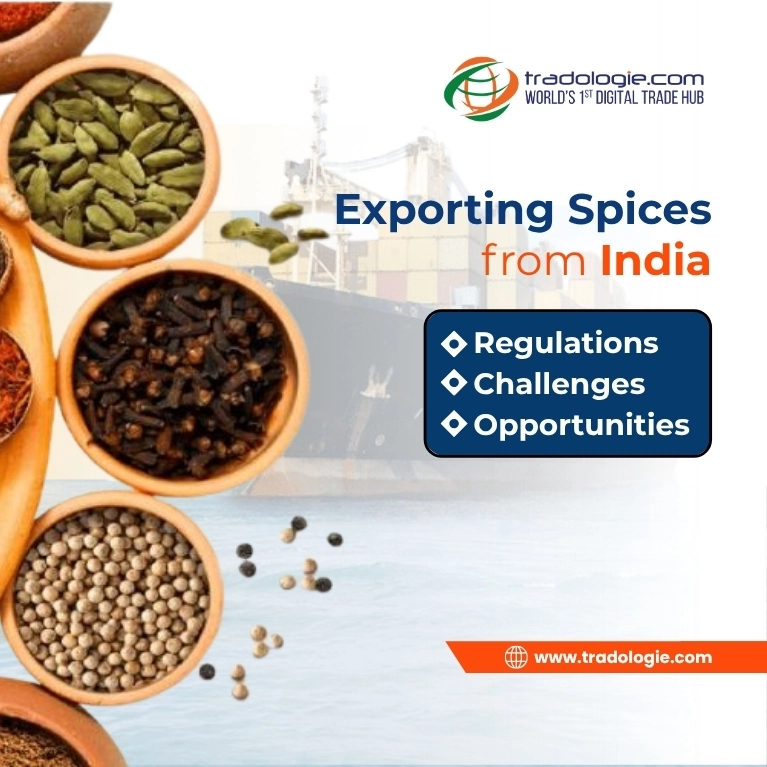
India's spice exports are worth more than ₹39,000 crore a year, but the business behind those figures is not as straightforward as buying produce from a mandi and selling it overseas. A systematic and well-synchronised process is needed for exporters to export spices from India . There are multiple layers and compliances that exporters need to adhere to.
According to the Spices Board of India, the country exported 17.34 lakh tonnes of spices and spice products worth ₹39,140.11 crore (US$4.43 billion) in FY2025-26. In FY2024-25, exports stood at 17.99 lakh tonnes, valued at ₹39,994.48 crore. The latest figures therefore show a decline in both volume and value, even as the trade remains substantial.
For anyone exploring how to export spices from India, the figures offer useful context, but they do not tell the whole story. An exporter still has to decide which spice to sell, where to source it, what quality the overseas buyer will accept and whether the price will leave enough margin after processing, testing, transport and freight.
Take cumin and turmeric as examples. Both are widely traded Indian spices, yet they are not interchangeable products from a buyer's perspective. Cumin may be purchased on the basis of purity, aroma, seed uniformity and foreign matter. A turmeric buyer may be more concerned with colour, curcumin content, processing and the results of laboratory tests. Once the product is ground or blended, processing controls and contamination risks become part of the discussion as well.
That is why a successful export transaction begins before the shipping documents are prepared. The exporter needs to understand the product and the market first, then build the supply and compliance arrangements around the order.

Choosing the Spice and the Market to Export Spices From India
India's strength lies partly in the range of spices it can supply. But an exporter does not need to deal in every product. A business with dependable access to good-quality cumin may be better placed to develop that trade than one trying to source six different spices without consistent quality or reliable suppliers.
The major products include chilli, turmeric, cumin, coriander, black pepper, cardamom, ginger, fennel and fenugreek. Indian businesses also export ground spices, spice blends, essential oils and oleoresins. Each product opens up a different set of buyers and processing requirements.
| Spice or Product | Important Sourcing Regions | What Matters When Preparing an Export Order |
|---|---|---|
| Chilli | Andhra Pradesh, Telangana and Karnataka | Colour, pungency, moisture, cleanliness and pesticide residues |
| Turmeric | Telangana, Maharashtra, Tamil Nadu and Andhra Pradesh | Colour, curcumin where specified, moisture and contamination |
| Cumin | Gujarat and Rajasthan | Purity, aroma, seed uniformity and foreign matter |
| Coriander | Rajasthan, Madhya Pradesh and Gujarat | Colour, aroma, cleanliness and seed quality |
| Black Pepper | Kerala and Karnataka | Density, size, moisture and aroma |
| Cardamom | Kerala, Karnataka and Tamil Nadu | Grade, size, colour, aroma and moisture |
| Ginger | Kerala, Karnataka and other growing regions | Product form, cleanliness, moisture and processing |
| Fennel and Fenugreek | Rajasthan, Gujarat and other growing regions | Seed quality, purity, moisture and buyer specifications |
These are broad sourcing regions rather than fixed boundaries. Traders routinely move produce between states, and an exporter may purchase from a processor or wholesale market rather than directly from a grower.
The more important decision is whether the supplier can deliver the same quality repeatedly. An overseas buyer who needs a regular supply will want consistency from one shipment to the next. If the colour, moisture, purity or processing quality changes with every consignment, the exporter may struggle to retain the account even when the initial price is competitive.
Whole spices can be a practical starting point for businesses without their own processing facilities. Ground spices and blends may reach different buyers, but they require greater attention to processing, packaging, ingredient declarations and contamination controls. The product range should follow the exporter's sourcing and quality-control capabilities, not the other way around.
The Registrations Required to Export Spices
Before accepting an order, an exporter needs to establish that the business is registered for the intended activity and that the product can be exported under the policy in force.
An Import Export Code (IEC) issued by the Directorate General of Foreign Trade (DGFT) is generally required for commercial exports from India, subject to applicable exemptions. The exporter should also check the current export policy and any product-specific conditions rather than assuming that the rules are identical for all spices.
The next important registration is the Certificate of Registration as Exporter of Spices (CRES) issued under the Spices Board of India's registration framework. Spice exporters generally need this registration in addition to the IEC. The application requirements differ for merchant exporters and manufacturer exporters, so the business should use the applicable checklist on the Spices Board's current portal.
A merchant exporter will typically need business and identity records, including the IEC, PAN, relevant GST documentation or declaration, bank-related documents and proof of the business's constitution. A manufacturer exporter may also need information about the manufacturing unit and applicable factory, food-safety or other approvals. The precise requirements should be confirmed at the time of application.
GST and customs arrangements also need attention. The exporter should have the applicable export-tax procedure in place, prepare the required shipping-bill documentation and complete relevant banking and customs formalities, including AD code registration where applicable.
These registrations establish the foundation for exporting. They do not mean that every consignment is automatically ready for shipment. Depending on the spice and destination, additional testing, inspection or certification may be required.

Quality Testing: The Part That Can Decide Whether a Shipment Succeeds
Spices are agricultural products, and their quality can vary with the crop, storage conditions, handling and processing. A sample that looks acceptable at the warehouse may still fail a buyer's specification once it is tested for pesticide residues, microbial contamination or other parameters.
The exporter should therefore settle the quality requirements before purchasing the goods. A buyer importing whole cumin may specify purity, moisture and foreign matter. A buyer purchasing chilli powder may ask for colour values, pungency, microbiological results and checks for unauthorised colourants. The tests required for one product should not automatically be applied to another.
Pesticide residues are particularly important in markets with strict food-safety controls. The European Union, for example, has maximum residue limits for pesticides in food, and shipments that do not comply can face regulatory action. Certain products and destinations may also be subject to additional sampling or testing requirements under the Spices Board's export inspection and certification framework. Exporters should check the latest notifications for their specific product and destination.
Other parameters can matter just as much commercially. Excess moisture may affect storage life; foreign matter can cause rejection; and inconsistent colour or aroma can make a product unsuitable for the buyer's intended use. For ground spices, the exporter also needs to consider hygiene during grinding, packing and storage.
A certificate of analysis can help demonstrate that a batch meets agreed specifications, but it is not a universal approval for export. The applicable rules may require a particular test, official sampling or a certificate issued under a designated procedure. The exporter should confirm these requirements before the product is packed.
Good records are part of the same exercise. Keep the supplier details, batch identification, processing information and laboratory results together. If a buyer questions a shipment later, the exporter should be able to trace the product and investigate the problem rather than having to reconstruct the entire transaction from scattered paperwork.
Documents Required to Export Spices from India
The paperwork depends on the product, the destination, the shipping arrangement and the buyer's contract. Some documents are part of routine export clearance; others are required only when a particular regulation or shipment condition calls for them.
| Document | Purpose |
|---|---|
| Import Export Code (IEC) | Establishes the exporter's registration for commercial exports, subject to applicable rules. |
| CRES | Spices Board registration required under the applicable exporter-registration framework. |
| PAN, GST and Business Constitution Records | Used for business compliance and may form part of CRES registration or renewal requirements. |
| Commercial Invoice | Records the buyer, seller, product description, quantity, value and agreed sale terms. |
| Packing List | Details the package count, packaging type and net and gross weights. |
| Shipping Bill | Indian customs export declaration. |
| Bill of Lading or Air Waybill | Transport document for sea or air freight. |
| Certificate of Origin | Establishes the declared origin when required by the buyer or destination procedure. |
| Certificate of Analysis or Laboratory Report | Records test results for agreed quality and safety parameters. |
| Spices Board Analytical Report or Official Certificate | Required where the applicable testing and certification procedure calls for it. |
| Phytosanitary Certificate | Required when the destination's plant-health rules require one. |
| Fumigation or Treatment Certificate | Needed where the applicable rules or contract specify the treatment. |
| Insurance Certificate | Relevant where insurance is arranged under the agreed delivery terms. |
| Destination-Specific Documents | May include import permits, food registrations, health certificates, declarations or labelling records. |
This is a working checklist, not a claim that every document must accompany every shipment. A phytosanitary certificate, for instance, should be obtained when the relevant plant-health rules require it. Food-safety certificates, laboratory reports and other supporting documents depend on the product and the destination's requirements.
The commercial invoice and packing list should be prepared with particular care. Product descriptions, package counts, weights and origin details need to agree across the shipment records. A discrepancy can create questions at customs or with the buyer, even if the goods themselves are in order.
For anyone researching how to export spices from India , the sensible approach is to prepare the document checklist around the actual transaction. Confirm the Indian export requirements with the relevant authorities, ask the buyer or importer which destination documents are needed, and establish who will arrange each item. That is more reliable than relying on a generic list copied from another spice shipment.
Choosing the Port: Follow the Cargo, Not Just the Map
India's spice-growing regions are spread across the country, so the most convenient export port depends on where the goods are sourced or processed. An exporter shipping cumin from Gujarat has different inland transport options from a pepper supplier in Kerala. A chilli processor in Andhra Pradesh may find a different route commercially attractive depending on the destination and the available sailing schedule.
The major ports below are practical options to compare. They are not exclusive routes for any particular spice, and actual export volumes can vary by year, product and shipping service.
| Port | Regional advantage | Spices and sourcing areas it may serve |
|---|---|---|
| Mundra Port, Gujarat | Strong option for cargo sourced in western India, subject to route and freight availability | Cumin, coriander and other spices sourced or consolidated in Gujarat and Rajasthan |
| Deendayal Port (Kandla), Gujarat | Useful to compare for cargo originating in Gujarat and parts of north-western India | Cumin, coriander and other western-region products |
| Jawaharlal Nehru Port (JNPA/Nhava Sheva), Maharashtra | Major container gateway with connections to a broad range of international markets | Spices processed or consolidated in Maharashtra and inland centres served through western freight routes |
| Kochi Port, Kerala | Close to important spice-growing and trading centres in Kerala | Black pepper, cardamom and other southern spices |
| New Mangalore Port, Karnataka | Relevant for cargo from coastal Karnataka and nearby sourcing areas | Pepper and other spices sourced or processed in Karnataka |
| Chennai Port, Tamil Nadu | Option for exporters with cargo originating in Tamil Nadu or connected southern supply chains | Cardamom, ginger and other spices processed or consolidated in the region |
| V.O. Chidambaranar Port, Thoothukudi, Tamil Nadu | May suit exporters in southern Tamil Nadu, depending on the destination route | Spices sourced or processed in southern Tamil Nadu and nearby areas |
| Visakhapatnam Port, Andhra Pradesh | Worth comparing for cargo from Andhra Pradesh and parts of eastern India | Chilli and other spices sourced or processed in the region |
| Kolkata-Haldia port system, West Bengal | Potential option for cargo originating in eastern India, depending on the shipping service | Spices consolidated or processed in eastern and north-eastern supply chains |
A port's proximity to the source is only one part of the calculation. Exporters also need to compare inland freight, container availability, port handling costs, sailing frequency, transit time and whether the shipment will be transshipped en route. A port that saves money on road transport may not be the best option if the ocean freight is higher or the sailing schedule does not fit the buyer's delivery window.
Consider a cumin exporter in Rajasthan. A western port may be the natural first choice, but the final decision should follow the total delivered cost and the service available for the destination. A Kerala-based pepper exporter may begin by comparing Kochi with other practical routes, rather than assuming that the nearest port will always be cheapest.
Before booking, obtain a complete quotation covering inland movement, handling, documentation, ocean freight and insurance where applicable. The port should be selected on the economics and reliability of the shipment, not on geography alone.
From Buyer Enquiry to Shipment: How the Export Process Works
The export process is easier to manage when the commercial discussion and the compliance checks happen together. An exporter who waits until the goods are packed to ask about the buyer's specifications or destination requirements may have to rework the consignment, arrange additional testing or absorb unexpected costs.
First, establish the buyer's requirement. Identify whether the customer is a spice importer, wholesaler, food processor, retailer or manufacturer of seasonings. Confirm the variety, grade, quantity, packaging, intended use and delivery schedule. If the buyer needs a particular laboratory report or inspection before shipment, agree on it in writing.
Next, check the export and import conditions. Confirm that the product can be exported under India's current policy and that the exporter has the required registrations. The buyer or its import agent should establish the destination's food-safety, labelling, plant-health and customs requirements. This is particularly important when exporting ground spices, blends or products subject to additional testing.
Work out the full cost before quoting. The price should include procurement, cleaning, grading, processing, packaging, laboratory testing, inland transport, port charges and freight. Insurance and destination-related costs should be included according to the agreed delivery terms. The exporter should also settle payment arrangements before committing the stock.
Prepare the goods to the agreed specification. Source the spice, arrange the necessary processing and maintain batch records. Conduct the required tests and obtain any mandatory certificates. If the buyer has specified an inspection procedure, make sure the goods are available for inspection at the agreed stage.
Complete the documentation and customs formalities. Prepare the commercial invoice, packing list, shipping bill and transport documents. Arrange any required Spices Board testing or certification and other product-specific documents. Check the information across all records before submitting the export declaration.
Dispatch the cargo and coordinate destination clearance. Once Indian customs formalities are complete, the shipment can move according to the booking. Send the documents to the buyer promptly so that the importer can complete the applicable customs and regulatory procedures. Retain the export records and follow up on payment under the agreed terms.
The exact sequence can vary with the product and destination, but the principle remains the same: the exporter should know what is required before the cargo is ready to leave.
Finding Buyers and Building a Repeat Export Business
Finding an overseas buyer is often the part that attracts the most attention, but the quality of the commercial relationship matters just as much as the initial enquiry. Spice importers may purchase in bulk for wholesale distribution, while food manufacturers need products that meet precise ingredient and quality specifications. Retail suppliers may require branded packaging and additional labelling work.
The exporter should establish whether the buyer has a genuine requirement, can handle the import and is comfortable with the proposed payment and delivery terms. For a first transaction, it is worth being clear about the quality parameters, inspection arrangements and procedure for resolving a dispute.
B2B trade platforms such as Tradologie can help Indian exporters connect with potential buyers and initiate commercial discussions. They can form part of the buyer-sourcing process, alongside trade fairs, industry networks and direct outreach. But an enquiry should not be treated as a confirmed order. The buyer's requirements, credentials and payment arrangements still need to be checked before goods are committed.
Repeat business usually comes from supplying what was agreed. If a buyer receives the expected quality, the documents are in order and the shipment arrives within the agreed schedule, the next transaction has a stronger starting point. For a spice exporter, consistency can be more valuable than offering a lower price on the first order and struggling to reproduce the same product later.
Conclusion
India has a wide range of spices to offer, from cumin and coriander grown in the west to pepper and cardamom sourced in the south. That geographical spread gives exporters several sourcing and shipping options, but it also means that each business must understand its own supply chain. The right port for a shipment from Gujarat may not make sense for one originating in Kerala, and the tests needed for whole spices may differ from those required for powders and blends. Export seller registration can help spice exporters establish their presence in the B2B export market and connect with potential global buyers.
For businesses learning how to export spices from India , the work begins with choosing a product they can supply consistently and identifying buyers whose requirements match that capability. CRES registration, quality testing, customs documentation and destination-country compliance then become part of the same process, rather than separate tasks to be handled at the last minute.
A well-prepared shipment is not simply one that has cleared Indian customs. It is one that reaches the buyer in the agreed condition, with the required records and without avoidable complications at the destination. That is the foundation on which an Indian spice exporter can build a lasting overseas business.
Disclaimer
The information provided is for general guidance. Export statistics, registration procedures, export policies and destination-country requirements may change. Exporters should verify the latest requirements with the Spices Board of India, DGFT and relevant destination-country authorities before shipping.