Look at the rice export sheet for the five months between the month of November 2025 and the month of March 2026, and the headline seems clean enough on the surface. India shipped out a massive 4.79 million tonnes of rice which stood worth rupees 23,476 crore to 26 focus markets. But compare that to what we usually do in those same winter months over the last three years, and you notice an odd disconnect: export volume rose by 5.6%. But the actual cash value barely budged, inching up just 1.1%.
To the casual observer, positive growth in both volume and value across 11 key markets—with total shipments setting four-year highs in destinations like the UAE, the UK, Belgium, Germany, France, and Mexico—looks like a straightforward export expansion.
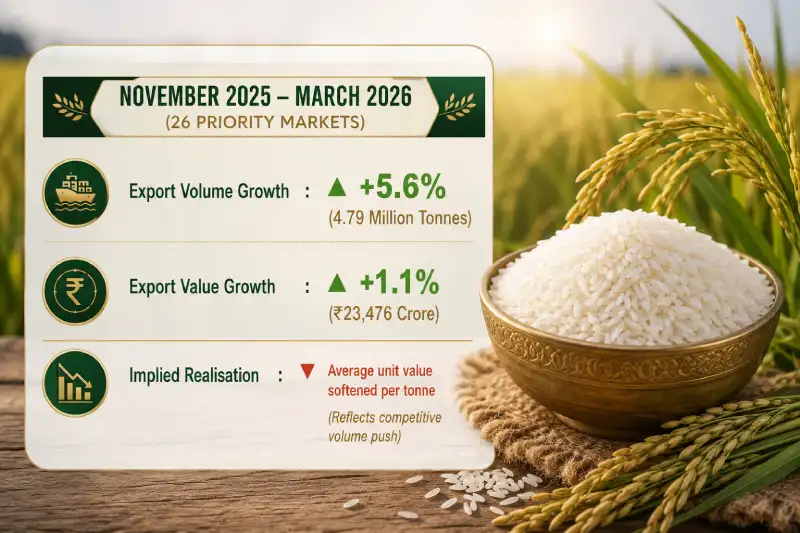
Look beneath the surface at unit economics and trade mechanics, and a more complex picture emerges. When volume expands at five times the pace of value, average unit realisations soften. India achieved greater physical throughput across major seaports, but did so largely by selling volume at competitive price points.
The real structural shift is not the headline quantity. It is the deliberate attempt by trade bodies and millers to move away from low-margin, generic commodity pricing toward functional, application-driven differentiation.
Deconstructing the Value Spread
The trade data from late 2025 and early 2026 reveals divergent pricing dynamics across individual export destinations.
In the United Arab Emirates, trade value climbed 65% year-on-year to ₹3,859.04 crore against a 64% rise in volume. Here, value and volume moved in near-perfect lockstep, indicating steady unit realisations and strong commercial absorption across hospitality and re-export channels. European destinations like Belgium (+53.8% value, +44.5% volume) and Germany (+33.5% value, +24.6% volume) similarly preserved positive pricing spreads.

VALUE VS. VOLUME DIVERGENCE
| Destination Market | Value Growth (%) | Volume Growth (%) |
|---|---|---|
| UAE | +65.0% | +64.0% |
| Belgium | +53.8% | +44.5% |
| Germany | +33.5% | +24.6% |
| United Kingdom | +26.9% | +25.6% |
| Mexico | +22.1% | +50.9% |
| South Africa | +26.0% | +42.9% |
| Kenya | +22.3% | +34.1% |
| Senegal | +5.3% | +29.9% |
The data from emerging and price-sensitive markets reflects a different commercial reality. In Mexico, export volume surged by 50.9%, but value increased by only 22.1%. In South Africa, a 42.9% jump in volume yielded a 26% gain in value; Kenya saw volume rise 34.1% against a 22.3% rise in value; and Senegal took 29.9% more volume for a modest 5.3% increase in value.
These disparities illustrate the fundamental economic limit of pure commodity trade. Moving surplus volume into global trade corridors clears domestic inventories and keeps port terminals active, but without product differentiation, exporters remain price-takers. Incremental volume is absorbed only when discounted against competing origins like Vietnam, Thailand, or Pakistan.
The Economic Thesis: Selling the Application, Not the Grain
The industry's current pivot—crystallized around initiatives like the Bharat International Rice Conference (BIRC)—is an attempt to alter the price elasticity of demand for non-Basmati varieties.
Standard white or parboiled rice is highly substitutable. An institutional procurement desk in West Africa or Central America compares offers strictly on landed C&F cost, broken percentage, moisture content, and payment terms. Under this model, the supplier with the lowest cost structure captures the order.
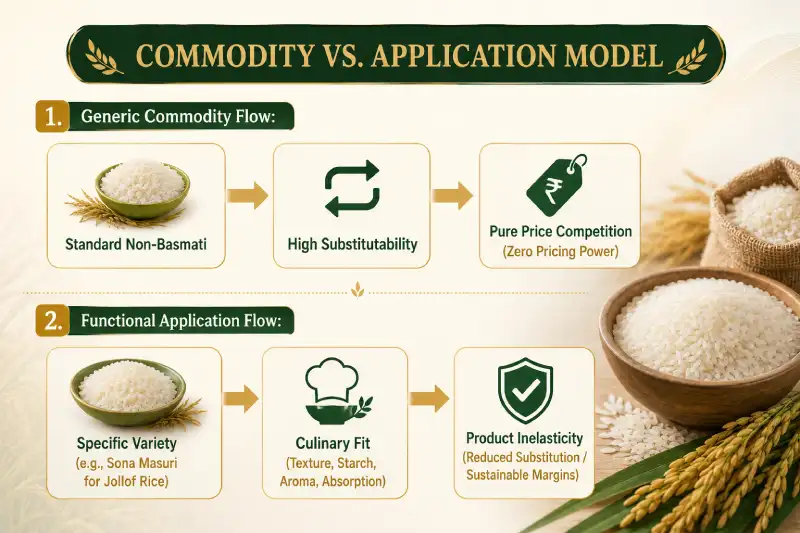
By linking indigenous varieties to specific global culinary applications, exporters attempt to introduce functional switching costs. If a variety like Sona Masuri is systematically proven to deliver the specific starch release, elongation, and moisture absorption required for West African Jollof, or if short-grain Gobindobhog matches the starch profile needed for Risotto Milanese, the purchasing decision changes.
The buyer is no longer sourcing interchangeable starch; they are buying a functional culinary ingredient.
If overseas chefs, food service operators, and consumers accept the pairing, substitutability drops. Over time, lower substitutability protects exporter margins and decouples realisations from generic commodity price swings.

Mitigating Concentration Risk and Surplus Pressures
From a macroeconomic perspective, expanding into a wider 26-market basket provides vital risk diversification for India's agricultural sector.
Relying heavily on a handful of traditional buyers in the Middle East and West Africa exposes the domestic supply chain to sharp external shocks—ranging from unilateral tariff adjustments and currency devaluations to sudden import bans or balance-of-payments crises.
Spreading demand across a broader network of North American, European, African, and Latin American destinations creates a more resilient trade portfolio.
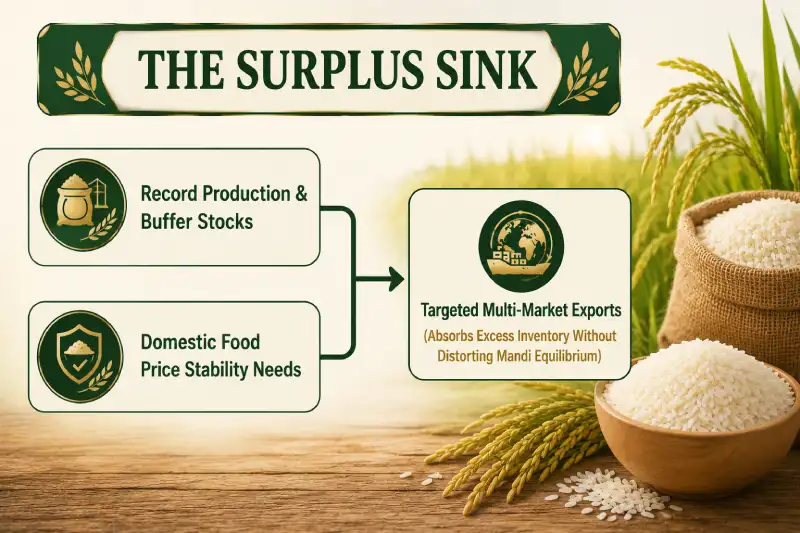
Simultaneously, structured export channels serve as an essential relief valve for domestic inventories. Following consecutive years of robust output, public silos and private warehouses hold ample grain.
Allowing calibrated exports to absorb this surplus reduces carrying costs, minimizes physical storage losses, and maintains liquidity across rural mandis. The policy objective is to sustain steady export off-take without reducing domestic supply buffers to levels that could trigger consumer price inflation at home.
The Transmission Mechanism: From Global Menus to Rural Mandis
If functional export differentiation takes hold, its long-term value lies in how efficiently price signals travel backward through the domestic supply chain.
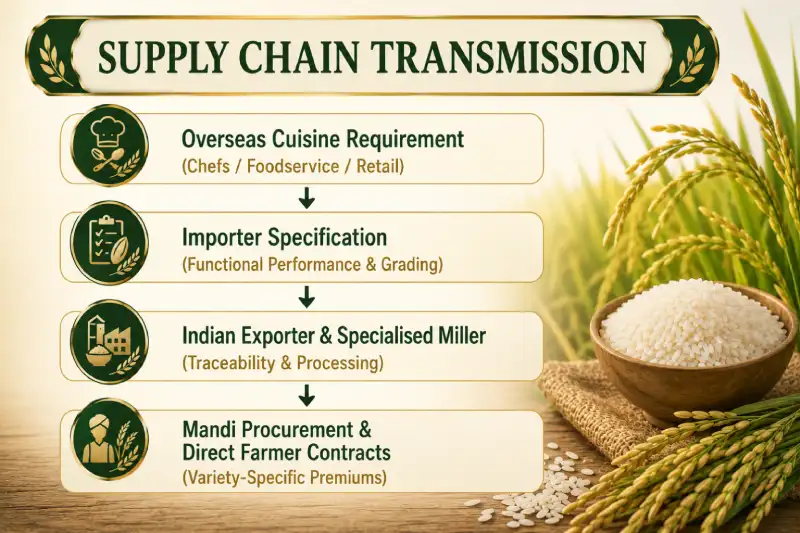
In an undifferentiated system, farmers produce generic paddy, and intermediaries aggregate it with minimal grading.
In a demand-driven system, international culinary specifications dictate procurement. If global buyers pay a premium for specific cooking characteristics, millers and exporters can offer variety-specific procurement prices to growers. This transmission can incentivize:
- Investment in advanced optical sorting and precision milling lines.
- Identity-preserved storage and farm-level traceability.
- Structured contract farming for indigenous, region-specific cultivars.
The economic caveat is distribution: if margin gains remain concentrated entirely among port-side trading houses and exporters, the incentive for farmers to maintain pure seed lines and strict crop management diminishes. A sustainable export model requires that value-added realisations filter back to the farm gate.
Structural Headwinds: The Limits of Culinary Positioning
While application-led trade offers a clear path toward higher margins, several structural constraints prevent it from becoming an overnight solution:
- The Supply Elasticity Constraint: Many of India's most distinctive culinary grains (such as Kalajeera, Mushk Budji, or Chak Hao) are regional cultivars grown in limited agro-climatic pockets. If international demand surges, domestic production cannot instantly scale without yield dilution or regional price spikes.
- Logistical Consistency: Culinary buyers require zero variance in grain length, moisture, aging, and cooking performance across shipments. Fragmented milling infrastructure in non-Basmati growing belts makes consistent quality grading a persistent operational challenge.
- Information Asymmetry: Convincing overseas commercial kitchens to modify established recipes requires sustained market education, chef engagement, and reliable local distribution—investments that individual mid-sized exporters often struggle to finance alone.
The Commercial Horizon: From Promotion to Repeat Purchase
Culinary showcases, and chef demonstrations are effective tools for addressing initial buyer uncertainty. They reduce information barriers by showing international procurement managers exactly how an unfamiliar grain behaves in a pan.
However, promotional events generate only initial inquiries. The true economic test of this strategy will unfold over the next 12 to 24 months across three measurable benchmarks:
- Unit Value Realisation: Whether average export values across the 26 focus markets begin to outpace volume growth, reversing the current margin dilution seen in emerging destinations.
- Contract Longevity: Whether trial consignments convert into regular, multi-year container shipments for non-Basmati specialty varieties.
- Supply-Side Integration: Whether millers and farmer-producer organizations successfully build reliable, identity-preserved supply chains capable of meeting international food safety and phytosanitary standards at commercial scale.
If these conditions are met, India's rice export framework will have achieved a meaningful transition: moving away from low-margin volume competition and establishing a defensible, application-led presence in global agricultural trade.
Want to export or import? Rise in bulk? Register as a seller on Tradologie today!




.webp "India's 20% Export Duty on Parboiled Rice: Short-Term Disruptions and a Shift in Global Attention")

.webp "Vietnam's Rice Exports Hit Record Highs Despite Decline in Production")